ALBION BREWERY
Also Lankasters Albion Brewery
Nos 1-5 Coleman Street, on the corner with St Mary Street
Brewing Started Circa 1846?
Brewery acquired by Perkins Brewery, and/or Wheatsheaf Brewery 1882
Brewing ceased 1883.
This Brewery was at the rear of the Albion Hotel in St Mary Street, but had addresses in St Mary Street at Nos 150 and 152, and Nos 1-5 Coleman Street at various times.
Tony Gallagher in his book ‘Southampton’s Inns and Taverns’ says that the Albion Hotel was at 150 St Mary Street and dates back to the 1850s when it was run by Thomas Wolfreston. The earliest reference I can find is to an Inquest at the Albion Hotel in October 1851. I believe that brewing started before the 1850s, but details are a little hazy, and I have been ‘connecting the dots’ to come up with what I hope is a plausible history until about 1853, when things become clearer. The 1846 map of Southampton clearly shows a ‘Brewery’ at Coleman Street, behind what would become the Albion Hotel.
The 1841 Census shows Edward Fox, aged 35 years, possibly as a brewer, but it is very hard to decipher the official handwriting! The 1839 Directory refers to him as a maltster in Totton.
The 1843 Fletcher & Forbes directory lists Edward Fox of Totton as a maltster, and by the 1845 PO Street Directory his is a brewer at St Mary Street, as well as a maltster at Hanover Square Totton. There is also a George Fox, brewer in Totton, and a Mrs Sophia Fox who is described as Matron of the Orphan Asylum, 1 Albion Terrace. Charles Fox is a Yeoman at St Mary Street. (Yeoman; someone with land, holding a small freehold estate)
In 1847 Edward Fox is again a brewer at St Mary Street, listed at No 33 with the Albion Chapel. He appears again in the 1848, and 1849 Directories, at No 1 St Mary Street in 1849.
Newspapers of January 1849 advertise an auction on behalf of the Administratrix of the late Edward Fox which is to be “On the premises near the Albion Chapel”. This was for the sale of part of the household effects, also a strong and useful horse, gig, cart, harness etc. The Administratrix (executor) was Mary Ann Fox. An Edward Fox died of apoplexy aged 43 on 16th December 1848 at St Mary Street.
In the 1851 directory, the separate list of ‘Brewers’ shows E Fox as a brewer at 1 St Mary Street, but no ‘E Fox is listed under ‘residents’. There is Mrs Charles Fox, and Mr Frederick Fox at St Mary’s Street. This directory also shows “Wolferstan Thomas brewer etc 1 Coleman Place St Mary Street”. These entries are largely repeated in 1853, also with Thomas Wolferstan listed at the Albion Brewery & spirit store Lower St Mary Street, being a ‘Brewer’ in trade section. The 1851 Census lists Thomas and Sarah Wolferstan at 1 Coleman Place as brewers.
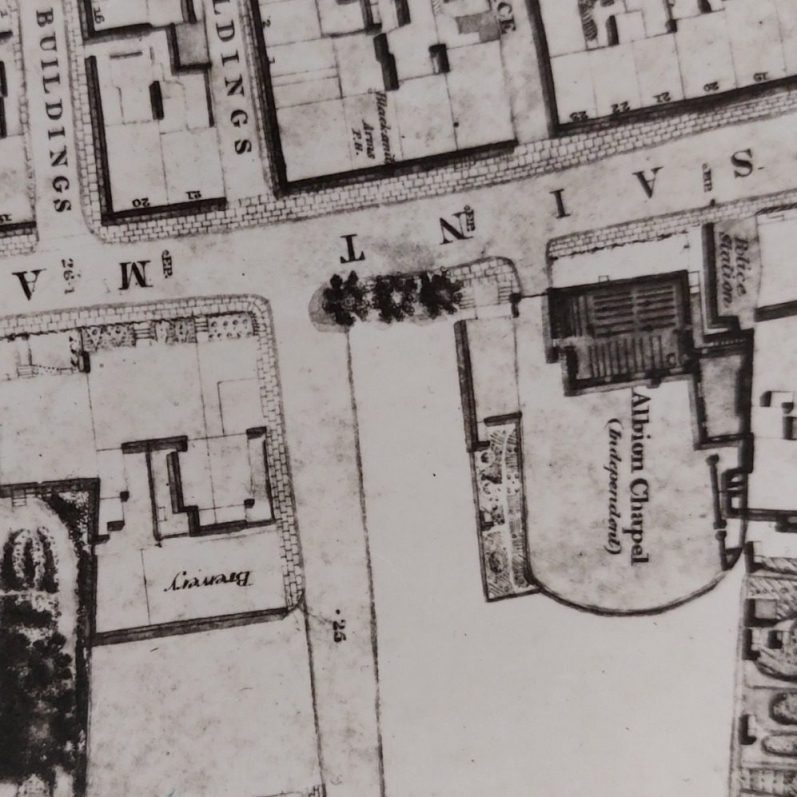
Time to join the dots. The Fox family were brewers in Totton, but had connections in St Mary Street, including with the Orphan Asylum opposite what would become the Albion Hotel. Perhaps they used the ‘brewery’ shown on the 1846 map as a second brewing site. An Edward Fox died in 1848 and perhaps his son Edward Jun ran the Brewery jointly with Thomas Wolferstan until he took over a year or two later. Another member of the Fox family, Thomas, owned the freehold of the entire site, as we see later. The 1851 Census shows Thomas Wolferstan at 1 Coleman Place, a Brewer aged 53 with wife Sarah. The handwriting for her occupation looks to be “same”, but is again unclear.
We know that the Albion Hotel had been constructed by 1849, and after 1846, because of a Court case in the Hampshire Advertiser of 13th March 1852.
There is no hotel shown on the 1846 street plan, just a 'brewery'.
This was a case between Wolferstan and Mr Purchase of the Globe Inn (another local brewer, see the Globe Commercial Inn page). It was said Mr Wolferstan had moved from Salisbury to Southampton in 1849. His large Billiard table would not fit in to the Albion Hotel so he sold it to Mr Purchase for use in the Globe. Mr Wolferstan had received malt to the value of £10.4s, and he was now claiming the balance. Mr Purchase said the table was at the Globe, but it was for the benefit of both parties. There was a dispute also as to value and the Jury could not agree, so the Court suggested that Mr Wolferstan keep the malt, and Mr Purchase keep the table, with each paying their own costs.
Thomas Purchase was a brewer at the Globe Commercial Inn from 1845 to 1857, and before it was taken by J Farnden who created what would become the Perkins Globe Brewery. This is the first of a few connections with Perkins.
In 1855 and 1857, T Wolferstan is again listed at the Albion Brewery & spirit stores 1 Coleman Place (Lower St Mary Street in 1857). In May 1856 he was advertising for sale a steam boiler in excellent condition, 15ft long, 6ft 6” in diameter.
The August 1856 Licensing Sessions refers to a Mr Hartley applying for a licence for a house on Glebe land built by the owner, Mr Wolferstan; “on the corner of St Mary Trinity and New Road”. The House had cost him £800. The Tenant was Hartley “who had been his brewer for many years”, and was a respectable man. The licence was not granted. I believe this application was for the Deanery Inn, as in August 1857, William Hartley applied again for a licence for the Deanery Inn St Mary Road. This also was not granted. I cannot find reference to this Inn elsewhere, but it does appear later on this page!
Thomas Wolferstan’s tenure was short lived as on 1st October 1857 he died in his 60th year. He was also the landlord of the Deanery Inn Churchtown. He had been a Town Councillor and a Senior Bailiff in 1856. HIs widow Sarah continued to run the Hotel, and in August 1858 she, as sole executrix, was allowed to continue the licence for the Albion Hotel. Indeed, the 1859 directory shows her as a brewer at the Albion Hotel.
At the 1859 Licensing sessions, Sarah Wolferstan applied for a Licence of the Deanery Inn, on the corner St Andrews Road and St Mary Road. It was said she was a Widow of slender means, and the Mayor said the house was well known to the Bench, as having been one of the worst conducted in the town. The Applicant was the widow of T Wolferstan a Councillor for St Mary Ward, and was highly respectable, and the house belonged to her. In 1858 it was said the property was held under a lease which mentioned a skittle alley and dwelling house. The present occupier, Hartley had been fined and was about to leave. We saw above how Hartley unsuccessfully applied for a licence in 1856.
Back to the Albion, where changes were happening. The Hampshire Advertiser of 2nd April 1859 contains an announcement by Frederick Perkins, wine and brandy merchant that he had taken the Albion Brewery for the express purpose of supplying superior pure malt liquor. He had taken on a London brewer of more than 30 years’ experience and being able to buy hops and malt in the ‘first market’, he could guarantee an article of “strength and fine flavour equal to any yet offered to the public”.
There was no Perkins Brewery at this time. Sir Frederick Perkins was the son of Richard Hopkins Perkins, and he was well established as a wine merchant in London, and he seems to have acquired the business, either alone, or in partnership with Frank Lankaster. Later that year, Frederick Perkins became Mayor of Southampton.
Frederick Perkins had 9 brothers and sisters. One sister was Sarah, born 1835, and a brother Richard Henry born 1842. The 1891 Census shows Richard H Perkins aged 49 years as being the brother of Sarah Lankaster (born Perkins) aged 54 years. She had married Francis Lankaster in 1860, and he was therefore Frederick’s son in law, which explains many things!
The 1861 directory refers to Frank Lankaster as a brewer at St Mary Brewery, private address Anglesea House. He is not listed under ‘Brewers’ but is shown as such in the ‘residents’ listing. By 1863 he is a brewer at Coleman Street, Albion Brewery. The 1861 Census shows Sarah Wolferstan as a Hotel Keeper aged 59 at the Edinburgh Hotel St Mary’s Road.
In the Hampshire Advertiser of 8th June 1861, F Lankaster was advertising his ale and bitter ales from this brewery which were strongly recommended for family consumption as being a perfectly pure and wholesome beverage, in casks of 4 1/2, 6, 9 and 18 gallons at 1s 4d and 2s per gallon. Also, Dublin Stout and porter in bottles by the dozen or by single bottles. Other Wines at lower prices.
In December that year he printed an ‘Extract of Analysis’ of these fine ales as reported by the celebrated Dr Hassall. He had subjected a sample of the pale ale brewed by Mr Lankaster to analysis. His finding was “This ale is of a pale colour, very transparent and well attenuated. Possesses strongly the aromatic and wholesome bitter taste of the hop in all which particulars it agrees with best description of Pale Ale. It is in fact a pleasant and wholesome beverage, perfectly genuine consisting only of the products of the fermentation of Malt and Hops and is well suited to the use of families. Signed Arthur Hill Hassell MD London. This commendation was repeated in later years.
In newspapers of 25th October 1862 there appears advance notice of an auction in one lot, of the freehold property of the Albion Steam Brewery, the Albion Inn, and Nos. 2 and 3, Coleman Place, all adjoining, at the corner of St. Mary's Street, and Coleman Street, Southampton. It was said that the brewery, the inn, and No. 2, Coleman Place were let on a repairing lease with six years unexpired, and under which the tenant and his sub-tenant had expended a considerable sum on permanent additions. No 3, Coleman Place was let to a yearly tenant. The reputation of the brewery was well established. For further particulars apply at the Auction Offices, “or to the proprietor, Mr. Thomas Fox, 3, Coleman Place, Southampton.
This 1862 sale was simply a sale of the freehold site by Mr Fox subject to the various leases, which were to expire in 1868. Fox lived at No 3, and the rest was leased to Lankaster, who certainly continued in business as the 1865 directory shows Frank Lankaster at Coleman Street, Albion Steam Brewery, as do other directories up to and including 1876. One question remains. The sale advert says No 3 was tenanted, yet Edward Fox the owner is said to be at No 3, so perhaps this was offices let to his firm/company?
At about this time, I suggest that Mr Clifford from the Fawn Brewery becomes involved. On 5th November 1859 an advert appears; ‘wanted good sweet barrels hogsheads and puncheons. Inquire C A Clifford, Fawn Brewery Kingsland or the Albion Brewery Saint Mary’s Street.’ I said in the Fawn Tavern page that perhaps Clifford helped out Sarah at the brewery after her husband’s death, and before he moved to the Vine (see the Vine Inn on the ‘Limited Information, pub breweries’ page).
The 1861 Census shows Charles Clifford as a Brewer and Victualler, aged 60, married to Elizabeth, also a brewer and Victualler, aged 29.
In 1863 there is reference to the Albion Steam Brewery, producing tonic pale ales for family use. Also in this year we find William Hartley as a brewer at 9 Coleman Street. Remember him? He was at the Deanery before Sarah Wolferstan took over. Had he always been a brewer, here? Or was this a later career move? Newspapers do not help.
In December 1862, Frank Lankaster donated a Hogshead of ale to the Southampton Poorhouse for Christmas.
In April 1863, James Russell was charged with stealing a bucket containing beer, the property of his employer, Mr. F. Lankaster. PC Weeks, while on duty in St. Mary's Street, saw the prisoner coming round the corner of Colman Street with a bucket, and accosted him. Seeing that the bucket contained beer, he asked the prisoner what he was doing with it at that time in the morning. He replied that he had a party in Chapel Street, and that Mr. Lankaster had given him the beer. The constable not believing this story, took the prisoner into custody and called up the clerk at the brewery, Mr Frederick Wright, who examined the premises, and found footmarks on the sill leading to the cooling room, and also that the tap had been altered. He identified the bucket as Mr. Lankaster's property. The bucket had contained strong beer, which the prisoner, on being apprehended, upset into the gutter. The prisoner pleaded guilty, and was sentenced to four months' hard labour.
As is so often the case, we have a gap, until in September 1873. At the Licensing Sessions Mr Scott, a brewer, applied for a retail beer licence to be granted to Mr Lankaster to supply beer to men employed in the dock extension work. This was refused as no proper notices had been given.
On 26th February 1876, we find a notice of retirement of Francis Lankaster of the Albion Brewery, Stephen Scott having purchased the same. The business was to be carried on by Scott under the name of Lankaster & Co, “dated this 24th Feb 1876”. Stephen Scott was the manager of the brewery in the 1870s, according to Dave Marden in his book Southampton’s Old Kingsland and St Mary Street.
Although he retired from the business, Lankaster may have carried on, perhaps as an employed brewer. The 1878 Cox Directory shows Lankaster & Co Albion Brewery Coleman Street, but also Francis Lankaster as a brewer at Anglesea Place. There is a separate entry for T Scott, Albion Brewery Coleman Street. This is broadly repeated in 1880.
Mr Scott is shown in the 1871 Cox Directory as a ‘Clerk, 152 St Mary Street’, and by the 1876 edition he was ‘Manager Albion Brewery 152 St Mary Street,’ so he clearly had been involved with the business before his acquisition (note the apparent renumbering).
In March 1882, Francis Lankaster died at Anglesea House aged 48. Sarah Wolferstan went on to run the Edinburgh Hotel at St Mary’s Road by 1865, and she died on the 19th of December 1891.
If you were paying attention earlier, you will recall that I mentioned Mr Frederick Perkins who had become involved with the brewery in 1859. In newspapers of 15th April 1882, there is a notice of sale by the executors of the late R H Perkins, (his father) by auction of the “The Albion Brewery, with hotel and two dwellinghouses, the brewery stores and stable yard” and a number of properties belonging to Perkins Globe Brewery (see the Perkins Brewery page). On 22nd April, the same advert with the same auctioneers is repeated BUT with no reference to the sale of the Perkins (Globe) Brewery properties.
On 6th May 1882, only about two weeks later, there is a similar advert by the same auctioneer which describes the property as “an exceedingly valuable freehold property known as the Albion Brewery with Hotel and two dwellinghouses in Coleman Street and the Brewery stores, stables and yard situate in Dickinson Place Coleman Street”. Date of Auction, 18th May 1882.
This was for the sale of the premises only, ie not brewing plant and business, suggesting a sale of the freehold subject to leases, or sale of a long lease subject to sub tenants. Since this was a sale by the executors of R H Perkins. Perhaps he acquired such title in 1859, and for his son Frederick who ran the business, in partnership with, or as the employer of, Frank Lankaster.
There is then an announcement made in the Hampshire Independent of 16th December 1882. This referred to the Albion brewery and said that R H Perkins, having purchased the above, begs to announce that after the 25th Inst. orders entrusted to him addressed to Globe Brewery Orchard Lane would receive prompt attention. By January 1883, adverts refer to orders to The Globe and Albion Brewery. This R H Perkins was Frederick’s nephew.
Confusingly, there is however another notice on the same day by Mr Stephen Scott, who announced that having disposed of the business of the (Albion Brewery) to Mr. Henry Welsh of the Wheatsheaf Brewery, that after 9th of December, orders entrusted to Mr. Welsh addressed to the Wheatsheaf Brewery, Bridge Street would receive prompt attention.
How can we explain this? Perhaps Perkins acquired the brewery premises and Wheatsheaf acquired the business goodwill. Both breweries said they would deal with orders, suggesting there was some arrangement between them. They were very close to each other geographically, and Perkins had transferred the Engineer’s Arms in Northam to Wheatsheaf in April 1881 I will say nothing further here and try to ‘dig deeper’.
In February 1883 there was an advert for “Commodious stores with steam power to let adjoining the Albion Hotel St Mary Street” suitable for factory, apply R H Perkins Globe Brewery, so the connection with Perkins continued in some form. Three months later, in June 1883 an auction was announced of the Albion Steam Brewery, which included an 8 quarter mash tun, (about 1,150 gallons per brew), a 22-barrel copper, a Steel’s patent mashing machine, two throw liquor pumps, a wort pump, a six Quarter malt mill, four fermenting vessels, a hop back, upper and underbacks, two malt hoppers, iron and lead piping and the usual plant of a well fitted brewery. This was all “in consequence of the present owner having closed the brewery. Note the premises are to let either with or without steam power”.
The Albion Hotel was later taken by Forder’s Brewery, and then Brickwoods (who took over Forders). It was sold to the College of Technology next door in the mid-1970s and demolished soon after.