GEORGE BREWERY
15 Orchard Lane
Brewing started at the George & Henry 1843
Became George Brewery 1855
Brewing ceased late 1880
Taken over by possibly by Crowley or Garton.
The beginnings of this brewery stem from the George & Henry beerhouse aka the ‘Degee & Nutley’ brewery. George Degee and Henry Nutley established a brewery at the George & Henry. In or around 1857, following some sort of disagreement, they split and George Degee carried on, and Henry Nutley set up the Phoenix Brewery a few doors down. George Degee transferred the licence of the beerhouse to John Martin who then ran the brewery business as George Brewery.
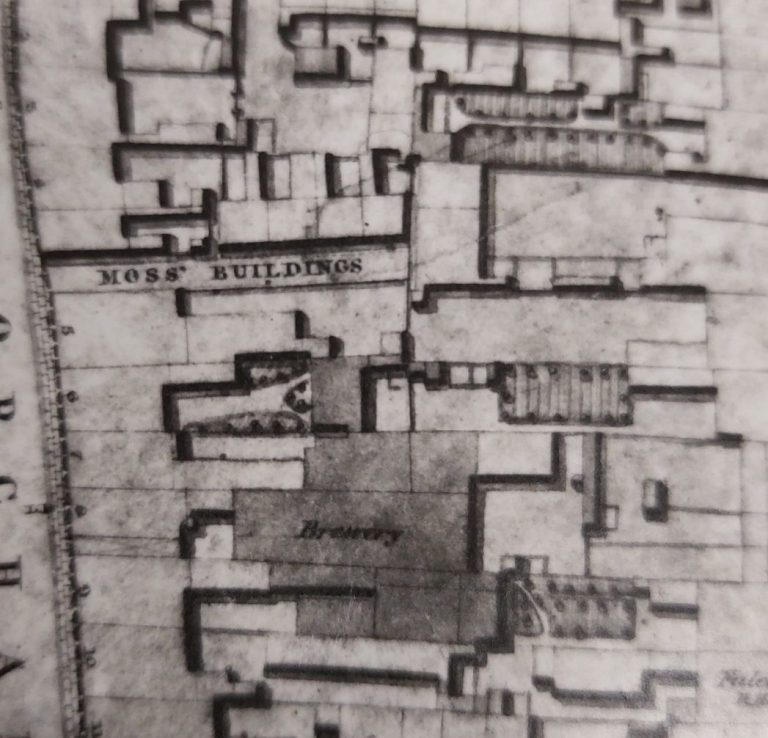
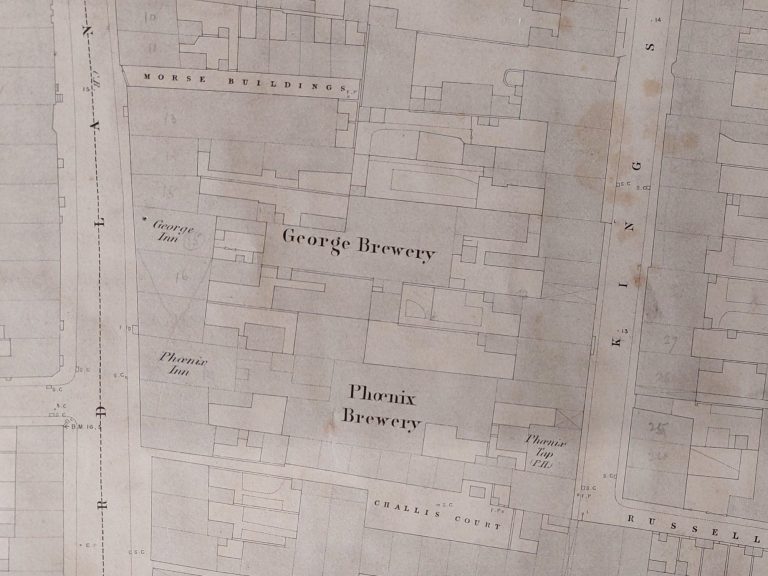
As for location please refer to the 1846 map which shows the George Brewery at No 8 (and/or 9) Orchard Lane, and by 1870, at number 15, and this helps explains the directory entries.
I cannot find a reference to George Degee as brewer in the directories after 1857, although he is listed as a ‘gentleman’. He owned the premises, so it is likely that he entered in to an
arrangement with John Martin of the Black Horse beershop elsewhere in Orchard Lane (see
the Black Horse page). Also, the 1861 Census shows him as a ‘retired brewer’. However, it is not until the Hampshire Independent of 12th February 1859 that the licence for the George
& Henry Orchard Lane was transferred from George Degee to John Martin. The 1859 and 1861 directories show he is a brewer and a wine & spirit merchant, but in 1861 he is also listed as an innkeeper at the George Brewery. In this year we also see his wife Elizabeth Martin listed as a ginger beer manufacturer in Orchard Lane. The 1861 Census also shows John Martin as a brewer at “George & Henry Inn” Orchard Lane, employing seven men, with wife Elizabeth. He was aged 44 years. I guess this is a case of time delay in the publication of information, but the transition from George & Henry, to George Brewery seems to be around this time.
John Martin did fall foul of the law. The Hampshire Advertiser of 26th October 1861 reports that he was summoned “for keeping the tap attached to his house the George and Henry open for the sale of beer during unlawful hours. The tap in King Street is kept by a Coombes, a tenant of Martin. PC Blake found four men with beer.” He was fined 40s plus costs. In 1863, John Martin of Orchard Lane is listed at George Brewery, a spirit store Innkeeper. In the 1865 Forbes directory he is at 15 Orchard Lane “Innkeeper George Brewery”and Elizabeth Martin still as a ginger beer manufacturer. However, in 1867, 1869, and 1871 the entry is “Martin Mrs, George Brewery 15 Orchard Lane”, and in the Southampton Observer and Hampshire News of 18th November 1871, there is reference to Elizabeth Martin being the landlady of the George.
The Hampshire Advertiser of 9th October 1872, states that at the Licensing Sessions, an application was made for “confirmation of the licence for the George Brewery Tap, King Street, the property of the late Mrs Martin (leasehold). Charles Yaldren landlord of the Tap. Application confirmed.”
Newspapers of June 1873 refer to Mr Martin as a brewer, but there is also mention of a Mr Martin at the Three Swans in September Sept 1873, (although I feel this may be a different person). He was still at the George brewery in 1874
As an aside, I can report that the Licensed Victuallers Tea Association was founded in 1867 to sell tea. Because of the irregular competition of the grocers in the sale of wine, pubs and breweries started to sell tea! Only Licensed Victuallers and wine merchants were able to act as an agent and one of them was “Martin Mrs E George Brewery 15 Orchard Lane” If you are interested, see the Hampshire Independent of 5th December 1874 for further details and list of local agents.
The brewery was still trading in May 1875 as an advert appeared. Wanted “a strong active man” who understands brewery work, apply George Brewery 15 Orchard Lane. Note the change of address, probably as a result of renumbering in the street. John Arthur Martin is still listed in Directories as a brewer and beer retailer.
The freehold of the brewery was owned by George Degee (see the George & Henry page). In the Hampshire Advertiser of 10th March 1877 there was an auction in the estate of the late George Degee of the “Valuable freehold brewery two public houses and other premises, being part of the Estate of the late Mr. George Degee.” The premises were described being freehold property “comprising a fully licensed public house known as the George and Henry, on the east side of that capital business thoroughfare, Orchard lane, in the heart of the town, together with the three quarter plant brewery (a brew of about 432 gallons at a time) and premises adjoining approached from King Street, and the fully licensed public house the George and Henry tap, King street, aforesaid with a cottage at no 28, King Street, used in connection with the brewery. The whole let on a repairing lease, expiring at Christmas, 1879, at a rent of £150 PA (with special covenants as to the plant), and forming an investment alike particularly worthy of the attention of trustees, brewers, maltsters, and publicans.
This description helps identify an earlier auction reported in the Hampshire Advertiser of 9th November 1872. This was “for the benefit of legatees, under the will of the late Mr George Degee, the following valuable freehold property in 2 lots”. Lot 1 was public houses in Orchard Lane and King Street and which consisted of a four quarter brewery, malt store, excellent cellars, stabling, coal pound, and with a back entrance from King Street etc now held by Mr Martin and his undertenant for the unexpired term of 7 years from 25th December next on a repairing lease inside and out at an annual rent of £150 payable quarterly with all rates and taxes (except property tax) in addition to rent
Note that in 1872 the plant is recorded as a four quarter brewery, (576 gallons brewed at a time) and in 1877 as a three quarter brewery (432 Gallons brewed at a time).
It appears the lease was owned by Mr Martin, but expired in December 1879, although I can find no references to this brewery in the Directories of 1876 or 1878. However, we do know from a newspaper article of February 1867 that Thomas Wickham was a brewer for Georges Brewery. Newspapers of 12th June 1880, make reference to Mrs Squire as landlady of the George Brewery and as the wife of the manager, with a separate newspaper entry referring to a “Mr Squires manager of the brewery”, also in June 1880.
The Hampshire Independent of 28 August 1880 carries an advert for ”a number or vats, casks, and the plant of a three-quarter brewery for private sale at the George Brewery. Orchard Lane Southampton. Apply on the Premises.” Also, on 2nd October 1880 there was an advert for the sale of “a 200-gallon copper, vat of from 8 to 36 barrels, tuns coolers and Casks, of various sizes to be sold cheap at the George Brewery, Orchard Lane Southampton.
On 4th December 1880 there were further adverts for “stores or brewery to let, the large and spacious premises lately used as a brewery.apply to the George brewery. Again, on 25th December 1880; "as stores, brewery or mineral water manufacturer, to let the laerge and convenient premises known as the George Brewery".
It looks therefore as if the freehold was perhaps purchased at auction, the lease expired in December 1979 but no new tenant could be found. Perhaps the Squires were managers until the brewery was closed or sold.
According to Tony Gallagher’s book ‘Southampton’s Inns and Taverns’, the George & Henry became the property of Crowley & Co, of Alton, however, neither this nor the George & Henry Tap appears on the list of pubs owned by Crowley’s on the Brewery History Society Website. Crowleys (via William Garton) did take over Bells Itchen brewery in 1889, and at various times had 3 pubs in Kings Street and Orchard Lane so they may well have taken theses as well, or perhaps William Garton took over directly?
This whole area became part of the East Street shopping centre, which has recently undergone further redevelopment and was partially opened as the ‘Bargate Quarter’ in August 2026