HINE BROTHERS BREWERY
Birmingham Street Brewery 68 Marland Place.
AKA the Windsor Brewery, Birmingham street Brewery
Brewing started 1857 (acquired the M’Kean & Tobin Brewery)
Acquired by Strong & Co 1898
Brewing ceased Strongs refer to Windsor Brewery up to 1909/10.
This brewery was originally founded in 1857 when Henry Hine and James Cullen Hine bought the Netherbury Brewery in Dorset. The brewery business was transferred to Birmingham Street Southampton in 1860, when they acquired the brewery business of M’Kean and Tobin (see the McKean & Tobin page). They later added a wine and spirit business in Marland Place. The business in Southampton was run by Henry Hine, and he was joined by his brother James Petty Hine in 1865.
This brewery is a rare case of where details of the beers they produced are readily available from the numerous adverts in newspapers, and they heavily promoted the quality of their product.
I have said in my introduction to this website that water is important for the production of beer, and the Southampton water was similar to that in Burton-on Trent, which was/is often described as the brewing capital of England. I also said there were issues with the water supply. In June 1879, Hines asked the Corporation of Southampton to provide them with a better supply of water to their brewery in Birmingham Street, ‘for scarcely one night a week could they get any water in their tanks at the top of their premises’ This was referred to the Special and General Works Committee.
The brewery has been described as being a six storey ‘tower’ brewhouse with offices stores and cellars etc. One wing of the frontage was the ‘Brewery Bar’, which was the brewery tap.
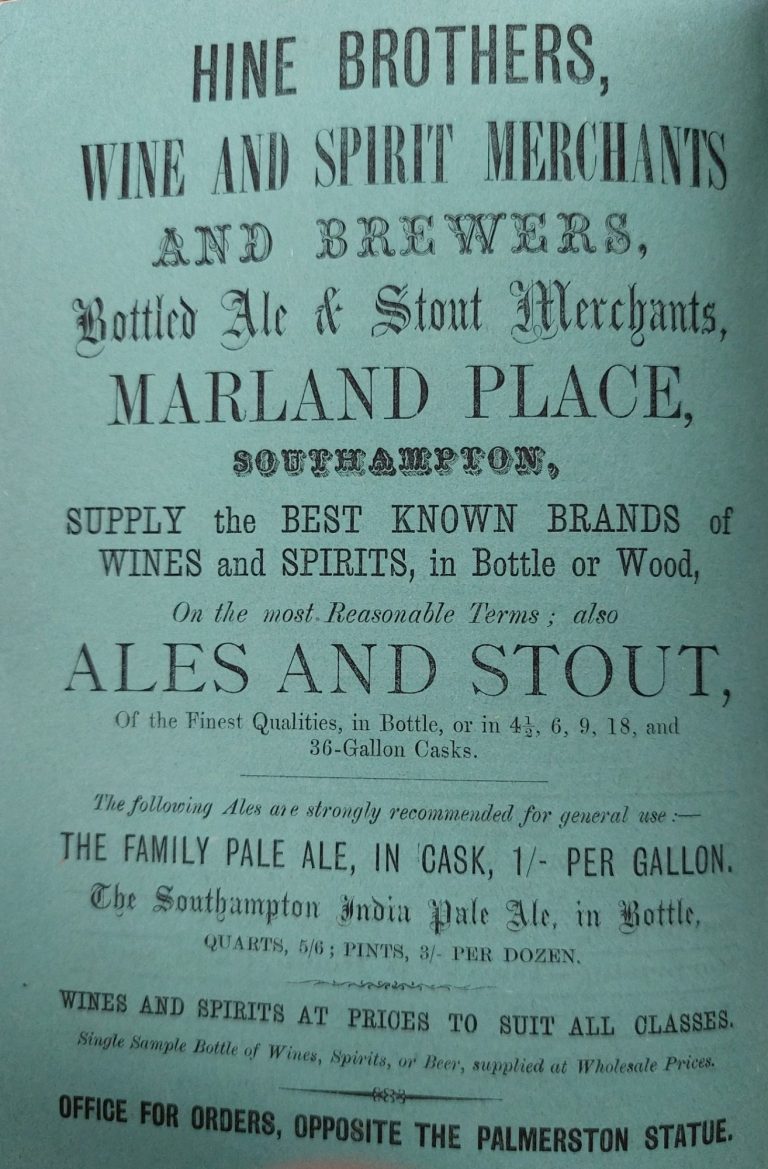
Adverts appear in newspapers of 21st January 1860 for the Windsor Brewery (late Partridge) calling the attention of families and the trade to the list of their fine sparkling ales & porter. It was said that these were similar to those supplied from their celebrated brewery at Netherbury, Dorset. They listed fine dinner ale, strong sparkling mild ale, bitter pale ale, in fine condition, family porter, double brown and Dublin stout. They could supply families with 41/2, 6, 9, 18, and 36-gallon casks. Similar adverts also appear much later. (Arthur William Partridge was a brewer at M’Kean & Tobin, and he may have been retained by Hine).
Later obituaries refer to 1860 as the date of the move to Southampton. The date of the advert (January 1960) suggests that the move must have taken place in very early January, or perhaps late 1859.
In newspapers of 12th May 1860, a notice from ‘Hine Bros’, explains that from their long experience in brewing the celebrated Burton ales, they could supply families in small casks, from breweries in Birmingham Street, and Netherbury Brewery Dorset. By June 1860, another notice reads; “Medical men being unanimous in their opinion that confined gas in bottled ales proves most injurious to the constitution”. Hine brothers were supplying families with casks of ale!
Directories of 1861 and 1865 show Henry Hine as a brewer & wine merchant at Birmingham Street. By the 1869 Cox directory, the listing is Hine Bros at Marland Place Brewery Birmingham Street, with James Hine as a brewer, and wine & spirit merchant at 76 Marland Place.
By June 1862, they were advertising their Harvest Ale by the gallon which was “unsurpassed for quality and price” and could be sent by rail in quantities of two hogsheads and upwards to any station within 20 miles. In August that same year they promoted their ‘Hine’s India Pale’, a quart at 5s, a pint 3s. Separately Hine Bros quoted a ‘report on the ale brewed by Hine Brothers by the celebrated Dr Hassall, chemical and microscopital laboratory 76 Wimpole Street Cavendish Square on 22nd June 1862”. He was said to have subjected the pale ale brewed by Messrs Hine Brothers to careful chemical analysis. It was even a paler colour than ordinary pale ale, was bright, clear, and brisk. It was of considerable strength in alcohol but contained less extractive matter than the generality of Pale Ales owing to the extent it has been attenuated. “It therefore nearly reaches wine in its character and it may be termed a wine of malt”. It was sound, wholesome, and pure and from its extraordinary lightness and freedom from acidity it was calculated to agree with the most delicate stomach
On 5th December 1863 the brewery announced “in consequence of the abolition of the duty on hops” they were supplying a first class pale bitter ale at 1s a gallon in splendid condition in 41/2, 6, 9, and 18 gallon casks.
In August 1863, Henry Hine applied for a full licence. He had converted part of the brewery to a beershop and now wanted to sell spirits. This was refused.In January 1867 the sale of the Netherbury brewery and spirit business by J and H Hine was announced, due to the increasing trade in Southampton. The sale was to Mr H Pulman, who said he would continue the business. The Dorset brewery therefore had continued to trade after James Hine came to Southampton in 1865. In October the same year it was advertised that Hines had bought land at Lyndhurst Road station and built a hotel. People used to picnic there and it was decided to build better facilities. This became the Railway Hotel.
The 1871 Cox Directory refers to Hine Bros Windsor Brewery Birmingham Street, 80 Marland Place, as brewers, ale and stout and wine merchants, separately listing Henry Hine and James Hine. The same entry appears up until 1898.
The brewery continued advertising the quality of their beers. In July 1869, their pure family ale was one shilling a gallon, and brewed from the finest malt and hops “under immediate superintendence of an eminent brewer and is vastly superior and much more wholesome than many other ales that are brewed with sugar and other cheap substitutes for malt”. They also mentioned again their fine dinner ale at 1s a gallon, strong sparkling mild ale at 1s 6d, bitter pale ale, in fine condition 1s 4d, family porter at 1s, and double brown and Dublin stout also at 1s
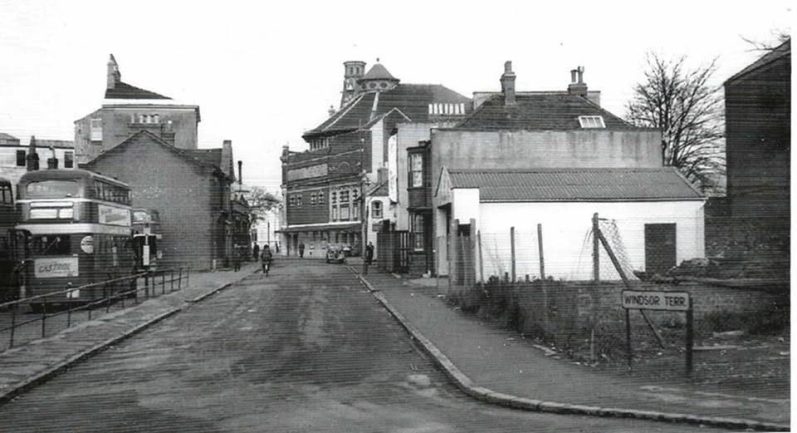
The brewery prior to demolition, to be replaced by the the Marlands shopping centre
As seems to have been all too frequent in breweries generally, newspapers of 21st December 1870 carry a report of the fatal accident of Edward Stone, a labourer employed by Mr Hine of the Windsor Brewery. He and another were raising coals with a rope and block. The strap of the block gave way and the deceased fell to the ground. He died of internal haemorrhage consistent from falling a great height. Verdict, accidental death.
In January 1871 the brewery advertised Bass in bottles and also “The Southampton India Pale Ale, highly recommended, pints 3s per dozen”. By December, they were advertising an ale which was similar to that supplied to H.R.H the Prince of Wales, and which had proved a beneficial restorative, and could be obtained in cask and bottle from Hine Bros Brewers. By December 1875, their ales had been analysed by the Borough Analyst and “pronounced pure”.
Rather confusingly, in newspapers of 20th March 1880, there appears a notice of a brewery for sale, or they would take an active young man as partner, apply to Hine Bros. It is not clear if this was Hine’s brewery premises, or another in which they had an interest.
Directories show Hine Bros at 80 Marland Place as brewers and retailers from 1884 until 1898/9. In 1887 however they are also "wine&spirit merchants & insurance agents, 68 Above Bar Street and Birmingham Street”. This entry only appears once so perhaps it was a ‘typo’ in the Directory? By 1883, the brewery occupied the malthouse of the Fawn Brewery (See the Fawn brewery page).
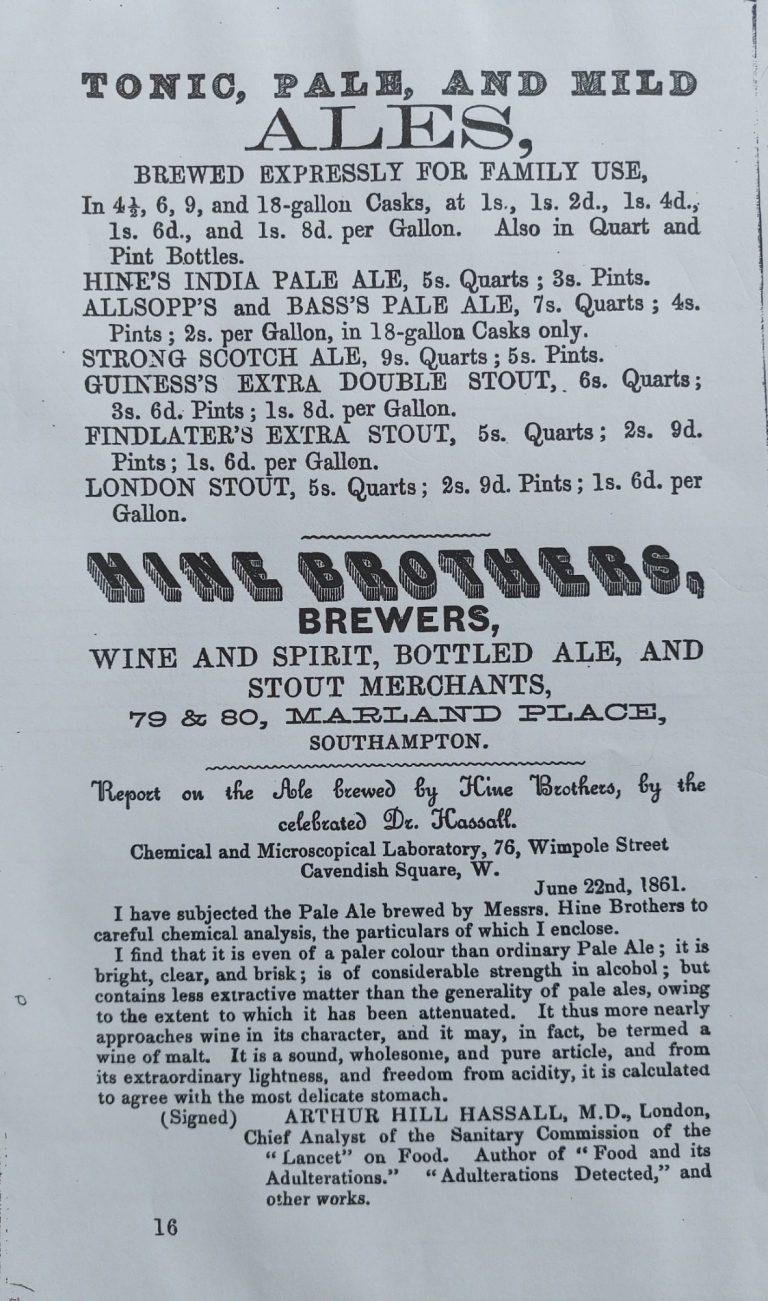
Advert from 1863 drectory
Henry Hine died on 30th December 1885 aged 49. His Obituary says that he was the fourth son of S D Hine of Thickthorne near Sturminster and in 1857 was joint owner with his brother of Netherbury Brewery Dorset. In 1860 they bought the Birmingham Street brewery business and added a wine and spirit business in Marland Place. He was a town Councillor and Specific Commissioner of the Harbour Board. He was treasurer of the Southampton Licensed Victuallers Society. The funeral notice refers to Telford Hine and Stephenson Hine as being his sons. It was said that most of his inheritance passed to Henry Telford Hine, who had been managing the brewery. Henry’s brothers were John, James, Dr Samuel, and Dr Conway Hine.
In August 1889, the landlady of the Salisbury Arms Shirley was charged with allowing her licensed premises to be a brothel. Police found two prostitutes in bedrooms at 2am. There was not enough evidence to prove this, but Hines said they “would take steps to find a fresh tenant at once”.
As well as their beer, the brewery also promoted whiskey. In January 1890 an advert ran; “Influenza the best preventative the Glen Cullen Whisky 8 years old only to be obtained by Hine Brothers wine and spirit merchants and brewers” Two years later, in an article about attractions in Southampton, reference was made to the purest and most wholesome blends of whiskey, in particular Glen Cullen, which was supplied by Hine Bros in large quantities.
The Southampton Observer and Hampshire News of 1st October 1898 refers to an application for the Brewery Bar to have a full licence. It was said that Hines was the only brewery that did not have a licenced house attached to their premises. This was granted.
In 1898, there was an agreement for the business to be taken over by Strongs, brewers of Romsey. Shortly afterwards, James Petty Hine died on 5th January 1899 at home in Carlton Crescent, aged 67 years. His Obituary said that he had got over the grief of losing his son J Cullen Hine. His nephew was Telford Hine. He and his brother Henry Hine had bought the brewery in Netherbury, where they traded for three years. They traded until the recent sale to Strong & Co of Romsey…” although we understand the actual transfer has not taken place”. He left a widow and two daughters. His two sons predeceased him J Cullen Hine having died on 3rd June 1898.
As well as Hine Bros, Strongs had taken over Scovell’s brewery in 1896. Telford Hine was the manager in 1899, and possibly remained after Strongs had taken over. Directories from 1901 show Strong & Co of Romsey Ltd at 91 Above Bar Street, Windsor Brewery Birmingham Street and at College Street (the Scovell brewery site) and this seems to be the position until the 1912-13 Kelly’s Directory.
I have as yet been unable to establish how long brewing continued after the takeover. According to Tony Gallager in his book Southampton’s Inns & Taverns, the Brewery Bar at 16 Birmingham Street was known as the Old Brewery Bar in the early 1900s. It was owned by Eldridge Pope in 1909 and they used the old brewery building as a bottling plant. By 1915 the Brewery Bar was owned by Strongs. This may suggest that Strongs did not originally take the Brewery Bar, just the brewery, or that Strongs let the Bar to Eldridge Pope for a time. Both scenarios seem a little unlikely however.