FAWN TAVERN
13 Broad Street (was Broad Green 1846), also No 15 at one time.
Brewing started Circa 1834
Brewery taken by Hattatt’s brewery Circa 1870s
Brewing ceased 1889
The Fawn Tavern was on the corner of John Street and Broad Street, and was run by the Lock family, who also owned the freehold of the site, as we see later. A Facebook post on the Southampton Sotonians and Friends page states that Richard Lock Senior was in fact brewing in 1830. He first appears in the 1834 directories as a brewer & retailer at Broad Street. By 1839, the entry is ‘Lock R & Son Broad Street Kingsland brewer & maltster’. The ‘and son’ however does not appear in entries after then, so perhaps Richard Junior took over fully around this time. Richard Jun had been running the beerhouse since about 1826 (see later) and his father was the brewer.
I break here to take you on a diversion. In the Hampshire Independent of 2nd July 1842, we see an auction notice for the disposal of brewery plant stock and utensils to be sold at the brewery Broad Lane, by order of J W Drew “who is declining the brewery business”. I have assumed this is the same ‘J W Drew’ who was brewer and owner of the Houndwell Brewery (see Houndwell page). If so, the terminology suggests it was Drew’s business, and he wanted to exit brewing, so it is very possible that J W Drew already owned another brewery, which was larger than Houndwell (as shown later). The sale advertised the plant only, not the premises and included a dome copper, which could contain 23 barrels, an eight Quarter mash tun (allowing a brew of about 912 gallons, so a large concern. The Houndwell brewery capacity when auctioned in 1840 was 6 Quarters), a nearly new 15 barrel
underback, two 18 and one 20 barrel working Squares, pumps and a malt mill and a quantity of lead piping. There was also 50 Quarters of prime malt, a quantity of sound store beer and large quantities of barrels, kilderkins and hogsheads, as well as two very powerful dray horses, a six barrel dray and numerous other effects.
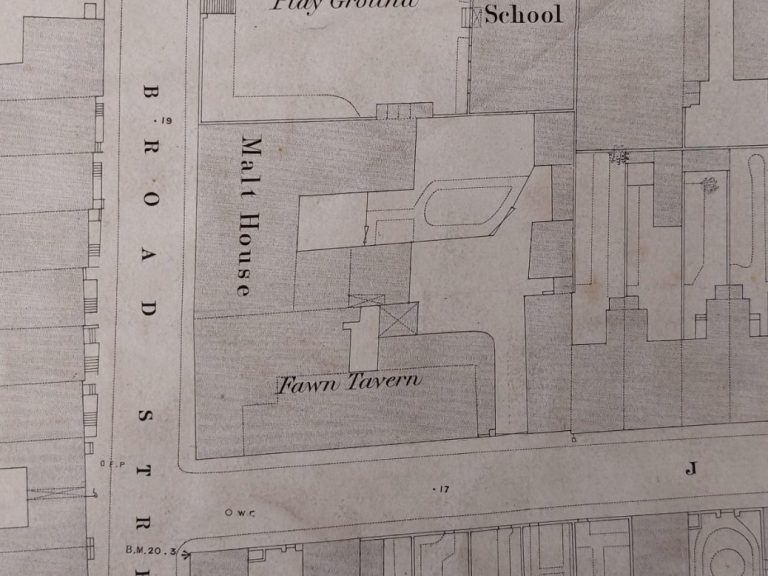
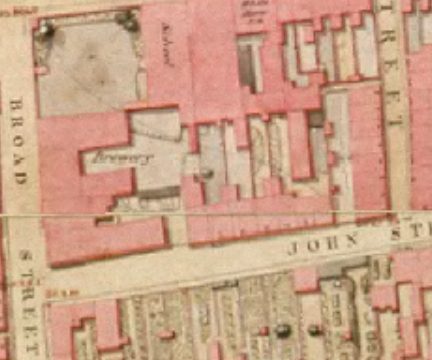
J W Drew retired from Houndwell in April 1841 and (if I am correct) sold in Broad Street 15 months later, so dates for a gradual retirement do fit. The question now therefore is what was this other brewery? Broad Street was a very short road. It is logical to conclude that this brewery plant for sale was attached to the ‘brewery’ which is clearly shown on the 1846 town map which is shown below. However, by the time of the 1870 map, also shown below, there is nothing specific shown in that area which looks to be an open area, perhaps a yard and access. It certainly looks as if the 1846 brewery has been demolished, leaving the ‘Malt House’.
The demolished brewery had a capacity of 9 quarters, whereas Fawn (in 1856) was a 5 ½ Quarter brewery. We see later in the auction notice of 1856 that the freehold was owned probably by Richard Lock Senior. It may well be that Drew brewed here, perhaps for the Fawn, retired, sold his plant and vacated the site. The brewery was later demolished by the Lock family and they invested in a smaller plant, perhaps in part of the ‘Malt House’.
This is however one of many points in this research generally yet to be resolved. Coincidentally, the auctioneer of the Broad Street brewery was H Withers. Any connection with the brewing Withers we see at Houndwell?
Broad Street was well served by breweries/brewers. The Pure Drop was at 11 and 12 Broad Street but they only brewed in the 1860s. Two other brewers are listed. The first, John Mears who I cannot find in directories but Dave Marden in his book ‘Southampton’s Old Kingsland and St Mary Street’ says he was a brewer at No 3. Also, James Exall is listed at 4 Broad Street Kingsland in 1865 and 1867 as a brewer.
Returning now to the Fawn Tavern. Richard Lock Sen died on 2nd November 1849, in Broad-Street, in his 81st year. His son also Richard takes over the business and appears in directories up to 1855. The 1851 Census shows him as a brewer and maltster, aged 46, with wife Sarah.
At the annual Licensing Sessions in September 1854, Richard Lock applied for a licence for his house which “was a corner house with malthouse and brewery in a good situation for an Inn”. He had lived in town for 46 years and had kept this beerhouse for 28 years. By December 1855 he was advertising the sale of a “quantity of good stale beer” enquire Lock’s Brewery Kingsland Place Southampton.
The Hampshire Advertiser of 13th September 1856 announces an auction, on an order of the trustees of Mr Richard Lock under a deed of assignment on 17th October 1855 at the Fawn Tavern. This was for the freehold brewery, public house, malthouse, large stores stabling and yard. The brewery comprised a 5 1/2 quarter plant (a brew of about 792 Gallons at a time) and extensive cellaring and public house on the corner of two streets. Bar parlour, smoking room four bedrooms tap room and kitchen were included. Adjoining was a 12 quarter malt house consisting of two working floors, kiln and loft over, with excellent stabling, stores and lofts and a large yard, all with a frontage of 90 ft. to Broad Street and a depth of 100ft with frontage to John Street. Plant and fixtures to be at valuation. The whole was offered as one lot, and if not sold then as two lots. Lot 1 would be Brewery and pub, and Lot 2, the malthouses. After the sale about 260 barrels of old ale was to be auctioned in lots. Note the reference to stabling and a large yard, perhaps on the site of the 1846 brewery.
Perhaps the brewery was managed by Richard Lock senior’s trustees and with the family deciding to sell in 1856. What we do know is that in August 1857, Charles A Clifford applied for a licence for the Fawn Tavern, and had taken over. At the Transfer Session, it was stated that he applied for a licence because Mr Heriot who held the licence (for the pub) had left the area and filled in the forms. The Licence was granted but it was not a new application, more a transfer.
Richard Lock jun. died on 10th June 1858 aged 53 years.
In the Hampshire Advertiser of 9th January 1858 there is a notice for the letting of a ten quarter steep maltings with immediate possession. Inquire Mr C A Clifford Fawn Brewery Broad Street Kingsland. On 23rd January 1858 he was informing the public that he was sending out his celebrated Suffolk Ales, XXX Old ales, mild, XX ale, and X ale. Trade supplied, 10% under any other brewery. Terms cash. Whether he was brewing these, or just selling for others is not clear.
A warning was issued during the 1859 Licensing Sessions, that if Clifford was fined again for misconduct, the Magistrates would put a stop to his licence. It was said that Clifford had been fined once during the year, although he maintained there had been no ball conducted in his house since the fine, but if he could not hold balls, then neither should the Victoria Rooms. The Mayor said they were attended by different clientele and “the defendant’s balls were frequented by prostitutes and others who were doing great mischief to the morals of the community”. The Licence was renewed.
In the Hampshire Advertiser of 24th September 1859 there is an auction notice for the sale of the freehold of the Fawn brewery public house, malthouse, large stores stabling and yard, the sale being by order of the Trustees of Richard Lock under a deed of assignment and with concurrence of the mortgagees. The brewery was described as a compact brewery with a 5 1/2 quarter plant, extensive cellarage, with pub at the corner of two streets, with bar, smoking room four bedrooms, taproom and kitchen. Adjoining was the 12 quarter malthouse with 2 working floors kiln and loft over. There was a frontage of 90ft to Broad Street and depth of about 100 ft. with frontage to John Street. To be offered in one lot but if it does not sell, then in 2 lots as before. This is of course almost a repeat of the 1856 notice.
There had clearly been no sale of the freehold in 1856, and perhaps Clifford was operating under a lease granted by Lock’s estate.
On 5th November 1859 there is a ‘wanted’ notice; “some good sweet barrels, hogsheads and puncheons. Inquire C A Clifford Fawn Brewery Kingsland or the Albion brewery Saint Mary’s Street Southampton.”
I believe it is likely that this was the same Charles Clifford who was at the Vine Inn Portswood Road (see the Vine Inn Page). He started there Circa 1860, so he may well have moved from the Fawn in 1859, to the Vine. Why does the advert refer to the Albion Brewery? In 1859, the widow of Thomas Wolferstan was looking after things at the Albion brewery, so did Clifford help her out there before moving on to the Vine? (See the pages on the Vine, and the Albion Brewery). The 1861 Census shows Charles Clifford as a brewer and victualler, aged 60, married to Elizabeth, also a brewer and victualler, aged 29.
In 1864, the licence was transferred from Francis Welsh to James Sly, who became Innkeeper at the Fawn Tavern. Jumping forward to the 15th September 1883, there appears an auction notice for sale by mortgagees of the “valuable and well known freehold licensed house called Fawn Brewery and malthouse situate in Broad and John Streets Kingsland” held for the residue of lease for 21 years from 25th March 1874. “The brewery is in the occupation of Mr Hattatt and the Malt House is rented by Messrs Hine Bros”.
Although the lease was granted in 1874, we do not know if the pub/brewery was separated from the adjoining malthouse at the same time, or perhaps later (by subleases?)
An auction notice in September 1889, again by order of Mortgagees, refers to the extensive and
complete freehold corner property known as The Fawn Brewery Kingsland Southampton comprising fully licensed public house, old brewery premises and malt house (easily convertible to stables) small cottage and land the whole having a frontage to two streets. On the 23rd November 1889 the same auctioneers advertised for sale a brewery copper and 2 iron tanks complete with taps.
It seems that by the end of 1889, brewing had ceased, as the term ‘old’ brewery is used. This again was the sale of the freehold, but with no express mention of the leases to Hattatt and Hine as 25 years earlier. What became of the malthouse? Dave Marden in his book ‘Southampton’s Old Kingsland and St Mary Street’ says that by the end of the century it belonged to Cave who were mineral water and beer merchants. The Fawn Tavern was subsequently owned by Forder & Co, and was closed in 1931.