HILL THOMAS & CO
The Docks Southampton, and Lower Back of Walls
Also Hill Garton & Co and Anglo Bavarian Brewery from 1869
Started late 1860’s
Name change to Anglo Bavarian Brewery from 1869
Brewing ceased 1871 in Southampton
Most people interested in beer and brewing will have heard of the Anglo Bavarian Brewery of Shepton Mallet Somerset, which had its roots in Southampton.
Thomas Hill had a long association with Southampton and he was a Director of the Union Steamship Company, a general shipping agent dealing with trade to the Cape of Good Hope. He founded the Saccharum (sugar) works in the docks (some say Canute Road) with Francis Christopher Hill of Southampton. William Garton came to Southampton in the late 1860s on the introduction of Thomas Hill, and he went in to partnership. I have a separate page detailing the Garton family.
Thomas Hill also ran a brewery, and he supplied beer to the Union Steamship Company.I am unsure as to when the brewery (which would become the Anglo-Bavarian Brewery CoLtd) was established, but it was brewing in 1869.
In the 1861 Census, Thomas Hill is an Innkeeper, aged 51, with his wife Catherine. In directories of 1859 and 1861 we find ‘Hill Thomas Ale and Porter store, Old Sugar House Lower Back of Walls’. In directories of 1863 there is an entry “Hill & Co Thomas ale & porter stores Old Sugar House Lower Back of Walls”. In 1865 and 1867 he is a sugar refiner and innkeeper. There is no reference to a brewery.
In the 1871 Cox’s Street Directory we find “Hill & Co Thomas ale & porter stores Lower Back of Walls”, together with “Hill & Co Thomas Anglo Bavarian Brewery Saccharum works Docks”. Separately we see Garton & Co Brewers 37 Above Bar Street, and James Garton brewer etc Roseland, Bridge Road Woolston. The Above Bar entry may relate to Charles Garton, brewer of Bristol. There were separate businesses for brewing, and sugar refining, as we see later.
In the Southampton Observer and Southampton News of 28th August 1869, we see the first (I believe) reference to the Anglo Bavarian Brewery Company in Southampton, and I think we now need to change direction to Somerset. Many sources, including the Brewery History Society (BHS) state the first buildings of the Anglo Bavarian brewery Shepton Mallet were erected in 1864 for Morris, Cox and Clarke of London specifically for the production of India pale ale. They say that in 1872 the business was taken over by Hill, Garton and Company, the owners of a large brewery in Southampton, who made considerable additions and improvements. The name Anglo-Bavarian appears to stem from this date as well.
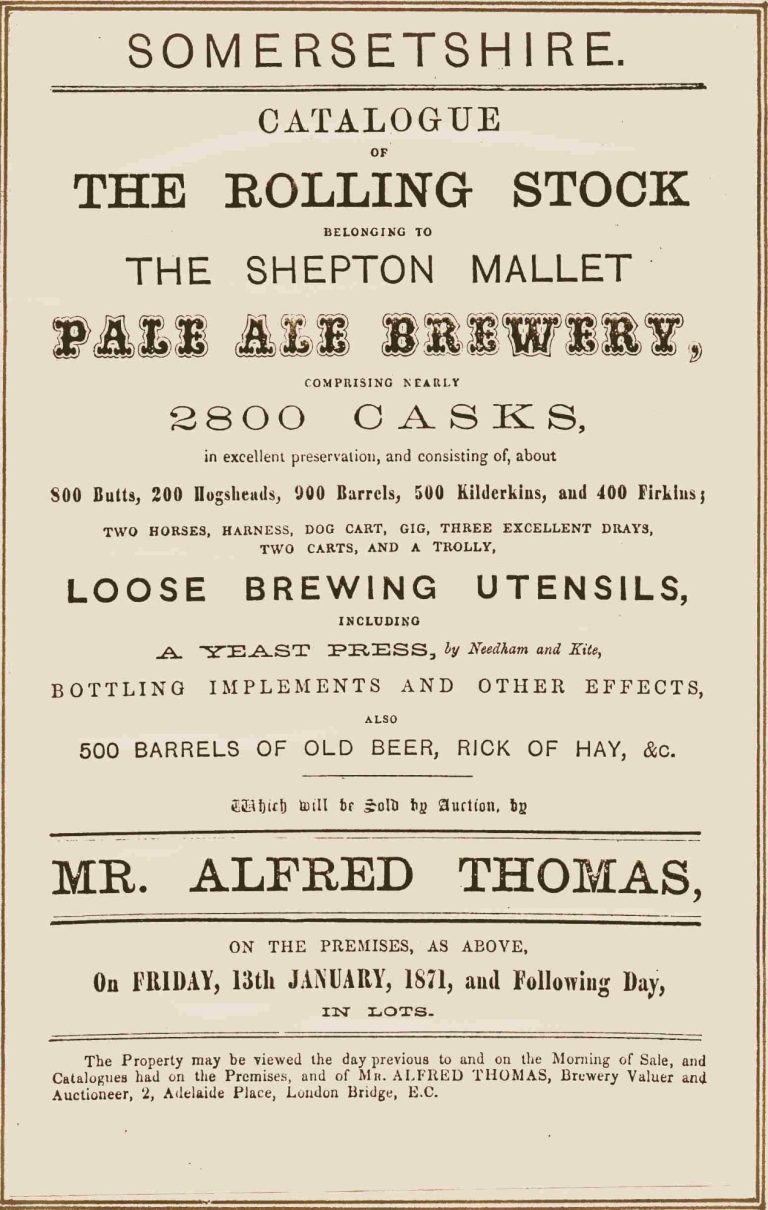
Notice of sale of the Shepton Mallett brewery from 1870/71. Courtesy of the Brewery History society
Martin Cornell, a well respected beer writer and brewing historian says the 1864 building was initially called the Shepton Mallet Pale Ale Brewery. It was then one of the largest breweries in the country. He continues “In December 1870 the Bristol Mercury announced that the premises of the Shepton Mallet Pale Ale Brewery would be put up for auction on Friday January 13th, 1871”. It looks as if nobody bought the brewery at the auction, for on March 11th 1871 the Mercury was reporting that “the extensive premises lately occupied as a pale ale brewery” in Shepton Mallet were being considered as a site for a barracks for the militia”. However, the Shepton Mallet brewery may have brewed on site, since in the December 20th 1871 edition of the Daily News in London there was an advert for “Shepton Mallet Pale Ale – Leonard Cox and Co, proprietors of the original Pale Ale Brewery, Shepton Mallet … their export ale, which is so well known in India and the Colonies for its delicacy of flavour.”
In the meantime, back in Southampton, Thomas Hill was brewing in Southampton. In the Southampton Observer and Southampton News of 28th August 1869, there is a report that “Thomas Hill & Company of the Anglo Bavarian Brewery in the docks…” gave a holiday to all their employees at the Crystal Palace in London. I have concluded that the date of 1871 or 1872 for the name ‘Anglo Bavarian Brewery’ is not correct, as it was clearly in use by 1869 in Southampton.
The following year in April 1870 there is reference in a Court case to “Ephraim Brown a young man employed at Mr Hill’s brewery”. Later, in August there was a dispute as to the rating of the Saccharum works and brewery in Southampton. The Rateable Value was reduced from £1,000 to £800, and Hill said he paid the dock company £500 pa for the sugar works, and £320 for the brewery making £820 pa rent. The sugar business and the brewing interests were clearly separate, with Hill Garton on the sugar side, and Thomas Hill (Anglo Bavarian) on the brewing side.
Mr Hill continued to brew in Southampton, using the Anglo Bavarian name. However, there was a major issue with the water supply. Newspapers of 12th August 1871 refer to discussions as to Southampton’s commercial prospects, and included a complaint by Mr Hill respecting the want of a proper supply of water. The water mains had not been large enough to supply Mr Hill’s works, as well as the residents. He had not joined a deputation of brewers who had urged the Special Works Committee to reduce the cost of water, as he was willing to pay the going rate, but only if he could get a supply. The report says “his repeated complaints having proved of no avail he has now taken steps to remove his brewery to another place where his requirements will be attended to”. It was likely this business would have had large export potential and would benefit the docks. It was felt “a little attention during the last few months to this practical business instead of building castles in the air and talking like laundrywomen respecting critics thereof would, while rebounding to the credit of
our local rulers have tended to establish the port, and possibly attracted other manufacturers here”
A few days later, the issue of improvements was discussed again. It was asked if the members of the Special and General Works committee possessed a conscience, and if so why a decision had been delayed. Was it because it had been decided to remove Mr Hill’s brewery to Shepton Mallet in consequence of there not being enough water? It seemed that this was the straw that broke the camel’s back. It was suggested Mr Hill might get a larger water supply and worse beer at Shepton Mallet. The water supply had been for residents, and had not been contemplated for trade purposes. There was also produced to the meeting a letter from Mr Hill which I make no apology for setting out in full;
“To the Editor. Sir —I beg to refer to your paragraph in last Saturday's Independent respecting the water supply to the brewery with which my name is connected. Your informant, probably in ignorance, mis-stated the fact as regard our being satisfied with the rate charged. On the contrary, we think it very high, and considerably more than breweries and factories ought to be charged; but we felt that quantity, rather than cost, was the serious difficulty we had first to deal with, and as soon as that should be satisfied we could take up the minor one of expense. It appears to me that large consumers of water by meter are treated very unfairly. I am informed the water costs the town 9d. per 1,060 gallons, but I would ask why is it so costly? Our Town Clerk has partly accounted for it in his statement that the consumption, instead of being six gallons for each person per day, is actually thirty gallons. Now, if the inhabitants were charged in proportion, that is, five times as much as they are now charged, it would, perhaps, work out that manufactories consuming by meter should pay 2d. instead of 9d. It is evidently most unjust that they alone should be saddled with the loss which results to the town through other people's waste. Instead of weighting their business in this way, I would reverse such a policy and give large establishments every encouragement, even if at some expense to the town generally, because without such aids a town's prosperity cannot be of a permanent character. I am, sir, etc T. HILL. Southampton, August 16th, 1871.
On November 8th 1871, the Hampshire Advertiser carried a report from a Bristol newspaper that the Anglo Bavarian Brewery Co. had recently purchased the new buildings in Shepton Mallet known as the Pale Ale Brewery. Alterations were being made and it was expected to be open by Christmas. It was expected they would employ 50-60 men locally. The newspaper lamented; “We regret that the company should be leaving Southampton but wish them success notwithstanding the removal of their manufactory to Somersetshire.”
Martin Cornell also refers to an advertisement for the Anglo-Bavarian Brewery Company, Shepton Mallet from the Daily News in London just before Christmas 1871 suggesting operations were by then fully transferred from Southampton, since it reported that “orders can now be registered for the October brewings of this Company’s Pale Ales, which are so well known for their soundness … also for their celebrated Amber Ales, as supplied to the leading London Clubs” There is a also a separate reference to Amber Ale being sold at the Carlton Club. They were also selling India Pale Ale, mild and strong ales, and stout, as well as amber ale (which won a prize medal in the Paris exhibition in1878, the Vienna Exhibition 1873, Sydney 1879 and Melbourne 1888).
The date of purchase of the Shepton Mallet brewery by Hill & Co was therefore in 1871, probably October or November, when the site was the Pale Ale Brewery.
It is clear that if Southampton had an adequate water supply, it may well have retained what become an extensive and well known brewing business, with all the jobs, money and prestige that would have brought to the town. That was not the only loss. In December 1872 there was a report that George Walker, organist was now organist at Shepton Mallet Parish Church “to which place he went to the removal of the Anglo Bavarian Brewery staff, of which he forms a part, from Southampton”.
The company was already a major employer. In September 1871, the company provided an ‘Annual treat’ in the New Forest for 387 employees of the Saccharum works and the brewery (Hill & Co).
The invert sugar works moved to Battersea from the docks, and the brewery moved offices from the Docks to 64 High Street in December 1875.
On the 22nd October 1881, the business partnership between Hill and Garton ended, announced by the following;
“Notice is hereby given that the partnership lately subsisting between us the undersigned Thomas Hill, of Reigate in the county of Surrey and William Garton and Francis Christopher Hill, both of the town and County of the town of Southampton, trading together at Southampton aforesaid as Saccharum Manufacturers and Sugar Refiners, under the style of Hill Garton & Co and at Shepton Mallet, in the County of Somerset, as brewers, under the style of "The Anglo Bavarian Brewery Company," was, on the 30lh September last dissolved by mutual consent. The Business of brewers will henceforth be carried on by the said Thomas Hill and William Garton under the style of " The Anglo-Bavarian Brewery Company," and that of Saccharum manufacturers and Sugar Refiners by the said William Garton and Francis Christopher Hill in conjunction with Richard Charles Garton and Charles Henry Garton, under the style of Garton, Hill, and Co." All Debts due to and owing by the said late partnership for the brewery will be received and paid by the said Thomas Hill and William Garton.
William Garton would go on to acquire the John Bell and Son’s Itchen brewery in Woolston, Cooper & Co of East Street, and the brewery of Vincent & Elliott.
William Garton died 8th March 1905 aged 72 at home at Roseland, Woolston. The Hampshire Advertiser of 11th March 1905 carries an obituary setting out his background as described earlier and also stating “Mr Garton was the founder of what is known as the Anglo Bavarian Brewery. Commencing with small things, the fame of the productions of the brewery soon caused the business to largely extend and the result was the building of a brewery at Shepton Mallet.”
Thomas Hill died in March 1883. His obituary says he was one of the founders and Directors of the Union Steam Shipping Co. He founded the Saccharum works which he carried on until it moved to Shepton Mallet. He was brother in law to Arthur Anderson, chairman and one of the founders of the P & O company.
The word ‘Bavarian’ was dropped from the name during the first world war, and by 1920 the brewery was employing only a few men. The Garton family still owned the brewery but in April 1921 all of the machinery, plant and other fittings of the brewery were put up for sale by auction. In August, the brewery site itself, and all of the brewery’s land in Shepton Mallet was put up for auction. The Brewery was revived with new owners in 1934 who once again use the name 'Anglo-Bavarian Brewery company'.
I cannot mention the Anglo Bavarian Brewery without mentioning the scourge of CAMRA Lager!. The often repeated ‘fact’ is that they were the first lager brewery in the UK and they employed German brewers. That is not correct as the first brewery in the UK to produce lager was the Austro-Bavarian Brewing Company in 1882, based in Tottenham, and run by an entirely German staff. It was renamed the Tottenham Lager Company 4 years later. (Source, The Morning Advertiser 13.3.2003). I had thought that the Wrexham Brewery was first, having started in 1883 until Google corrected me. As we saw earlier, the brewery output was pale ale, and export ale, with no mention of lager!
Those paying attention will have noted that the name ‘Bavarian’ was also in use in Shirley in 1866, (see the Shirley Mills brewery page).
Interesting fact. On 9th May 1936 the Hampshire Advertiser had a retrospective of ‘firsts’ in Southampton from newspapers in 1891. It was reported that “the Anglo Bavarian Brewery installed the first electric bottle washing machine”. That’s put us on the map!
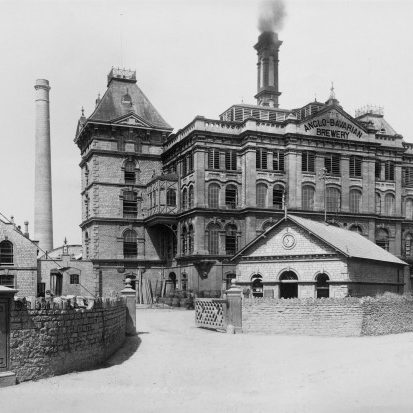
The Anglo Bavarian Brewery, shepton Mllett, Courtesy of the Brewery History society
In February 1879, there is a report of a Court case, where a pair of iron hinges and some screws worth about 4s was stolen from Messrs Hill Garton & Co brewers of Southampton Docks. William Channell, an employee, was imprisoned for 2 months with hard labour. ItLooks, therefore as if there was still a brewery presence in Southampton in 1879, with the Anglo Bavarian brewery trading in Somerset. Indeed, the brewery retained a large presence in Southampton, with stores and offices (at various times) at 64 High Street, 31 Above Bar, and 17 East Street. They had agencies with Henry Frederick Raynes at 4 High Street. In
newspapers of 1st January 1898, there is a report of a fire at Millbrook Road Malthouse, occupied by Bailey & Son of Frome. “The building is the property of the Anglo Bavarian Brewery Company”.