CHAPEL BREWERY
43 Chapel Road, Corner of Albert Road and Chapel Road, sometimes 2 Albert Road.
Also Loosemores Hotel.
Started Circa 1844
Taken over by Enever & Perry 1867, and by Mew & Co from 1881
Brewing ceased probably 1881
According to Tony Gallagher in his book ‘Southampton’s Inns and Taverns’, these premises were originally the American Hotel, so named (probably) as it was near American Wharf. Robert Loosemore became the owner and changed the name to Loosemore’s Hotel. He was a brewer, as was Charles Loosemore who was Landlord in 1855. This was nothing to do with present Chapel Arms.
Dave Marden in his book Southampton’s Chapel Area says the building was occupied by Robert Loosemore from at least 1836. The building was split around 1850 in to two premises, with half becoming a shop, at 4 Albert Rd, run by Thomas Simmons. The remainder continued as a hotel (listed as being 43 Chapel Road) until the 1970s.
Robert Loosemore is referred to as a master mariner in the 1836 Post Office Directory, at 11 Chapel Road. In a Court case, the Judge refers to him as ‘Captain’ and I see from reports that he does have maritime connections. I believe his family was from the Isle of Wight. From reports we shall see later, I believe the premises were built by him Circa 1841, which may explain why he does not appear in directories until the 1845 Post office directory when he is a brewer and Ship Chandler at Chapel Road.
We do however know there was a brewery here in September 1844, as Robert Loosemore applied for a licence for premises in Albert Street, having 3 parlours 12 chambers, a brewhouse and tap. He presented a ‘memorial’ signed by 90 people. The application was refused (as were all others that day).
As we see later, Robert Loosemore the brewer had a son named Robert so it is difficult to know which one we are talking about, but I believe most of the references here are to Loosemore senior. Robert Jun is described as a brewer at the Northam Brewery, Princes Street in the 1853 directory. See the ‘Limited info-Pub Breweries page’, where I suggest this was the Oddfellows arms.
Directories pick Robert up again in 1847, when he is a brewer and ship’s chandler. The 1848 Kelly’s directory shows him as a brewer and Innkeeper, which remains the case until 1871. The 1851 Census shown him as a brewer. His address is usually Chapel Road, with the odd reference to ‘Loosemore’s Hotel’.
Two examples show that Robert had a humorous and rebellious streak. First, in the Hampshire Advertiser of 14th August 1847, he was reportedly summoned for not paying ‘improvement rates’. He said he had made a vow not do so until his property was properly lighted with a lamp, and he would not pay without being summoned. He said “the commissioners are a set of humbugs. It is dead robbery to make me pay. I shall pay when summoned. I shall pay now”. The report then concludes that “He paid the rate and costs, grumbled much, swore a little and then marched out of Court.” He was also fined 10s and costs for being open after hours in separate proceedings.
Second, the Hampshire Independent of 26th August 1848 carries a report of a Licensing meeting. It was said that Mr. Robert Loosemore in a humorous address, personally applied for a license for the American Hotel, Chapel. He had earned £3,000 by working hard at sea, and then retired on land, with which he bought a field at Chapel, which was now covered with buildings, including his hotel. His house possessed every accommodation, and he presented a memorial, signed by several master tradesmen and ship masters, in his favour. There were three clubs held at his house, and he had been frequently being obliged to turn off the gas at eleven o'clock precisely, and leave the clubs in total darkness. He brewed himself and sold good ale. The committee said that they only had his word for that. Mr. Loosemore replied that he did not want the magistrates to take his word, but to come and try it. He had not employed a lawyer, as he thought that the farther he kept law from him the better, and he came there to plead his own cause. This was the eighth time he had applied for a license. Since the last license was granted in that neighbourhood, several streets had sprung up. He objected to Mr. Silva being granted a license, (to open a pub in Queens Terrace) as he was a foreigner, and he thought that the magistrates ought to grant a license to an Englishman in his own country before they would to a foreigner. He said that the licensing act was passed because there were several 'banditti' about who carried out extensive smuggling and the Act was to allow licences to those who could show good character.
In October 1851 he places an advert for a young man, 25-30 preferably married and who erfectly understands the business of brewer of ale and porter. Apply R Loosemore Chapel Brewery. This seems to be the first mention of Chapel brewery. In 1852 there is a marriage announcement between Robert Loosemore, brewer of Northam eldest son of Robert Loosemore of the American Hotel Chapel. He married Emma Mitchell.
The Hampshire Advertiser of 25th February 1854 carries an advert for the letting of the Chapel Brewery on lease, or to be sold with immediate possession. This was for the freehold premises with the Inn tap and sundry offices adjoining thereto. The premises had been erected about 13 years since (ie about 1841) and the proprietor had possession of them up to that time and wished to decline business.
I cannot find evidence of any takers, although it is possible that he did find a tenant, perhaps to run the hotel on a short lease as nine years later, in August 1863, another notice appears “first rate inn and brewhouse. To be let, with immediate possession, a free public house of twenty-two years' standing, situate in a good business thoroughfare, near the Southampton docks, a corner house, in full trade, and contains a three-quarter brewery, (about 432 gallons per brew) which might easily be converted into one of ten quarters, under the same roof. Address, Loosemore's Hotel, Chapel Road, Southampton.
I said earlier that directories showed Robert here until 1871, as a brewer. However, the Post Office directory 1867 shows Enever & Perry at Chapel Road and in the 1869 Cox directory, Enever F. is at 43-44 Chapel Road. Perhaps Enever & Perry perhaps went in to business with Robert before the whole enterprise was transferred to them.
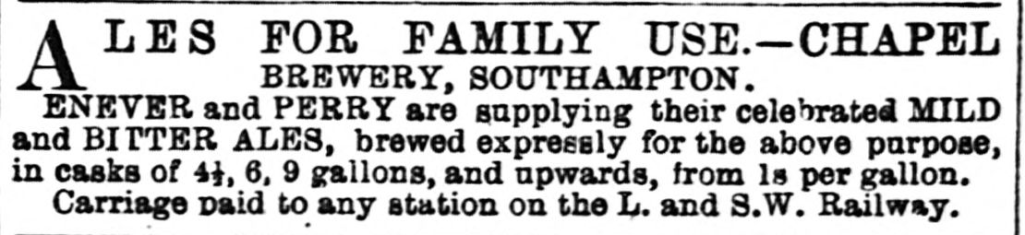
A notice appears in newspapers of 1st June 1867. Messrs Enever & Perry advertised that they had entered in to an arrangement with Mr Loosemore for the transfer of his old established brewery and intended brewing ales ‘expressly for family use’. There also appeared an advert for them supplying families with wines and spirits at wholesale prices in single bottles. Also their mild and bitter ales to families in casks of 4 1/2 and upwards from 1s a gallon. In October 1867 there is a similar advert. Perhaps they expanded the brewery to the 10 quarters mentioned in the auction notice. They did take on staff, as there is reference in January 1868, to a William Hartley being employed by Enever & Perry at the Chapel Brewery. He was previously at Albion (I assume Lankaster’s Albion Brewery). In May 1868 there is an advert for the letting of two pubs by the Chapel Brewery.
An advert in the 1869 Directory just shows ‘Frank Enevers’. Perhaps Enever and Perry owned the business but allowed Robert to remain as licensee, since on 25th June 1869, the licence of Loosemore’s Hotel was transferred from Frederick Francis Enever to Robert Loosemore. This change seems to have arisen as a result of financial difficulties 4 months earlier, as on 20th February 1869 Frederick Francis Enever, a brewer of Chapel Brewery filed for bankruptcy. He had debts of £3,247 including a debt to his late business partner of about £1,226 and his mother in law Mrs Godfrey £737. One can assume that the late business partner was Perry.
On the same day, an auction notice appears for the sale of all plant and fittings, casks vats, 8-barrel copper, coolers, wort pump, water meter, slate cistern malt mill, quantity of beer and ullage, and brewery fittings, a 5 pull beer engine, mangers, racks, straw and hay.
To digress slightly, on 18th January 1871, an obituary appears for Mrs Loosemore who died at the age of 102 years at Bembridge. “She was the mother of Robert Loosemore of Chapel Brewery and the late Henry Loosemore of Newport.” She was the widow of late Captain William Loosemore of Calshot Lightship.
Two years or so pass until we see on 25th February 1871 an advert for a small 4 quarter brewhouse to be let cheap at Southampton, with immediate possession. Plant was as valuation, apply to Mr R Loosemore Chapel Brewery. This would suggest that Robert owned the premises and the business was leased to Enever, whose business failed, with all the premises reverting back to Robert. The brewery capacity had increased from that shown in the details in the 1863 auction details (3 quarters, now 4 quarters).
Robert Loosemore formerly of Chapel Brewery died 20th December 1881 aged 83 years.
In July 1888, the death of George Loosemore was announced on 18th July, the younger son of the late Robert Loosemore formerly of Chapel Brewery, aged 41. It would appear thatafter his death, the brewery and premises were let to Mew & Co (brewers Isle of Wight) with the lease to expire in March 1890. In On 30th November 1889 an auction notice appears for the sale of the freehold of Loosemore’s Hotel Chapel Road with brewery, yards, stables, lofts and cottages adjoining and possession in March next. This was leased to Messrs Mew & Co at £60pa. Stabling and yard adjoining was let to Messrs Pollock & Brown. There was also a large assembly room or mission hall occupied by the Navy Mission, and a grocer’s shop, and three dwellinghouses. The sale was by order of trustees of the late Robert Loosemore.
Did Mew & Co brew here? For themselves, or for the hotel as before? The wording suggests they took the hotel and the brewery etc. We can perhaps conclude that brewing continued after Robert’s death, and may have been undertaken by Mew & Co, at least until March 1890.
The Loosemore family shad been involved with various businesses. Robert senior was in the maritime sector, and his son at a pub/brewery in Northam. In addition, the Hampshire Advertiser of 27th July 1867, shows an auction sale notice for the freehold premises, the “Old English Gentleman” at Queen street Lymington “with compact and well arranged brewery now in full work”, the property of Robert Loosemore. This was an inn with 11 rooms, a coachhouse “and a snug and convenient 2 1/2 quarter brewing plant, (about 360 gallons per brew) with cellars and stores attached to the brewery. The brewery and cellars are shaded with Lime trees”.
By 1905 the hotel was owned by Gibbs Mew, and the buildings were severely damaged by wartime bombing in 1940 and then demolished.