SHIRLEY BREWERY
23 Romsey Rd Shirley
Brewing started 1835
Brewing ceased 1865/6
This brewery is shown as the ‘Old Shirley Brewery‘ on some town maps, but that may be because it was a brewery in Old Shirley. The Old Shirley brewery was the name of the Shirley Mils brewery in Romsey Road (see Shirley Mills brewery page). Shirley was not of course part of Southampton originally but it is now for my purposes. The brewery served as a ‘training ground’ for two of Southampton’s major brewers later on; Andrew Barlow and William Aldridge.
The brewery was started by John Parsons, and the 1834 directory shows John Parsons as a Brewer in Broad Street, and earlier, Bridge Street. I believe that he was at the Wheatsheaf brewery (See the Wheatsheaf page). John Parsons announces in the Hampshire Advertiser of 11th April 1835 that he had removed his business to the Shirley Brewery in partnership with John Palk, “where those, who may favour them with their confidence, will be supplied with ale, and strong and table beer, free from any adulteration, as they pledge themselves never to use any article whatever, in the brewing of their beer, except Malt and Hops.” (what about water?). They were also dealers in malt and hops and they could supply pubs and beer shops. However, this must be the shortest partnership on record as just 5 weeks later the Hampshire Advertiser of 23rd May 1835 publishes a notice that the partnership between John Parsons and John Palk of Shirley, common brewers, trading as ‘Parsons & Palk’ was dissolved on 19th May 1835 by mutual consent. The business would be carried on by John Parsons alone. It would seem that by 1839, Palk was a chemist and druggist.
The 1836 PO Directory shows John Parsons as a brewer at Shirley, as does the 1839 Fletcher directory. In November 1837 newspapers refer to Mr Parsons of the Shirley Brewery letting the Red Lion Stubbington, and he also acquired the Anchor & Hope in Hythe in 1840, so it is clear that the brewery had a large trading area.
Further changes however took place this year as Parsons went into partnership with William Aldridge. The Hampshire Independent of 30 November 1839 announces that John Parsons had taken William Aldridge ‘late of Romsey’ as a partner in the Shirley Brewery from 22nd November 1839, and they would be brewers, and wine and spirit merchants. It was said that Aldridge had been engaged in dealing Porter, Burton Scotch & other ales.
This partnership as ‘common brewers’ continued until 5th March 1841 when it was dissolved. On 18th June a sale was to take place of the whole stock of wines which they held, being about 700 dozen bottles of port, sherry, madeira champagne etc., to be delivered from the cellars at Shirley. In February 1842 William Aldridge acquired the Bedford Brewery in Southampton from Thomas Payne (see the Aldridge brewery and Payne’s brewery pages).
In the Hampshire Independent of 31st July 1841, Parsons & Aldridge expressed thanks to customers and announced they had sold their business to Messrs Barlow and Clode who would continue business at the same premises. On 15th June 1841, Messrs Barlow and Clode announced that they had purchased the plant and stock of the above establishment, which business they intended to carry on in conjunction with the wine trade. They said that the circumstance of both partners being strangers to this part of the country, may for a time prove a hindrance to their success, and they asked for patience to make it a success.
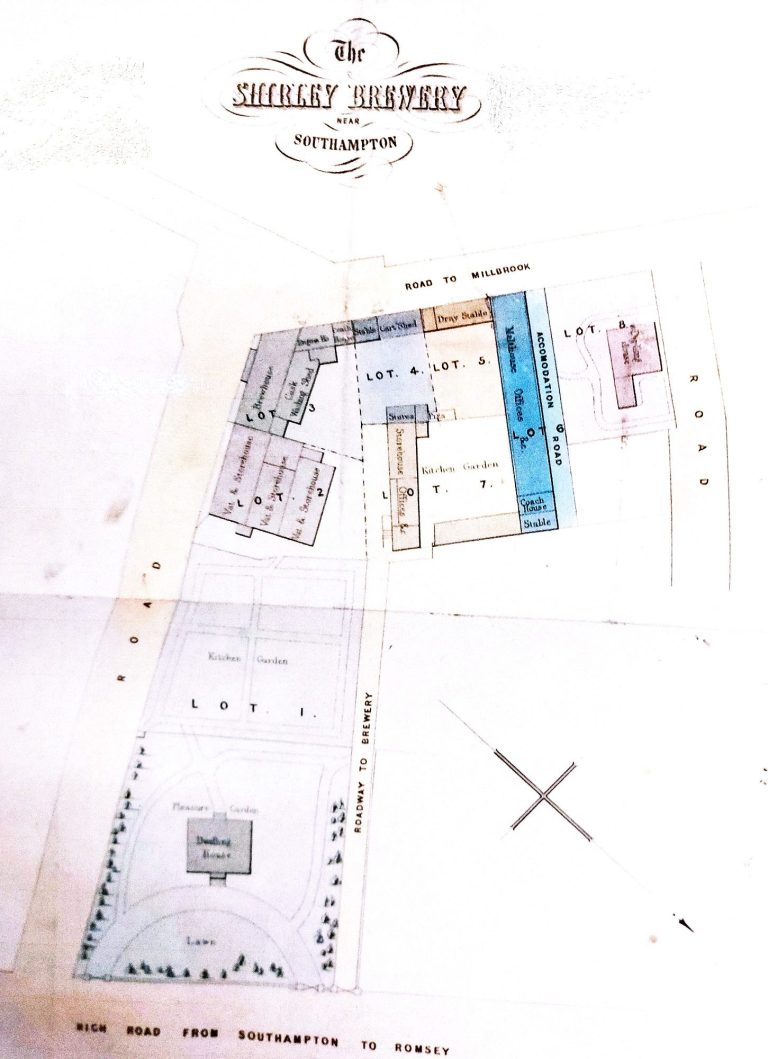
Plan taken from the 1866 catalogue, prepared for
the auction. Lot 1 was the freehold villa. Lot 2 was the brewery store houses etc. Lot 3 was the brewery.
By August 1841 a price list appeared with the assurance that “Mr Barlow has had the advantage of being attached to two breweries of considerable magnitude in one of which, as pupil to a most celebrated Porter brewer, and having been occupied at the copper side for five or six years is consequently enabled to produce that Article in the greatest perfection besides which he is practically acquainted with the brewing of Ale of every description including the celebrated India Pale Ale” Mr Clode had devoted 15 years to the wine trade in London, “the last seven of which as Partner in one of the oldest Establishments of the metropolis”. They advertised their XXXX ale (very superior) XXX ale, X ale Porter, Porter very superior stout, good table beer, superior table beer and Pale India Ale of finest quality, with a long list of wines etc. By September 1843, it was reported that Barlow & Clode supplied ‘ale and porter’ to the Royal Yacht.
Andrew Barlow was the third son of a well known corn dealer and hop factor, John Barlow. He was a pupil under Mr A Birkmyre of Messrs Reid & Co brewery in Windsor (see the Barlow Brewery page for more information).
Directories of 1845 list Andrew Barlow & Nathaniel Clode at the Shirley Brewery, Shirley Common, brewers and wine merchants. And then? Yes, another partnership comes to an end fairly soon after it started, as on the 1st January 1846 the partnership between Andrew Barlow and Nathaniel Clode was dissolved. Barlow continued the business as brewer and wine and spirit merchant on his own, and Clode returned to London to continue as a wine merchant.
Andrew Barlow appears in directories from 1847 as a brewer in Romsey Road Shirley, as he does until 1857, often also showing him as a wine and spirit merchant. In 1849 he was looking for “a steady and active young man to work in a brewery.” In 1852 he applied for a licence to sell spirits ‘from premises connected with his brewery’, but this was refused. Other reports say this was for ‘a house hitherto kept as a beer shop with a brewery attached by Mr Marsh of Shirley”, so this may have been an application for a brewery tap.
The Hampshire Independent of 8th June 1850 clarifies that John Parsons owned the freehold of the brewery and the other land and it seems that a lease had been granted for the brewery and/or other parts. There was an auction notice for sale on behalf of John Parsons of a number of lots on 13th June 1850. Lot 4 was a dwelling house with lawns, a large and convenient brewery malt house, cellars, wine vaults stables and other convenient outbuildings and large yard at Shirley let on lease to Messrs Barlow and Clode for a term of 21 years from 21st of December 1840, at an annual rent of £400 subject to the right to purchase the ‘fee’ within the first 10 years at £8,400, or at any time thereafter within 14 years at £9,000. There was also included a freehold garden.
The lease details are interesting. In December 1840 Parsons and Aldridge were running the brewery until March 1841, with Barlow officially taking over in June. Parsons could not grant a lease to himself, and Aldridge was on his way out the door, so we are left with the possibility that Barlow and Clode went in to possession in or about December 1840 under the lease, with official announcements of the changes made a few months later. As we will see, Barlow did not take up the right to buy the freehold within the 10, or 14 years. Four years later the Hampshire Advertiser of 4th November 1854 contains an almost identical auction notice.
Andrew Barlow was giving evidence in April 1861 in support of the ‘Petersfield Railway extension to Southampton Bill’ for a new railway line. He said he was brewer and malt and hop merchant in Shirley, and that half his malt came from Andover, about 2,000 quarters annually. There were frequent delays at Basingstoke Station, and the Andover line was useless for his needs and he supported a new Shirley line. He also required about 200 tons of coal a year. In addition to delays, he was subject to robberies and he never received the amount he ordered. Shirley it was said may be the beginning of Southampton just as Greenwich is the beginning of London. He took about 2,000 pockets of hops 90 of which he used, and the rest he sold as a hop merchant.
In May 1862 an auction sale is advertised in London of the freehold brewery premises for many years in the occupation of Mr Barlow “whose lease is just expiring” including a villa residence in its own grounds. There was presumably no interest as in the Hampshire Advertiser of 15th November 1862 there is a notice for the Shirley Brewery, 1 1/2 miles from Southampton in the Romsey Road to be sold or let on lease. The whole of the premises had for many years been successfully occupied by Andrew Barlow. This was a well arranged brewery, with offices for the sale of wines and spirits, stores, engine house, malt houses stabling etc and detached villa residence standing in its ow grounds. All was in excellent repair and good working order. A large part of the price could be left on mortgage, or the premises could be let to a respectable tenant.
Andrew Barlow had therefore decided that at the end of his lease in December 1861 he was to move, quite probably to expand his business. In 1862 he built a new purpose built brewery, the 'Victoria Brewery' in Commercial Road Southampton which included the latest equipment. In newspapers of 4th October 1862 there is reference to Mr Barlow’s new brewery in Commercial Road, and in August he complained about the rates on the brewery ‘lately erected
In the 1863 PO directory we see Andrew Barlow at High Street Shirley, a brewer & wine and spirit merchant, but by 1865 he is at the Victoria brewery Commercial Road, as well as High Street Shirley. This suggests a period of transition from the Shirley brewery to his new premises, as supported by references to him still being at the Shirley Brewery up to 1867.
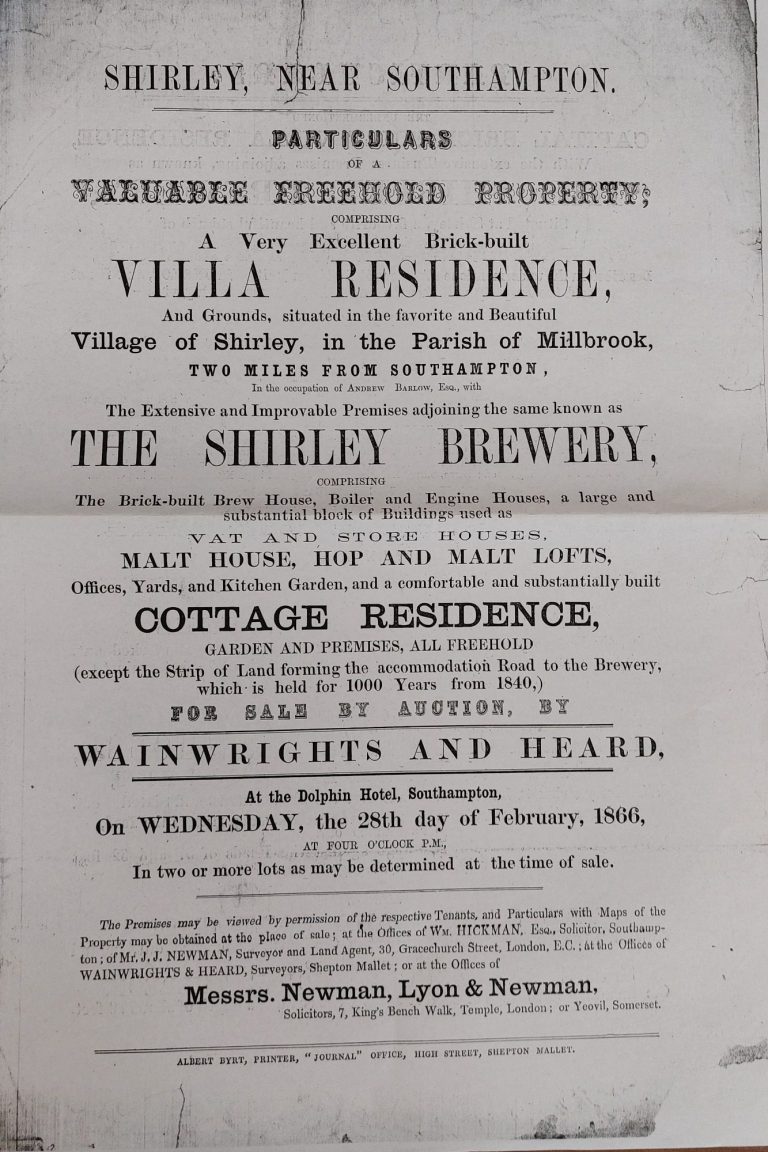
Andrew Barlow at £80pa, and a cottage let ay £19pa. This confirms the brewery was freehold. I have reproduced the catalogue and plan on this page.
There was a further attempt to sell the brewery and premises in April 1867. The notice was for the sale of freehold property, being a desirable site for villa residences and building materials. It Included a Villa, and grounds recently in the occupation of Andrew Barlow but now ‘in hand’ (presumably vacant?) with premises known as the Shirley brewery. These comprised a brick built brewhouse, boiler and engine houses, buildings used as vat and storehouse, malthouse, hop and malt lofts, offices yards and kitchen garden. Also a cottage residence. All was said to be freehold save for the “accommodation road to the brewery which is held on a 1000 year lease from 1840. The land would be good for building villas and the brewery buildings would give materials for the purpose” Apply to Mr Beavis Shirley (and others). Beavis was a well known local builder and sometimes brewer at the White Hart Inn, Shirley (see separate White Hart Inn entry).
Front page of the auction catalogue of February 1866 for the sale of the whole site
I suspect that the whole was acquired by a local builder, who sold off various parts. In the Hampshire Independent of 25th May 1867, C Beavis announced to the gentry and inhabitants of Shirley that he had the means of selling the house and grounds, formerly the residence of A. Barlow, Esq., the old brewery and materials. The only portion of the brewery property then unsold was the malt house, and Albion cottage, formerly the residence of J. Hunt, Esq. By July 1867 the spacious brewery premises occupied for many years by Mr Barlow was to be sold for £800 freehold with malt and hop stores three large cellars, offices stabling and yard. Apply C Beavis Shirley.
In February 1866 there was a lease of the villa to Andrew Barlow. By May 1867 he was no longer there and the ‘old brewery and materials’ were for sale, so we can safely conclude the brewery closed between early 1866 and May the following year and the brewery demolished. Three large villas were built in what is now Emsworth Road and two still survive. The villa occupied by Andrew Barlow is today No. 18 St. Edmund’s Road.
Andrew Barlow went on to become a much loved and distinguished businessman and benefactor in Southampton, and he carried on his successful Victoria Brewery up until his death in 1904.