WILLIAM ALDRIDGE & SONS LTD
Bedford Brewery, 24 Bedford Place.
Brewing Started William Aldridge listed from 1843
Acquired by Brickwood & Co Ltd 1927 (with C 50 pubs)
Brewing ceased 1930
Bottling continued until 1968
Some sources say William Aldridge started the brewery in 1827. Thomas Payne set up the brewery in Bedford Place, circa 1834, in a location that became the Bedford Arms in 1835/6, with the sale of beer dealt with by Mr Hillier (see the Payne’s brewery page). Thomas Payne is mentioned as a brewer in 1826 so this may be where the start date for the brewery arises.
Meanwhile, the owner of the Bell Street brewery, Romsey, died in 1819, leaving the business on trust for his children on reaching 21 years of age. The trustees carried on the business but it seems that William Aldridge was responsible for the day to day running of the business. In April 1838, William Aldridge was carrying on the business of a wine and spirit
merchant in Bell Street, Romsey. On 22nd November 1839 he went in to partnership with John Parsons at the Shirley brewery in (Romsey Road, Shirley, but this partnership was short lived and on the 2nd March 1841 it was dissolved by mutual consent. In June they auctioned the stock of wines.
In December 1841 Thomas Payne died aged 60, a brewer and coal merchant. In the Hampshire Advertiser of 5th February 1842 there is a notice by the executors of the late Mr. Payne informing his friends and others that they had disposed of the Bedford Brewery to Mr W M Aldridge. Also William Aldridge expressed his hope that Mr Payne’s customers
would support him and give him their business “in the brewing and malting business”. He added that he would be devoted to brewing and malting and he had disposed of his interest in the coal trade to William Richardson. He in turn refers to continuing the business of Mr Payne and says orders are still to be sent to the Bedford Brewery.
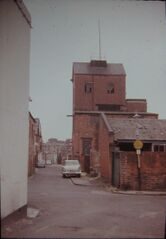
Brewery buildings 2013, courtesy BHS
William Aldridge was the fourth and youngest son of George Aldridge of Christchurch, with a brother Charles. William was born in 1816, making him only 26 when he took over the brewery. He had already set up his own
business in Romsey as a wine and spirit merchant. In the 1861 Census, his father George is a greengrocer and brewer, and in 1871 he is described as a miller, maltster and spirit merchant. He was also a banker so we can
perhaps deduce he may well have been involved with the brewery. George died on 14th February 1881 aged 86, and in his obituary it was said that he was the principal
partner in the firm of Aldridge & Sons, brewers and wine and spirit merchants.
The 1843 Fletcher & Forbes Directory shows William Aldridge at Bedford Place. This also contains an advert for Aldridge, ale & porter brewer maltster etc. Bedford Brewery. He appears in directories as a Common Brewer up until 1867, often with the addition of his business being a wine and spirit merchant.
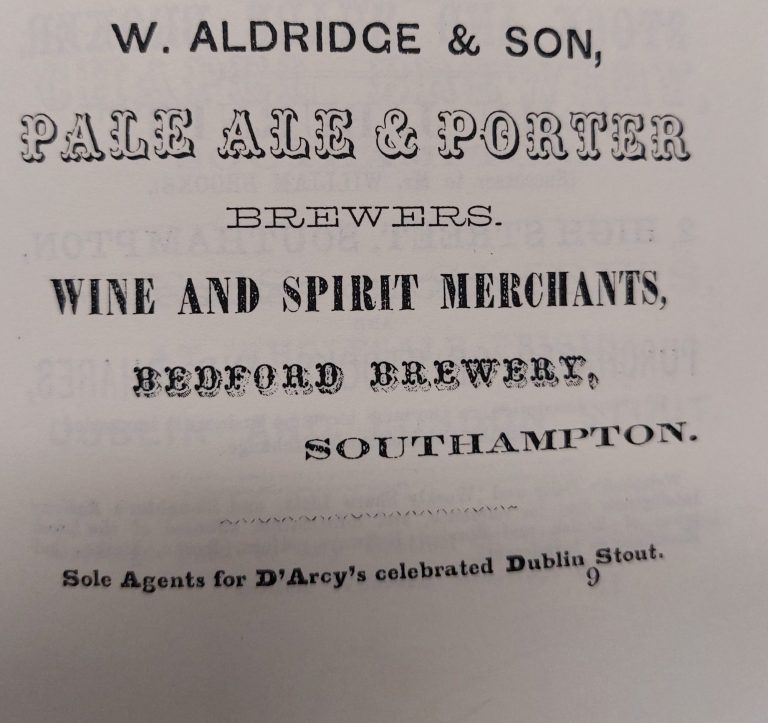
Advert from 1869 directory
As with other breweries, there were issues with water. In February 1845, During a debate about the sewage in Bedford Place, it is mentioned that Aldridge’s cellars had been “under water” for 8-9 months. Later, in the Hampshire Independent of 5th January 1850 there is a report of a public enquiry as to water supply and quality. Southampton was not well served on quality or constant supply. W Aldridge gave evidence that he could not get a supply of water to his brewery, and his home had been without water for a fortnight. He “had complained to the turncock on the common who told him there was none to give him”. Last summer he had supplied his poor neighbours in Bedford Place from his private well. He had paid £130 for sinking a well.
In 1849, the licence of the Bedford Arms was transferred from John Divers to William Aldridge.
In August 1859 the brewery advertised for “a confidential man as a cooper. One who understands the bottling trade would be preferred”. Apply Bedford Brewery. Also for sale was a 2 lift wort pump, brass barrels, and the ironwork complete of a baker’s oven. On the 12th November 1859 it was announced that William Aldridge and Bedford Brewery had added to his present business of brewer and spirit merchant, that of the wine trade.
In September 1860 John Lane, a cellarman at the brewery, was charged with stealing 6d from William Aldridge. He earned £1 1s pw, and his duties included buying yeast and there was a separate pot for these funds. Takings were down, and suspicions were aroused so the brewery drilled holes in the floorboards and Lane was seen by William Aldridge himself to take money from the till. Aldridge had marked a sixpence and he asked another man to go and buy 6d of yeast from Lane, who was seen putting the sixpence in his waistcoat pocket. When searched by police the coin was found. Lane said it was unintentional, but he was given “six months’ imprisonment with hard labour”.
Ihe 1861 census shows William as a Brewer and Spirit merchant.
In 1868 the brewery was advertising pale, and bitter ales, mild, and brown stout. By the 1869 Cox directory of Southampton the reference is to Aldridge William & Son up until entries in 1876, the year of his death. In March 1871 William and Francis Aldridge are mentioned In newspapers as brewers. In the 1871 census William is ‘Merchant’, an indication perhaps that he was taking a back seat in the brewery at that time).
In the Hampshire Advertiser of 28th June 1873 there is an advert, or a report; “Southampton Versus Dublin stout. William Aldridge and Son having made considerable improvements in their brewery” had produced a stout that was “in excellent condition and carries a beautiful creamy head possessing all the best properties of stout produced by the most eminent Dublin firms. Offered in imperial measure, and delivered free. it is particularly recommended by the medical profession being brewed entirely from malts and hops and subjected to the most minute analysis”. They also claimed it possessed “many of the properties and all of the advantages of Charcoal so largely used and so justly esteemed as a blood purifier”. (I will leave you to make up your own minds!).
In newspapers of 29th July 1874, there is a report on the “Mayor’s Sunday school treat”. The tent was said to be the largest in England and could accommodate up to 2,500 people. The tea was brewed at the brewery in 2 large coppers holding 27 barrels each. They were filled with water from the brewery well which was boiled with the tea being placed in it in large bags for seething, milk and sugar being added later to taste. “The tea was drawn off in to brandy hogsheads and delivered by the brewery, all entirely gratuitous.” (again, I will leave you to make up your own minds!)
William Aldridge died on the 8th March 1876, aged 61 years, after a short illness. His obituary states that he was a liberal for the Ward of All Saints. He was elected in 1847 but he retired and was elected Alderman in 1874, an office he held until his death. He left a widow and 4 children. His sons were Edwin, Elliott and Francis. Francis is described as a brewer and a wine and spirit merchant in MArch 1871, at the same adderss as his father. Francis and William applied for licences for a beer house so I am failry sure that Francis was the '"and Son" in the trading name. Sadly, Francis died before his father on 5th February 1874, aged just 28 years.
In August 1876 there was a presentation to Edwin Elliott Aldridge in honour of his approaching marriage. In a speech he referred to the deaths of his father and brother. He was young when he took over the business. Mr Coles, manager of the brewery presented him with a salver.
In June 1877, there was a dinner arranged by Edwin Aldridge for one hundred brewery tenants. Mr G Coles was still manager of the firm, and Edwin is described as proprietor of the business, so he clearly took over after his father’s death. Some tenants had been with the firm for a good many years, serving Edwin’s father and all the men who now worked for him had worked for his father.
In April 1878 there was another dinner arranged for local builders hosted by Mr E E Aldridge, to celebrate the enlargement and alteration to the recently established Soda Water business in Bannister Street. Later that year the brewery bought the Bold Forester in Twiggs Lane being a beer house, farm and 21 acres of land, for £900 (about £93,800 today according to the Bank of England Inflation Calculator).
The 1878 Cox directory refers to Aldridge & Son Bedford Place (sometimes at No 24). The same entry appears in 1880, 1883, 1884 and 1886. By 1887 we also see additional entries such as Aldridge E & Co mineral water Lower Bannister Street and Bedford Place. Similar entries appear, with and without mention of the mineral water business, until the 1912-13 Kelly’s Directory which lists Aldridge & Son brewers wine & Spirit merchants & Mineral Water manufacturers Bedford Brewery Bedford Place.
Edwin died in 1881, and there were changes following his death. We will see later that Edward and Charles Aldridge took over the business. In newspapers of 2nd July 1881 there is an auction notice on behalf of the trustees of the late E E Aldridge. This was for the sale of a number of pubs/beerhouses, namely the Firs Inn Bitterne, the Ship Inn Woolston, the Royal Albert Oxford Street Shirley, Bold Forester Twigg Lane Marchwood (and 20 acres of land), the Pilot Boat French Street, the Oak House Bedford Place (with off premises licence) and shop adjoining, the Dukes Head Wharf Road Winchester. All were freehold properties save for the Ship Inn, held on a 999 year lease. Some houses and a cottage were also sold.
In September 1887 there is a report of a fire at the soda water manufactory of Messrs Aldridge Brewers. The premises were in Bannister Street. Mr C Garcia was manager. There was a Ginger beer business as well, and the fire damaged hundreds of boxes and ginger beer bottles as well as the roof.
In October 1894 there is a notice that Messrs Aldridge & Son had taken on Mr E K Sykes, a Fellow of the Chemistry Society as a brewer “and in consequence of the splendid ale he produces the business of the firm has very largely increased”.
By January 1896 the brewery was advertising Kops Ale (non-alcoholic). ‘The Kop that cheers’ E Aldridge & Co Bedford Place. (The Kops brewery, founded by Henry Lowenfeld in 1890 was the first brewer of non-alcoholic beer in the United Kingdom, located in Fulham. In December 2014, the renovated building received a blue plaque from the Hammersmith & Fulham Historic Buildings Group, "Kops brewed non-alcoholic ales and stouts on an eight-acre site and exported its products throughout the British Empire".)
In 1897 there appears an advert for E Aldridge & Co’s Southampton mineral waters, and in 1902 there is mention of them having a mineral water factory as well as a brewery. This was at the time J H Sanders, manager, was emigrating to New Zealand. He was presented with “a valuable walking stick, by the brewery and a solid silver match box by the mineral water factory. “Also a gold watch”. I believe (but have no direct evidence) that Edward Aldridge ran the mineral water side of the business.
By 1905, Mr Ernest George Townsend Rose was the proprietor of the brewery, trading as W Aldridge & Son, but may have been involved a few years previously. In 1906 they were advertising bottles of Bass & Co Special Stout, and in 1908 they were advertising their Dinner Ale in 4 quart bottles at 1s 1d. In 1909 they advertised their Nourishing Stout which had been awarded a prize medal and diploma at the Brewers Exhibition 1909, which was brewed and bottled at the Bedford brewery.
In 1912 the brewery bought land in Swift Road Woolston to build a pub, but permission was refused as there were too many local pubs already (The Ship, Obelisk, and Victoria). Brickwoods applied again in 1936 and permission was granted, and the House became the Grove Tavern, 70 Swift Road.
The Hampshire Advertiser of 23rd December 1916 reported a serious fire at the Bedford Brewery. The fire brigade attended quickly and put the fire out, and damage was mainly in the bottling stores where bottles and corks were kept. The building was ‘practically demolished’ with walls coming down, and the whole brewery was inundated with water. The brewery was described as comprising one building from Bedford Place to a small courtyard at the rear, and offices at the front. There were bottling stores and the vat rooms and boiler house with extensive storage vaults underneath. The fire was confined to the upper stores in the central part of the building. The building contained a great deal of timber. “There was a constant maxim like noise caused by the falling fragments of glass from the windows; the beams of the roof fell with louder crashes while rising above was the rumbling fall of the masonry”. The next day the scene was described as being one of desolation, and the structural destruction was great.
Major rebuilding followed and the business became a limited company in 1925 with a capital of £40,000 (over £2 million now according to the Bank of England Inflation Calculator) raised to acquire the business carried on by Mr Ernest George Townsend Rose who became a director of the Company. He died in 1929 and his obituary describes him as being the owner of the brewery at one time.
The Hampshire County Council Archives hold a draft and copy abstracts of title and conveyances of the 'Bedford Brewery and 'Bedford Hotel', Bedford Place, together with freehold and leasehold public houses and other premises as described in the abstracts of title. In 1927 the brewery was leased by Aldridge & Son Ltd to Brickwood & Co Ltd (Brewers of Portsmouth) and then in the same year the premises were conveyed to Blake Properties Ltd (formerly S & T N Blake & Co Ltd of Gosport, who had been acquired by Brickwood & Co Ltd in 1926, but remained as a brewing subsidiary). The premises were then conveyed by Blake Properties Ltd to Brickwood & Co Ltd, subject to a mortgage securing debenture stock in 1942.
It looks as if this was not a tidy acquisition. Brickwoods had been granted the leasehold interest of the brewery in 1927, before the freehold was sold to Blake and Co also in 1927, and they remained leaseholders until Blake’s sold the freehold to Brickwoods in 1942. Had the lease been for 15 years?
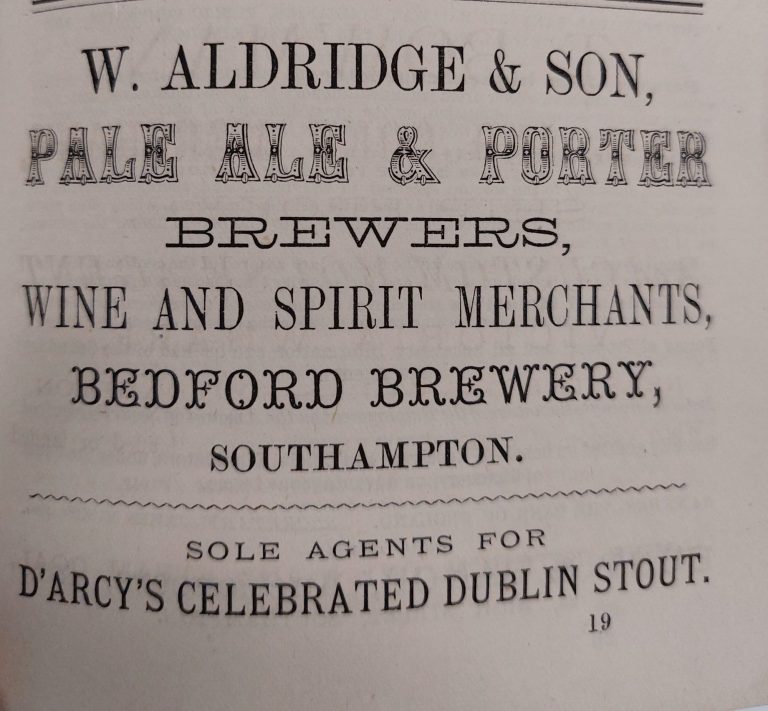
Advert 1876 directory
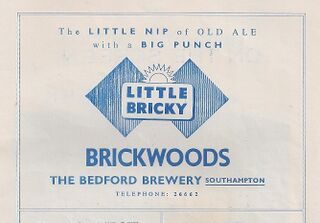
According to Philip Ely, in his Portsmouth Papers Portsmouth Brewers since 1847, Brickwoods had a policy of keeping their brewery operating at full capacity so they needed outlets to sell their beers. In 1927 Brickwoods bought Aldridge & Co Ltd with their 39 pubs. Brewing continued at the Bedford Brewery until 1930, although the last directory entry is in the 1926/27 Kelly’s. It was then used as a bottling store and distribution depot for the Southampton area until the late 1960s. (The Brewery History Society suggests 1968). The site bottled Watney’s Pale Ale, and Mann’s Brown as well as the Brickwood beers. Brickwoods closed in November 1983.
Brickwoods advert with refernce to Southampton. Courtesy BHS
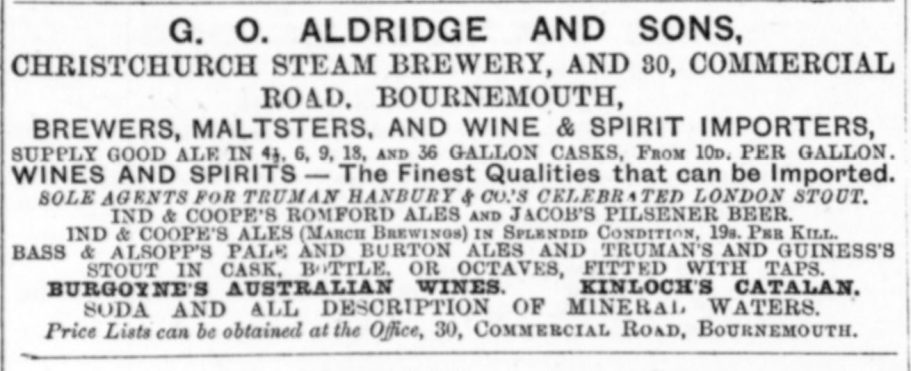
As an interesting aside, on 24th December 1884 there is a notice that the partnership between Edward Aldridge and Charles William Aldridge t/a G&O Aldridge & Sons Christchurch, Bournemouth and Sopley corn and flour merchants millers, maltsters wine and spirit merchants and brewers, was dissolved. I believe this was William’s brother, Charles, and is listed as a wine merchant in the 1891 Census. There was also an Aldridge brewery Christchurch, taken over by Frampton’s in 1906 when Aldridge ceased trading.
In 1952, the name 'E Aldridge' survived as suppliers of other firms' beers, as per the advert in the brochre produced in 1952 to celebrate the reopening of the Bitterne Brewery