BELL’S ITCHEN BREWERY
Hill Street Woolston
Also John Bell & Son, and Itchen Brewery
Brewing started 1765
Acquired by William Garton (a Director of Crowleys), 1889
Brewing ceased 1895
This brewery was built on high ground above the village of Itchen by the local Bell family, on the East bank of the River Itchen. Brewing may have taken place on the site in the 1600’s, and as we see later, the Bell connection goes back to 1683. They were certainly brewing by 1765 as shown on the brewery advert attached later. The brewery was for most of its time the only industry in an area dominated by fishing, and was trading for about 150 years, until acquired in 1889 by William Garton. He was a Director of Crowley & Co (Brewers of Alton). Eventually, the brewery was almost totally destroyed in a fire, and was then sold to Crowley & Co.
The Brewery History Society (BHS) has an excellent article on this brewery, which you can see on their website, and I reproduce an extract. “The brewery was founded early in the 17th Century by the Bell family as a small concern. It contained a curious horse mill, a 10 quarter plant, (approx.1,440 allons a brew) cellars, stores, offices, yard, stables, malt house, piggeries and two kitchen gardens. There were attached two dwelling houses containing two sitting rooms, kitchen, scullery and four bedrooms. One of the houses was occupied by John Bell the other by John Henry Bell. The Bell family had been an established part of Woolston life from the early 17th century and were originally merchants residing in the Peartree area of Southampton.”
Bitterne Local History Society has also researched this brewery, and a lot of information is contained in a paper entitled ‘Itchen Brewery’ by Beryl Varilone, which can be found ’on line’. This paper sets out the Bell family history and reveals; “As most of the early eldest Bell sons were named John, and were described as bakers or brewers, it was not easy to sort out, but the first I can pin point is John (1) and Sarah who had a son John (2) in 1761 who married and had 7 children before he died in 1812. They were named as John (3) born 1786, Richard, Henry, Ann, Mary, Marie (or Maria) and Elizabeth. From his will I learned that he was a baker and brewer. He owned several public houses and at least 7 cottages with gardens. The next in line was John (3), followed by John (4) who married Sarah Kerley in 1807 and George Henry was born in 1808. I found further about this child. In 1817 Sarah died. Three years later - in 1820 - John remarried. This time to Elizabeth Parley. There were two houses on the brewery premises, each had a kitchen, scullery, 2 sitting rooms and 4 bedrooms, so were quite roomy. John (3), now a widower, was living in one and John and Elizabeth settled down in the other where they produced John Henry in 1827. In 1848 John Henry married Laurie Henderson Sutton and they had 9 children, the relevant ones being Richard, born in 1851, Frederick, 1857 and William in 1865“.
A Southampton Sotonians facebook piece did say that John Bell had formed a partnership with his brothers Richard and Henry. In newspapers of 29th September 1820, that partnership was dissolved.
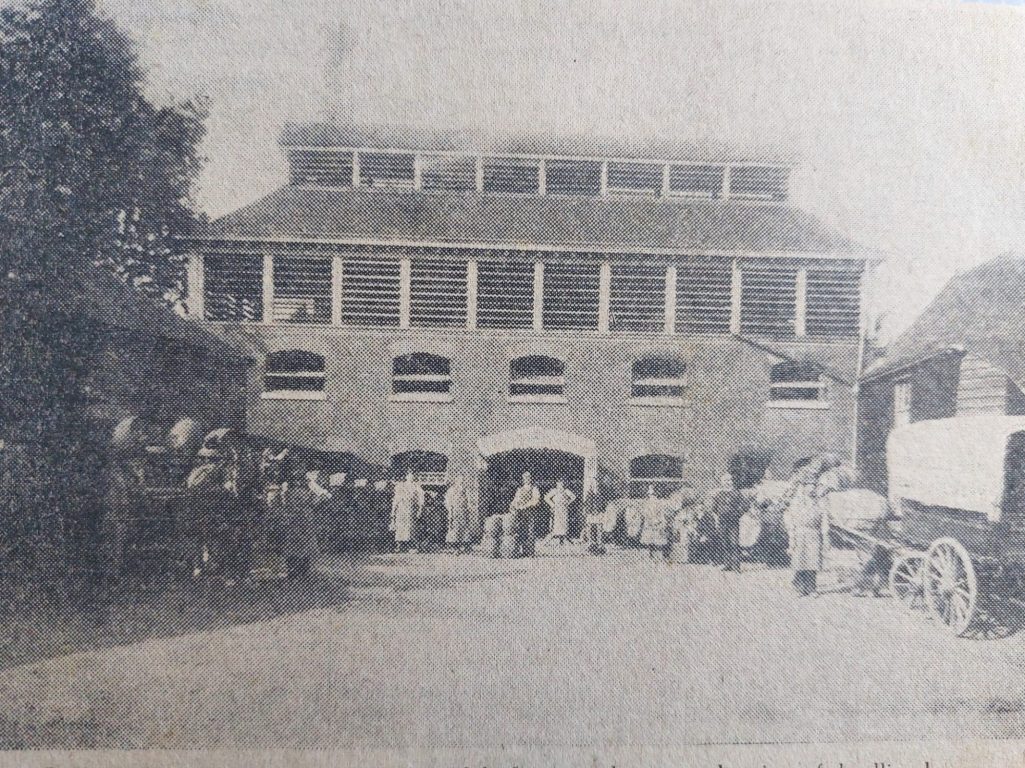
Bells Itchen brewery, photo from Hampshire advertiser November 1933
The first reference in directories that I can find is in the 1834 Fletcher Directory of Southampton, “Bell John Itchen”. He is also listed in directories up to 1848 as a brewer, and sometimes a maltster, and corn dealer at Itchen Ferry. The early directories do, I believe concentrate on ‘Southampton’, and Itchen would have been outside this area.
Newspaper references appear earlier, for example on 1st September 1823 there is reference to Bells “having neglected to conform to some regulations of excise”, and the excise department had seized their horse, dray and several casks of table beer that they were delivering.
In the Hampshire Advertiser of 28th April 1832 there appears a notice of letting; “to let on lease, with immediate possession, a well known and old established brewing, malting, baking, mealing (grinding/milling) business, which has been for nearly half a century advantageously carried on by, and is now in the occupation of the proprietor, (who wishes to retire from the business). The Premises are most conveniently arranged comprising two good Dwelling houses, brewhouse Cellars, malt-house, corn stores, bakehouse, stables, cart houses, two gardens, a large yard, and numerous other buildings.” The notice goes on to say that the whole of the above was fitted up and arranged in the best possible manner for carrying on an extensive business at Itchen Ferry, within one mile of Southampton. The whole of the fixtures and stock were to be taken at valuation. Presumably, there were no takers as the same notice appears in the same newspaper of 7th July 1832.
This raises an issue, as we know that the Bell’s brewery continued both before and after this time. I will digress for a moment but bear with me, as part of what follows is relevant (and also interesting). The Bitterne Local History paper includes the following detail; “The land on which the brewery was built appears to have been leased from Lord Kirkcumbright. I cannot find much connection between him and Itchen Village.” I believe this is in fact Lord Kirkcudbright.
In the Hampshire Advertiser of 8th December 1827 there is a report of a Court case in Scotland. This related to a dispute over a Will of the late Lord, and an extract from the case states that he made a Will leaving all to his wife. They had lived happily together for many years, however “at a late period of their cohabitation Lord Kirkcudbright had indulged himself in vicious pursuits, and formed a connection with his cook maid. That this was resented by his wife was not extraordinary; and in May 1825 Lord Kirkcudbright quitted his residence at Southampton with this servant, whose name was Charlotte Bicknell, and went to London where they cohabited together”. This extract means we do perhaps have a connection to Southampton and perhaps we can conclude that he owned land East of the Itchen? He does not appear in the 1811 Cunningham’s directory.
We could perhaps also suggest other scenarios. First, that John (3?) a widower, wanted to retire and could not find new tenants to take over, so John 4 (and his wife) took over? Second, the lease ended, or perhaps the Lord wanted to dispose of land so far from Scotland and John Bell/his family bought the freehold of their site? In 1892 there is reference to this land being freehold.
In the Hampshire Independent of 17 August 1839, a notice tells us that the brewery put in objections against the assessment of their premises to the Poor Rate in the parish of St Mary Extra. The premises consisted of “a brewery malt house yard, 2 gardens, stable and other outbuildings”. The parish officers reduced the rateable value to £87. In May 1846, tenders were requested for “Intended additions and improvements to the Itchen Brewery”. Tenders to Mr Bell.
Directories of 1849 show John Bell as a brewer maltster & corn dealer in Itchen. Directories from 1851 until 1871 show “Bell & Son brewers and corn dealers Itchen”, with small variations.
The family trades without incident, it seems, as there are very few reports or articles in newspapers. In February 1862 there was an advert for auction, of the Copyhold public house, the Red Lion Itchen Ferry occupied by John Bell brewer or his under tenants for the last 40 years at a rental of £32 pa. In January 1870 the landlord of the Angel Bitterne was John Wilson, and he was made bankrupt owing £72 10s for beer etc. to the Itchen brewery. On 29th 1869, there was a report of a fire at the Itchen Brewery, started by a spark on straw passing on to wood. It was put out quickly.
Richard Bell died on 3rd August 1867, and John Bell died on 23rd March 1870 aged 83. In May 1870, a notice appears in which John Henry Bell thanks customers for the support of Bell & Son, “and he has succeeded to the business as brewer maltster and corn dealer”. A valuation in March 1871 valued the brewery at £3,230 (£336,000 approx today).
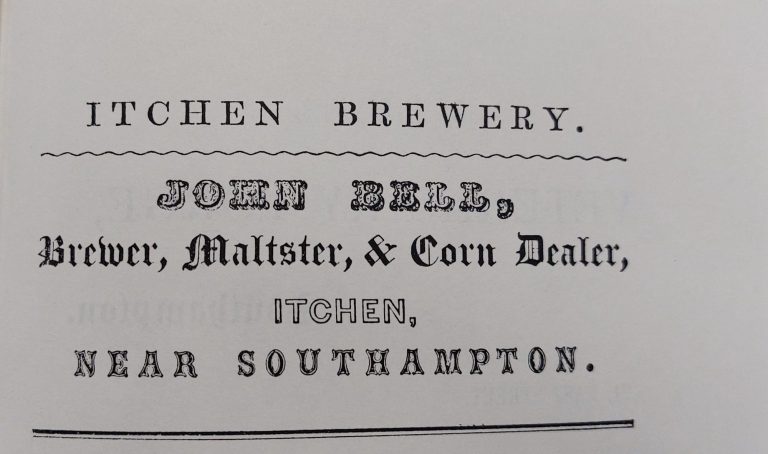
Advert from 1849 directory
Sadly, John Henry Bell died 4 years later, on 17th November 1874, aged 47 years (another report says he was aged 43!) and newspapers of 25th November 1874 report on his funeral. He died at his residence attached to the brewery, having not enjoyed good health. The procession left from the brewery, and he was interred in a newly built brick vault on the site of the graves of 2 of his children at Peartree Church, (St Mary Extra) whose coffins were moved in to it. He was Churchwarden there for 15 years. His son Richard Bell was then also a Churchwarden and a brewer.
In January 1875 the Hampshire Advertiser carries a notice that any claims against the estate should be made to the executors, being his wife Lawrie, and son Richard, described as a brewer and maltster. John left £50 to his wife Lawrie Henderson Bell together with rents. His property interests were split between sons Richard and Frederick upon their reaching 21 years of age (this information from the BHS website).
John Henry Bell had 3 sons, Richard, William Henry, and Frederick. In January 1877, there is also reference to an E Bell at Itchen Brewery (could this be Richard’s sister Ellen, see later). Richard was running the brewery and in 1875 he was granted an additional retail license. He was already the holder of a strong beer dealers’ wholesale excise licence. Also in 1875, there is evidence that he had been a partner in a grocery business. In the Hampshire Advertiser of 20th March 1875, there is a notice of dissolution of the partnership of Richard Bell and Augustus Edwin Cole, as grocers, tea dealers and wine and spirit merchants, carried on from Woolston. Augustus Cole took over from 9th March. I do not have any direct evidence that this is the same Richard Bell but circumstances suggest it was him. Perhaps he was disposing of other interests to concentrate on the brewery. In 1876, he is being escribed as being a brewer at the Itchen brewery when complaining about the cement works at Britannia Wharf Northam causing a nuisance. He complained that when the wind was northerly he and his family suffered from fumes, causing nausea and dry throats such that he had to keep windows shut in the Summer.
In the 1880 Hampshire Directory, Richard Bell is shown as a brewer, and the 1881 census also shows him as a brewer, with his 24 year old brother, Frederick, listed as a corn chandler, and his 25 year old sister Ellen. In September 1882 the brewery was advertising for a young man to look after cows, and who must understand milking and who would make himself generally useful in the brewery.
The name John Bell & Son appears in directories from 1883 until 1897, sometimes with ‘Ale and Porter Brewers’ added, so it is clear that for continuity, the trading name stayed as before. In a report of September 1885, Richard and Frederick Bell are brothers, and were said to be part owners of the Angel Inn Bitterne, which had been left under their father’s Will, their Mother having a life interest, (i.e. to provide her an income, with no sale until her death), but they could sell or mortgage it.
1887 to 1890 bought great change to the Southampton brewing scene, and Bell & Son were part of that change when in 1889 they were acquired by Crowley’s Brewery of Alton via William Garton for £2,140 (just over £242,000 today according to the Bank of England Inflation Calculator). In newspapers of February 1890 there appears notice of takeover of the High Street Brewery of Vincent & Elliott with its pubs by W Garton & Co. It was said that Gorton’s were fast becoming the largest brewery owners ‘in these parts’ having recently added the breweries of Messrs W Cooper & Co, Messrs Bell & Sons and now Vincent & Elliott’s.
I have a separate page on the Gartons so will not elaborate here, save to say that William Garton bought the Bell Brewery in 1889 with help from the family, and it was run by William Garton Jnr. According to the BHS article, William Garton went in to partnership with Harry Percy Burrell the then owner of Crowley’s Brewery. Together they floated Crowley’s as a limited company. William was a Director of Messrs Crowley & Co. brewers of Alton, but the name of John Bell & Son was retained, presumably for continuity of goodwill. William Garton did not live on the brewery site, and he is listed in directories as being at "Roselands", a large house in Portsmouth Road, Woolston. Locals will know that there is a Garton Road in Woolston, passing Woolston railway station to Bridge Road, where it finishes in a ‘dead end’.
Some sources suggest brewing was transferred from Coopers brewery, to Bells, and that Coopers was closed, which is not entirely correct. Coopers brewery had been acquired by William Garton in 1887, following the death of Alderman William Cooper. In 1890, Garton had also taken the High Street brewery of Vincent & Elliott which was closed. The Coopers East Street brewery was closed in 1889 and brewing was temporarily transferred to Bells. A new brewery was built at the combined East Street/High Street site, which was completed in 1898, and Coopers continued brewing, under the Coopers name until at least 1950.
In the licensing sessions in August 189, William Garton the younger of Roseland Portsmouth Road Woolston, applied for a licence to sell spirits by retail to be consumed off the (brewery) premises. They already had a wholesale licence, and this application was granted.
In newspaper of 21st November 1891 there is a report of Daniel Allen ‘an elderly man’ being charged with theft of a bass broom from the brewery valued at 1s 9d belonging to William Garton Jun t/a Messrs Bell & Co. The storekeeper said he had issued the new broom to Allen. PC saw him “walking away from the brewery with a rifle in one hand and something under his coat” (the broom). There was no proof of ‘felonious intent’ and Richard Bell, the former owner, gave evidence as to his high character. He was given the benefit of the doubt and discharged. (a Bass Broom had a brush made from robust plant fibres such as Date Palm or grasses). There appears to have been no issue with the rifle!
In February 1891, Mr Haisting was manager here. I also believe (but cannot prove!) that Richard Bell was the last brewer here, and remained a brewer during the Garton reign. It can be seen from the above report that Bell & Co continued to be a trading name after Garton became the owner.
Major Richard Bell died on 14th September 1929. His obituary stated that he came from a family with a 300 year old link to Itchen. At age 15 he started a career at Bells Itchen brewery, and was part of a succession of Bells who established the brewery in the late 17th Century. The brewery was rebuilt in 1765. In the attic a heavy brass skillet was found with the name of John bell and date 1683 cast upon it”. His father was John Henry Bell, and mother Lawrie Henderson Bell. His mother was 89 when she died in 1914, 40 years after her husband. He was one of the founders of the Royal Southampton Yacht Club. (Skillet was a large/heavy saucepan or cooking pot with legs).
In February 1895 the reference is to the Woolston Brewery, whose Manager was C H Cudlipp, and the owner Captain William Garton. Three months later we come to perhaps the most documented event in brewing history in Southampton; the catastrophic fire on 25th May 1895, which started at about 1.30pm in a room above the copper, after brewing had finished. The Hampshire Independent of 23rd May 1895 gives a first-hand account, and I make no apology for setting this out in full.
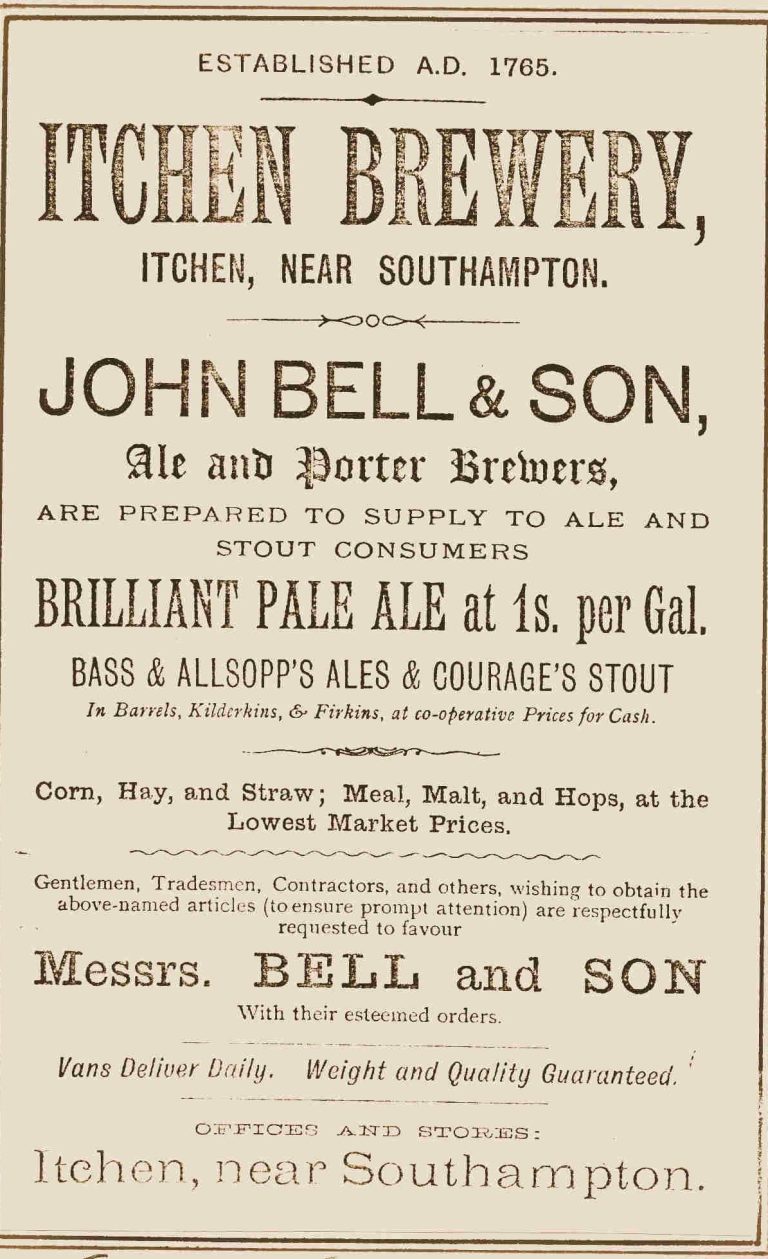
Advert, with thanks to the Brewery History Society. Note the date they were established.
“GREAT FIRE AT ITCHEN, BIG BLAZE AT A BREWERY ENORMOUS DAMAGE. Great excitement was caused at Woolston and Itchen about half-past one to-day by a conflagration at Itchen Brewery, lately owned by Messrs. Bell and Co., and now in the occupation of Messrs Garton and Co. The brewery occupies a prominent position on the side of a hill at Itchen and consequently directly the fire broke out the smoke issuing from the building could be seen for some distance around, and in a very few minutes a tremendous crowd was brought together, and they remained throughout the afternoon watching darting tongues of fire rapidly demolish the fine brewery.”
“From inquiries our representative made at the scene of the conflagration it appears that smoke was seen issuing from under the roof of the building just about half past one, sometime after the men had left to get their dinner. One of the employees who was in the grounds seems to have been the first to notice anything amiss and as the alarm was immediately raised. A young fellow who is engaged on the premises immediately ran up to the furnace room—the men having drawn the fire after brewing – and no sooner did he open the door than the air fanned the embers into a roaring blaze, and it was at once apparent that the whole building would soon be alight. The young fellow and another employee got out the small one inch hose which is kept on the premises, and with some water from a tap endeavoured to subdue the flames. Their efforts were, however, of no avail and so fierce did the fire become that the plucky young fellows had to relinquish their attempt. During this time Mr. A Johnston, who, with his wife, resides in the adjoining house, had telephoned for the Southampton Fire brigade and Supt. Johnson and his men quickly turned out, they arriving on the scene about 2 o clock”.
“The fire had now a complete hold on the building and it was seen that nothing could save the portion of the brewery from destruction The copper room was close to where the fire originated, and was completely gutted, as also were the grist room, the hop stores and the mashtun rooms. These rooms contained a great quantity of nearly new and very valuable machinery, and the whole of this has been lost in the general destruction, the damage to the property being estimated at several thousand pounds. A curious thing about the fire was the remarkable curvature made by the flames. When they had completely demolished the upper floor, part of the roof fell in with a tremendous crash, and then the darting tongues of fire went right down the walls of the building and attacked the cellar, which was very considerably burned. Luckily there were plenty of willing helpers at hand, and the full stock was soon removed from the cellar, whilst the whole of the furniture in Mr. Johnston's house was also placed in the street, fears being at one time entertained that the building would also be demolished.”
“When the firemen got on the spot they were confronted with the difficulty of discovering water. There is supposed to be a plug just outside the brewery gates, but this was found to be no use notwithstanding that one energetic individual dug the road up for some distance in his endeavour to find water. Several other plugs were also tried and a great deal of precious time wasted while flames were gaining greater hold of the doomed building; at least the stand pipe was fixed to a hydrant some 500 yards away from the building and close to the congregational Church at Pear Tree Green, and once the water was obtained firemen were soon able to get the fire under control. Whilst waiting for water the men had by no means been idle, however, for from the first they concentrated their efforts upon saving the tun room in which there were five tremendous vats, each holding from 45 to 50 barrels of beer and two large tanks which contained 300 to 400 barrels apiece. Luckily the flames were prevented from spreading to these, and had it been otherwise and these great structures had given way, nothing could have saved the total destruction of the whole building. The fire was still burning when our reporter left Woolston, but no further danger existed. Mr Garton, who had been away from the town, came on the scene towards three o’clock in the afternoon, and he seemed to be satisfied with the efforts put forth to save his property.”
Quoting again from the Bitterne Local History paper I mentioned earlier, we have further detail; “The report in the Southampton Times said that "... a message had been sent over the telephone to the Southampton Fire Brigade. Superintendent Johnson and his men turned out very shortly and within twenty five minutes of this they were on the spot, notwithstanding they had to cross the river by means of the Floating Bridge. By this time the fire had gained a firm hold and it was feared the whole of the premises would be destroyed. Despite many problems with the water supply, the firemen managed to subdue the fire in two hours, but several men were left on the premises for some hours, just to make sure that it did not break out again. Unfortunately, the fire happened at an extremely busy time, when the brewery had just been extended and business had increased anyway. (to satisfy the demand for the brewing of Cooper’s beers?). However, they quickly informed everyone that, because of their vast resources, all the orders would be met.”
There were reports later that the water supply was unsatisfactory and changes were needed.
The destruction was terminal for the brewery, which was never operational again. In February 1896 there is a report of an auction sale of freehold property of the Itchen corn stores at the rear of Itchen brewery, consisting office, stabling, coach house, and yard. In June that year there is notice of an auction for the sale of building land “Including the site of Bells Itchen brewery with the dwellinghouses erected thereon together with the whole of the building material of the brewery structure, stabling and shedding in suitable lots”. The auction was later postponed until the end of July. I do not think it sold at that time, or if it did, the site remained ‘vacant’.
In the Hampshire Advertiser of 3rd November 1897 there is a report on the Greek “invaders” who had visited Woolston the previous week. (In the Southern Echo of the same date this party is described as “refugees”!). A party of ‘Greeks’ was ordered off the Common. Police had been given prior notice of the ‘invasion’, and the whole party was moved under police escort back to Woolston which caused a “considerable commotion” as word had got round they would be located for the night “in the old brewery premises at Itchen Ferry”. They eventually left and moved to a vacant piece of ground near Oak Road.
The last directory entry is in the 1920 Kelly’s. By the 1900’s the site became a firelighter factory, and is now a residential block of flats in what is Hill Road Itchen.
Some miscellaneous detail. A bottle found on the site was marked ‘Itchen Table Waters’, (the Gartons’ had a mineral water works) and also, unsurprisingly, ‘Coopers’.