HATTATT’S BREWERY
Cross Street Aka Lime Street Southampton, and Marsh Lane, and East Street
Aka Anchor Brewery, and Marsh Mrewery and Saint Mary's Brewery
Brewing Started C 1836
Took over The Fawn Tavern (brewery) and possibly the Oriental Inn (aka Anchor)
Taken over by Stiles Cooksey & Co probably 1869
Brewing ceased 1886/7
John Foote Hattatt, was a brewer, born in 1813. He married Harriett and had 3 daughters, all of whom became brewers. He also had a son Arthur Coote Hattatt 1851-1919 (sometimes referred to as ‘Cave’ rather than Coote), who ran the later mineral water business.
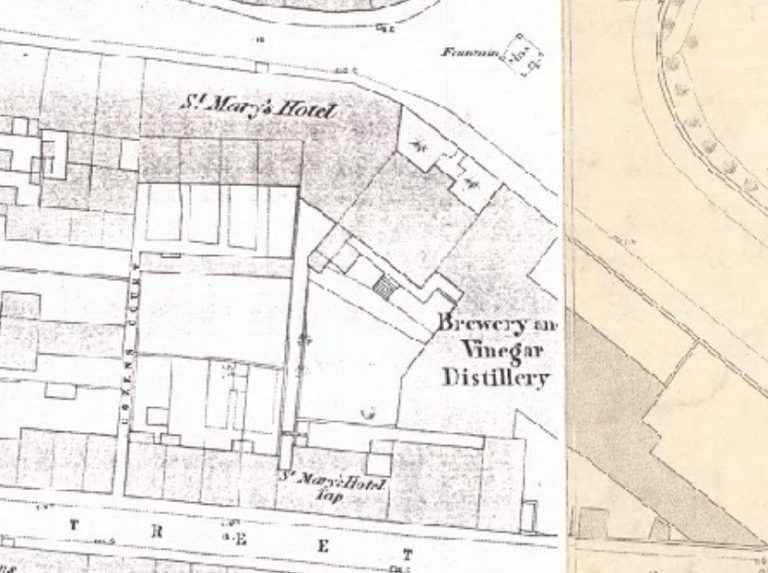
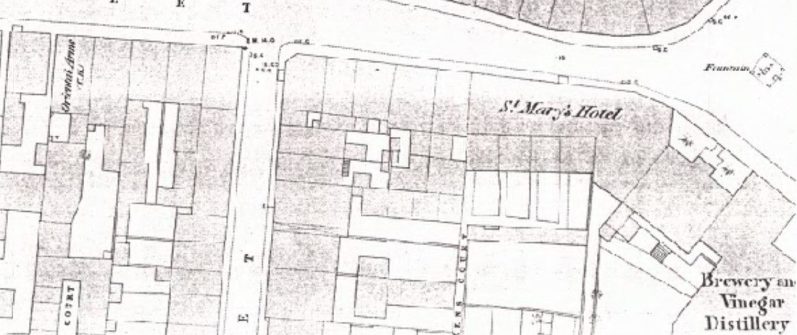
This business was variously known as Saint Mary’s brewery, Hattatt’s brewery, Marsh Lane brewery and Anchor Brewery. The address is given variously as being in Marsh Lane, East Street, Cross Street (was Lime Street) and the Rookery (a name generally given to deprived overpopulated areas of a town). All these ‘roads’ are very close to each other, as can be seen on the 1846, and 1870 plans shown.
The Gazeteer of Hampshire breweries by Southampton University Industrial Archaeology Group, which sets out the position as at late 1970s, states that in Lime Street there is a two-storey brick building at the rear of a fried fish shop between Lime Street and East Street, which bears indications of having been a brewhouse. They conclude that if this identification is correct, then this would be the remains of the 'Anchor' brewery, the proprietor of which from 1869-86 was J. F. Hattatt.
To say the research on this brewery has been confusing is an understatement and I hope I have put the pieces of the puzzle in place correctly.
I believe from piecing information together that JF Hattatt brewed at Marsh Lane as the St Mary’s Brewery until around 1855/6, when the trail goes cold. In 1872 Stiles Cooksey took over the site, and Hattatt continued at the Anchor Brewery in East Street, perhaps a ‘downsizing’, following his bankruptcy that year. The smaller business was carried on by his son A C Hattatt, until around 1885 when it was taken by Edward Showler who had married J F Hattatt’s daughter.
The earliest mention I find is in the 1836 Fletcher directory which shows “Hattatt John brewer Lower East Street”, an entry repeated in the 1839 Fletcher directory. However, the 1839 Robsons Southampton directory lists “Hattatt Henry & Co brewer Lower East Street”. The St Mary’s Hotel, brewed and was also in East Street and I did originally think that Hattatt may have brewed here at one time, but in the Hampshire Independent of 25th March 1843 there is an announcement that Henry Stevens had taken over the St Mary’s Hotel “Near Hattatt’s brewery East Street”.
Two newspapers in 1837 ran an advert for properties, and for details; “apply Mr Messum Marsh Lane Brewery St Marys”, and in 1838, application was to be made to J F Hattatt office or Mr Messum at Marsh Lane brewery. We see a clash of addresses as between directories (Lower East Street) and newspapers (Marsh Lane). Mr Messum was involved until about 1845, when he is described in the licensing proceedings as a “writing clerk and traveller for the sale of beer and porter” among other things.
The brewery supplied beer and spirits to the Yeoman Inn, East Street (later the St Mary’s Hotel, see the Crouch brewery page for more detail) and Charles Quick of the ‘Quick’ brewing family (see the Wheatsheaf brewery page) was landlord from February 1838, to March 1839. By December 1841 he was in the Insolvent Debtor’s Court, as he owed £430, which included costs to Mr Hattatt, brewer and spirit merchant. Quick had received stock from Mr Messum, described as clerk to Mr Hattatt, and when Quick left, he owed £350 to Hattatt.Rent for the pub is also mentioned, but it is not clear if Hattatt was the owner, as well as the supplier of ale and spirits.
By May 1842, Mr William Cheeseman was manager and a brewer at Hattatt’s brewery, which was said to be “second in quality in the town” (who was first?). He was described as a journeyman brewer. In September that year a question of water quality from the brewery had been raised. Mr Cheeseman said it was wholesome and he had drunk it. Also a sample had been taken and sent to London for tests that were awaited. His was hard water, not soft and he had 50 barrels every night in case of fire. He also offered water from the brewery wells if no one could get water.
In the 1843 PO Street Directory John Foote Hattatt is a brewer at Lower East Street, and by the 1845 PO Street Directory the entry has him as “Brewer and merchant St Mary’s brewery Lower East Street”. Note the reference now to St Mary’s brewery. Did Hattatt take over Crouch brewery, and the St Mary’s Hotel? Sadly, I do not know!
There were changes between 1845 and 1847. In September 1846 there appears a newspaper advert for the letting of “an established retail beer and porter trade” with immediate possession, apply Hattatt and Robinson St Mary’s brewery Southampton. From directories in 1847, we see entries “Hattatt & Robinson brewers and merchants St Marys brewery Lower East Street”, and this remains the case until 1855, with later additions showing they were also spirit merchants. There is no reference to the vinegar trade at this time although there is in auction notices in early 1855, as we see later.
The brewery did have a few ‘incidents’ and in August 1836, newspapers report that a wagon was on its way to Chapel from Hattatt’s Marsh Lane brewery with empty casks. One slipped and they all fell. A young man who was standing on the casks holding the rope “was precipitated to the ground” where he fractured his skull and gave little hope of recovery.
In newspaper reports on 11th February 1837, John Ingram (who had previously worked at the brewery) was charged with stealing money from Messrs Hattatt. George Pain, who was also employed by the brewery, put money in a box with bricks on top as the lock was broken. The next day the bricks had been moved and the money was missing!
A second serious accident is reported in the Hampshire Advertiser of 26th April 1851, which is another sad example of the very relaxed health and safely in breweries. A Coroner’s inquest in to the death of George Hoskins, a labourer employed by Messrs Hattatt & Co, reported that on 13th March he accidently slipped one leg in to a pan of wort which was at 160 degrees. Peckham, a stoker, heard the screams and found him on the side of the pan with one leg over. Hoskins went home, but collapsed. He died on 21st March. It was reported that “It is supposed he was walking along a plank on which he had no business and missed his footing”. Verdict, Accidental death. Just as distressing is a report in November 1871 of the inquest in to the death of Jane Hoskins who burned to death at her home. “It was stated that her husband was scalded to death 22 years ago by falling in to a vat at Hattatt’s brewery”.
1855 brought further changes to the brewery, and on 20th January 1855, newspapers carry an auction notice re the “Marsh Lane Brewery Southampton”. This was an auction by the trustees of Messrs Hattatt and Robinson, for the sale on 13th February 1855 of the brewery plant stock & effects together with the “working utensils of the vinegar works attached”. Also for sale were about 1000 nearly new seasoned casks of various sizes, with a stock of store ale, horses, carts and wagons. Some further details appeared the following week with reference to a 56-barrel brewing copper complete, working squares and rounds fitted with attemperatures, store vats varying from ten barrels to 112 barrels each, coolers, of various sizes, a refrigerator, etc. etc.
In February 1855, there was a postponement of sale from the 13th to 27th February. The equipment details also then included liquor and wort pumps, nearly new, an eight Quarter mash-tub, (a brew size of about 1,150 gallons at a time,) together with the mashing machine and sparger complete, a sixteen feet diameter horse-wheel with the working gear connected, a ninety-five-barrel liquor back, sixty barrel underback, a twenty-four-barrel steam back, with the *whole of the pipe connected to the same” About 1,000 nearly new seasoned casks of various sizes were listed, together with the stock of Store Ale, vinegar, etc. as well as horses, carts, waggons, and various other effects.
This was clearly a large capacity brewery, but it did not sell, and in December 1855 there is another auction notice for the sale of the plant fixtures and effects of the Marsh Lane brewery. A copper, working squares and rounds with copper “attemperatures” a 95-barrel liquor back, underback, store vats and the entire pale ale fittings were included together with the steam back and several hundred feet of copper and lead piping, and “big cocks” and various other effects. By 1856, there is an advert for sale by auction of 2,500 galls of proof vinegar, and 2,500 galls of unmanufactured vinegar at the Marsh Lane Brewery.
This was a sale of plant, not premises, suggesting Hattatt held a lease on the Marsh Lane site. In the1857 Kelly’s directory, the entry is “Hattatt John F, German Still Vinegar & Pale Ale Stores Marsh Lane.” There is no mention of him as brewer, so perhaps he sold the brewery plant etc and swapped trade for the vinegar business, and storage. The same entry appears in 1859, and 1865.
There is then a long period of uncertainty (to add to my previous uncertainty). John Foote Hattatt is referred to as a ‘brewer’ in newspaper reports of his appointment to a Grand Jury of the Southampton Borough Quarter Sessions in 1858, and 1863, but adverts predominately refer to his vinegar works. Up until 1860, the adverts are for pure German still vinegar supplied to the trade only, from J F Hattatt’s office Marsh Lane. In 1858 there is an advert for the sale of vats and old ale, “at breweries in this district. Breweries for present disposal. Partnerships desired” enquire J F Hattatt’s distillery Southampton. Directories of 1867 and 1869 and 1871 do show J F Hattatt as a malt vinegar distiller and brewer. In 1871 we also see A C Hattatt, John’s son, as a mineral water manufacturer.
Did the ‘brewery’ change direction and become a brewery agency for sales and lettings? Did they become a ‘contract’ brewery for other brewers (ie brewing another brewery’s beers for them on Hattatt’s premises, aka cuckoo brewing)? As we shall see, by the late 1860s/early 1870s there was a brewery business again, with reference to the Marsh Lane brewery.
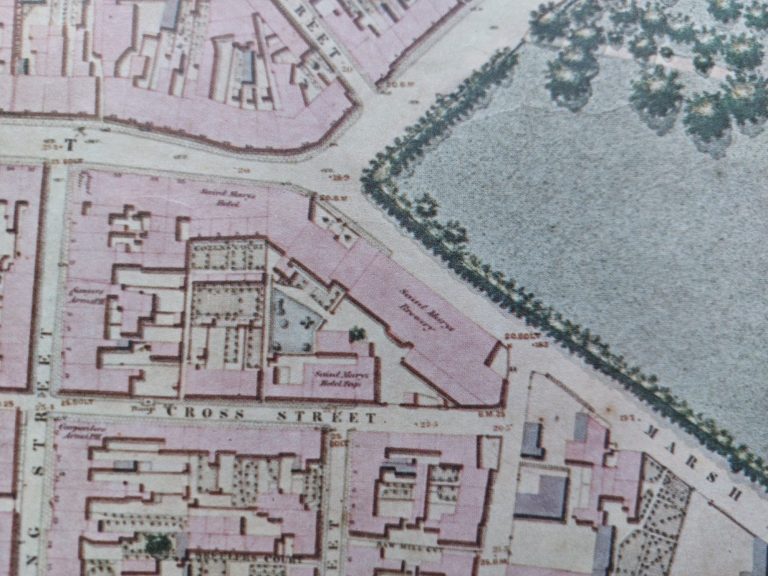
Below. The 1846 town map showing the Saint Mary's brewery in Marsh Lane, and the nearby St Mary's Hotel, and Tap (in Cross Street)
Below, he 1870 Town map. The Oriental Inn (Anchor) is shown extreme top left
Below, the 1870 town map. Now showing Brewery and Vinegar works, not the Saint Mary's Brewery
We can pick up the story again with an entry in the 1867 Gutch directory with “Hattatt J F maltster vinegar distributor and brewer Marsh Lane, East Street (an advert says 64 East Street), and again in 1869. In the 1871 Cox directory there are two entries, “Hattatt J F Marsh Lane Deanery Cottage East Street, malt vinegar distiller and brewer” and “Hattatt AC mineral water manufacturer Deanery Cottage.
Newspapers of 11th May 1867, advertise a hotel and spirit store to let, contact via J F Hattatt brewery department. There is also a notice “the Pale Ale brewery department is full this season”. In July 1867, there appears a similar advert ”To publicans and others, to let a newly fitted up retail spirit store with a respectable family trade attached. Also a small hotel, apply to Mr E Thompson, Mr Hattatt’s office Marsh Lane Southampton”. As I have said earlier, I have a feeling (but no evidence!), that this could well have been the Oriental Inn/Anchor in East Street, which was perhaps taken over, renovated and re let.
There had also been improvements to their Marsh Lane brewery, and they continued their brewery agency business. In April 1867, and later, there is an advert for J F Hattatt Southampton malt vinegar distiller and pale ale brewer, saying that additional steam power enabled him to complete orders without delay. Also, “The pale ale brewery department is full for this season orders commencing Oct to April.” The same narrative appears in June 1869, with reference to additional steam power and plant before stating that “Breweries now registered for disposal and partnerships in breweries requiring capital £500 and upwards. Open to supply a trade with ale and stout from 1600 to 2000 barrels pa. Old Ale wanted, Hattatt & Co’s brewery agency department Southampton”.
The notices that ‘the Pale Ale brewery department is full this season’ may support the suggestion that they were contract brewing for others. Capacity had been reached, and they could take no further orders.
The request for ‘old ale’ was to enable vinegar production. According to Google, the origin of Malt Vinegar dates back many centuries, and probably came about by accident in the ale brewing industry. Brewers inadvertently left their ale exposed to the air for too long, causing the beer to turn sour. This was a result of airborne bacteria converting the alcohol into acetic acid, leading to a new malt vinegar trade.
John Hattatt, however had financial issues. In the Hampshire Advertiser of 9th October 1872, there is notice of a first meeting of creditors re the bankruptcy of John Foote Hattatt brewer. Later in October there is an auction notice for the sale of the Marsh Lane brewery Southampton, being a sale by mortgagees. This sale included a 16-barrel copper with furnace and powerful 6 horse power steam engine etc. and 2 cottages. A malt crusher, coolers, a superior refrigerator equal to cooling 15 barrels an hour were also included, as well as upper and underbacks, liquor tanks six working squares, barrels, mash tun, 25-barrel vat with all pipes. Buildings included a hop room, malt room engine and boiler house, pump house, large covered shed, tun room and racking cellar and stables for 3 horses as well as 2 leasehold cottages on leases of 99 years at £18pa. Note the sale of premises as well as plant.
I believe that before or after that sale, the brewery was occupied, by Stiles Cooksey & Son I have no evidence for this other than circumstantial. Newspapers of December 1874 report on a fire at “the brewery premises of Messrs Cooksey & Co at the corner of Threefield Lane”. Marsh Lane had a junction with Threefield Lane at or near the Marsh Lane Brewery site. Further, the 1874 Tucker directory shows Cooksey Stiles & Co, Mitre Brewery at 4 Marsh Lane. In July 1873, Stiles Cooksey was announcing that they had, at very great labour and expense, re-fitted the Mitre Steam brewery with the most modern appliances, again suggesting a takeover and revamp.
Four years later in June 1876 a licence was granted to John Foote Hattatt of “Anchor Brewery Cross Street” to sell beer by retail. In September 1877 JF Hattatt applied for a licence to sell beer off the premises. There are similar entries in 1878 and 1889.
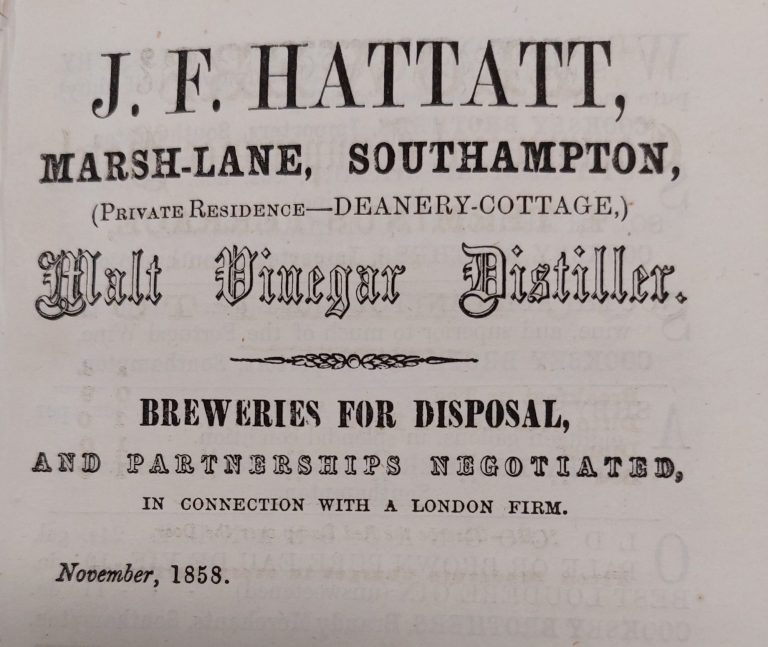
By 1876, the reference is to the Anchor Brewery East Street. My suggestion is that during this 10 year or so, Hattatt’s brewery acquired the Anchor brewery in East Street, (Oriental Arms) and the Fawn Tavern brewery in Broad Street, and possibly the St Mary’s Hotel as part of their diversification, perhaps running them as public houses /beerhouses and brewing beer at Marsh Lane for themselves or other breweries. The Anchor (Oriental Inn) came up for letting in December 1856, and was described as a two Quarter brewery (a brew of about 288 gallons at a time) with a moderate rent and with all brewing utensils with the advantage of supplying a public house/tap. It was also up for auction in 1863. The Fawn Tavern was available in 1859. (See the Fawn Tavern, and Anchor Inn pages). I have no evidence for any of this and the ‘missing years’ is very much a work in progress.
We can perhaps conclude that bankruptcy was avoided, or arrangements made, as John continued to trade, but on a smaller scale. It looks as if the Marsh Lane brewery was sold in or around 1872 and he was then based at the Anchor. It is possible of course that the vinegar side remained as a separate entity on part of the Marsh Lane site. From around 1872, the address of Hattatt’s brewery changes to Cross Street/the Rookery,
Mr Stiles Cooksey owned a brewery in 1869 (see the Stiles Cooksey page). Did Cooksey take a lease of the brewery earlier before acquiring part of the site following the sale in October 1872.
John Foote Hattatt died on 24th November 1882 aged 71. In a brief obituary he was described as carrying on in business in St Mary’s for a considerable period as a vinegar distiller, brewer and mineral water manufacturer. A few days later there was a correction to say that at the date of his death his only occupation was brewer. I suggest that I was not the only one to be confused by this business!
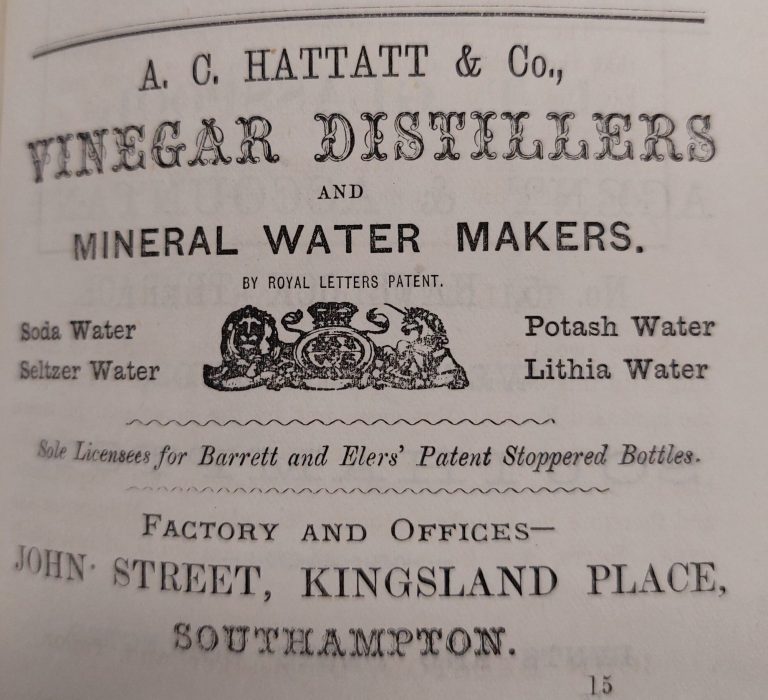
It would seem that his son Arthur Coote Hattatt carried on the business. In the 1883 Foster & Roud directory we see A C Hattatt at John Street Kingsland Place, and the Isle of Wight. By 1884 the entry is “Hattatt J T (late A C Hattatt) Anchor Brewery Cross Street Rookery”. This is in addition to A C Hattatt & Co Mineral water manufacturer at John Street.
In July 1883, there was a fire at Hattatt’s brewery in the Rookery caused by an overheating furnace. Police put it out with two buckets of water. In August 1883, the off licence of the Anchor brewery Cross Street was transferred from John Foote Hattatt (dec’d) to Arthur C Hattatt. In this year, he also occupied the Fawn Tavern in Kingsland (see the Fawn Tavern page). It would seem that the mineral water business was operated from premises next to the Fawn Tavern (brewery) which later became a bottling plant.
John Hattatt’s second daughter Emma had married William Edward Showler on 6th October 1881, and in March 1885, he took over the brewery business. Fairly soon after however, he was in financial difficulty and a Receiving Order was made on 8th December 1886. There was also an auction notice for the sale of the brewery plant and machinery at Hattatt’s brewery Cross Street.
On 25th December 1886 there is a report on the bankruptcy of William Edward Showler of the Anchor Brewery Cross Street. He was a mineral water manufacturer. He was declared bankrupt and had a large ‘deficiency’ as a result of bad debts and loss by the forced sale of his stock in trade as mineral water and vinegar manufacturer, and loss by depression of trade and liabilities through taking over the Anchor brewery business. He owed money to hop merchants, corn merchants maltsters and sugar merchants. Also to ‘A C Hattatt Carisbroke balance of purchase money of stock and book debts’, and ‘Mrs Tigg of Lower Woodford Salisbury, £30 balance of debt due from brewery business’. In examination he said he had carried on business at John Street since June 1884 and at the Anchor brewery since March 1885. He claimed an interest in the lease of the Anchor brewery granted in 1873 for 21 years at a rent of £80pa. The bar of the brewery was let to Mr Giddings at £37pa.
There is then an auction notice re the Anchor Brewery Cross Street in January 1887, for the sale of brewery equipment. There is also further detail of William Edward Showler who, it was said, took over the business from Arthur (Cave) Hattatt (the executor of his late father’s estate) in March 1885. The lease was never assigned to him however. He had previously managed the brewery and thought he could make a go of it. He received £100 to pay creditors, on undertaking to pay debts of about £300. However, there was rent of £300 due to the Misses Hattatt, his (Showler’s) sisters in law. He tried to sell the business but had no offers. “The Bankrupt was allowed to pass”.
In September 1887 at the Brewer’s Sessions, an application was made to renew the brewers licence for the Anchor Brewery Cross Street. That had lapsed as someone had forgotten to apply. The place had been empty for some time but was in the process of changing hands. The Licence was held by Arthur Cave Hattatt, but was not renewed as the premises had been closed.
Later in September 29.9.1887 there is a notice of sale by auction re W E Showler in bankruptcy, of the Anchor Brewery Cross Street and being the whole of the brewery plant, machinery, beer, hops etc.
There is some further detail of ownership in the discharge proceedings of the bankruptcy in 1904. William Showler purchased from Mr. Arthur Hattatt the business of mineral water manufacturer and vinegar distiller John Street Kingsland for £595. The Anchor brewery was taken over in March 1885. Mr. Arthur Hattatt, as administrator of his father’s estate, paid Showler £100 in consideration of his agreeing take over the liabilities the business, which amounted £100. The Judge commented that it seemed that Showler had taken over the businesses to save the wreck of the affairs of his late father-in-law. The discharge would be granted.
William Edward Showler does not appear in directories, other than in 1887 at 25 Richmond Road Freemantle but no occupation is given.
The Anchor in East Street was later acquired by Scrase’s brewery. The name ’St Mary’s Brewery does cause confusion, having been used for the Joiners Arms, St Mary’s Hotel, and St Mary’s brewery Love Lane/St Mary’s Road.
Random facts.
J F Hattatt was the sole seller of Celebrated ‘Gebrant Stout Extract’ (Gebrant; roasted or burned).
Lot 9 of an auction sale by the executors of the late Richard Eldridge refers to two freehold properties in Chapel Road for some time converted in to one known as the Portsmouth Arms with large stabling in the rear. Presently held by Mr Hattatt and used as a retail beer House I cannot find a Portsmouth Arms in Chapel road, or anywhere!
Perhaps the brewery changed direction, or split their business between acquisitions, vinegar manufacture, and brewing on a smaller site