No need to worry, I am not going to fully explain the brewing process. However, I do want to address a number of names and phrases that frequently arise on this site, especially in old adverts, and auction details of breweries and equipment. I hope the list below may help in clarifying some of these terms.
BREWING TERMS
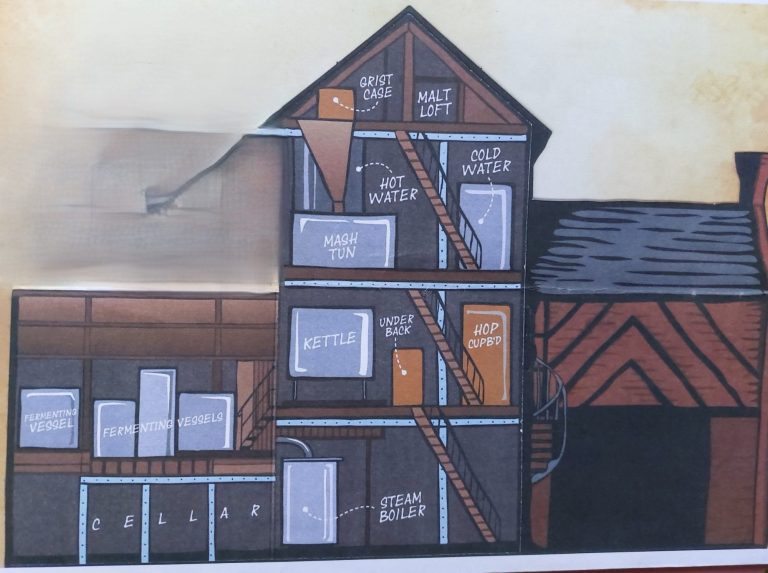
Most, if not all breweries until very recently were ‘tower’ breweries, with the brewing process starting at the top and working its way down, to maximise the use of gravity. Breweries were often clearly identified by their large towers which dominated the skyline, together with large chimneys. The boiling process was only possible by burning coal to provide heat to boil the water. Later, Victorian tower breweries were typically powered by a steam engine, hence STEAM BREWERY. a single engine housed on the ground floor would be used to lift the two main ingredients, water and barley malt up the tower. It is easy to see why a number of brewers were also coal merchants.
- Malted barley is moved from its storage a GRIST CASE and crushed (then known as Grist) in a MALT MILL
- The Grist is mixed , or mashed, with water in a MASH TUN/MASH TUB/ BREWERS TUN. When the imperial system was introduced in 1824, the tun was redefined in the UK as 210. The starch in the Grist is converted to sugars. This produces a sugary water called WORT
- The Wort is drained out, and the remaining grain is washed with hot water to wash all sugars out, this is SPARGING. The wort flows in to an UNDERBACK
- The Wort is transferred to a COPPER (or KETTLE) for boiling and the hops are added.
- Spent hops are removed after boiling by filtering through another perforated vessel, the HOPBACK.
- The wort can then be cooled by passing through a HEAT EXCHANGER
- The cooled wort is run in to a FERMENTING VESSEL where the yeast is added, or ‘pitched’
- The resulting beer is run off to CONDITIONING TANKS ready to go in to bottles or cans or in to a tank for RACKING in to casks for draught beer.
The beer can then be put in to a;
Barrel 36 Gallons
Firkin 9 Gallons
Hogshead 54 Gallons
Kilderkin (Kil) 18 Gallons
Pin 4.5 Gallons
Butt 108 Gallons
OTHER TERMS
ATTEMPERATOR. A coil of metal pipe through which hot and cold water passed, and used with a thermometer (rather like a modern heat exchanger).
BEERHOUSE. The Alehouse Act 1828 established general annual licensing meetings, to be held in every city, town and other designated area for the purposes of granting licences to sell alcohol subject to excise duties, to be drunk on the premises. However, drunkenness, mainly due to Gin, led to Parliament enacting the Beerhouse Act 1830. This Act created a new tier of drinking establishment and tried to use deregulation to encourage a return to a more supervised system of drinking beer rather than spirits. A new tier of drinking establishment, the beerhouse, was created. Any ratepayer could now brew and sell beer, ale and porter in their own domestic dwelling upon payment of an annual licence costing two guineas (£2.2s, or round £200 today). These new beerhouses were placed outside of their jurisdiction of the local Magistrates, as Licensees were prohibited from selling wine or spirits. They were however exempt from beer duty, but still had to pay the ordinary brewing licence. This meant that large profits were possible, and resulted in the opening of tens of thousands of new public houses and breweries throughout the country. Retail Brewers' licences declined and in England in 1839, only 13 were issued. The 1830 Act was not finally repealed until 11 November 1993.
COMMON BREWER. Made and sold beer on wholesale terms to public house owners, private customers, in quantities larger than a gallon. Also known as Wholesale Brewers.
PUBLICAN BREWER. Brewed and sold beer from their beer house.
QUARTER, as in a ‘4 quarter brewery’. Not to be confused with a “quart” (a measure of liquid). A quarter is the standard measure for barley as bought by a maltster. In brewing, it is the amount of malt that can be used in each brew. There is some dispute but one Quarter would have made about 4 ‘barrels’ of beer or 144 gallons. As a very rough guide, small brewers in Portsmouth around 1847 had 1 or 2 quarter mash tuns, medium brewers, 5 to 15, and large breweries 35 quarters (according to Philip Ely, in his Portsmouth Papers). I have tried to include the 'gallon equivalent' where the term appears in auction and sales notices.
RETAIL BREWER. The 1824 Retail Brewers Act introduced a system for those who wanted to brew, for consumption off the premises. They had to brew two quarters or more (about 288 gallons), and had to produce more than 100 barrels a year. They paid £5 for the off licence, and £50 for the brewing licence (about £480, and £4,800 today). Perhaps this was to deter new brewers, and their number substantially decreased after Beerhouses were permitted.
SQUARE is a two-storey fermentation ‘square’ or cube vessel, often formed of stone or slate developed by the Bentley and Shaw brewery Huddersfield and now usual called Yorkshire Squares
STILLION a cradle for vats or casks/barrels in a brewery (now commonly Stillage)
TREATING. Treating was buying a beer for another, ie a ‘round’. This was a crime. This was introduced originally to stop election fraud, by buying food and drink for voters in exchange for their vote.