ANDREW BARLOW & CO LTD
Victoria Brewery Commercial Road
Started brewing 1862, built by Andrew Barlow.
Acquired by Brickwood & Co 1929 (with 46 pubs)
Ceased brewing 1929
Andrew Barlow was born on 28th December 1920, the third son of a well-known hop factor, John Barlow. He was a pupil under Mr A Birkmyre of Messrs Reid & Co brewery in Windsor. In 1883 he was instrumental in forming the Hampshire Brewers Union. He was President of the Southampton LVA in 1896 and an Honoury President of the Southampton and District Licensed Victuallers and Wine and Beer Retailers Friendly & Protection Society. He was a very well-known and liked personality in Southampton, and he financially supported numerous charities and local causes.
He was in the brewery business at the Shirley Brewery, Romsey Road (see my Shirley brewery page). In newspapers of 31st May 1862 there was notice of an auction sale of the freehold of this brewery which it was said had for many years been in the occupation of Mr Barlow, “whose lease is just expiring”, and this included a villa residence in its own grounds. He therefore gave up that business interest and moved to, and built, his new purpose built 'Victoria Brewery' in Commercial Road Southampton in 1862, which included the latest equipment.
In the 1863 PO directory we see Andrew Barlow at High Street, Shirley brewer & wine and spirit merchant. By the 1865 Bennett directory he is at the Victoria brewery Commercial Road and High Street Shirley. This suggests a period of transition from the Shirley brewery to his new premises, as supported by references to him still being at the Shirley brewery up to 1867.
Andrew Barlow then appears in the 1867 Gutch directory as a brewer at Commercial Road Southampton, an entry which continues in various directories up until 1904, sometimes with an additional description of wine and spirit merchant, and hop merchant.
In newspapers of 4th October 1862 there is reference to Mr Barlow’s new brewery in Commercial Road. In August he complained about the rates on the brewery ‘lately erected’. By 5th September 1863 he was advertising ‘to let the brewery tap. This may be the time he finalised the transfer of his entire business to the new site.
I made details of this next extract but failed to record where I found it, so apologies for quoting without knowing the source. This was example of Andrew Barlow's willingness to embrace new technology for his brewery, and was taken from the 1873 edition of the 'Brewers Guardian' where Andrew had taken the time to write a letter dated November 5th 1872 which read: "Dear Sir, five years' use of your mashing machine enables me to say that it is a perfect masher. The great novelty of two mashing liquors in one machine is of the highest importance, and gives the brewer perfect control over the process of mashing. The first heat may be called a nursing heat, and the second, or higher heat, undoubtedly assists the saccharisation of the malt, thereby yielding a purer wort than by any other patented process. Yours Truly, A. Barlow." (a mashing machine mixes the crushed malt with boiling water to produce the sugars for fermentation. The liquid is the ‘wort’).
Newspapers of 15th August 1887 report another tragic accident in a Southampton brewery, namely the death of William Colver aged 41, a cellar man at Barlow’s brewery. He was lowering a 36-gallon cask on his own in to the cellar of the County Tavern Millbank Street when he slipped and the cask jammed his hand against the wall. He had no ropes. He was found with his hand “much smashed”. The hand was bound and he fainted. He developed gangrene and had part of a finger removed but developed tetanus and also had an arm removed. He died of tetanus, and the verdict was accidental death.
There is a report on 4th August 1880 of a case in the Southampton Police Court. A labourer was summoned for assault and the Court told the Defendant (the labourer) he had better pay “the 3s the woman had paid for the summons, and go away and live peaceably together”. The labourer complained he had not done any work for three weeks and the Court said “You don't knock off the beer” (presumably suggesting he abstained to save money). His reply; “Well, Mr. Barlow's is very good beer, and when a gentleman asks me to have a glass I do so, the same as you would, sir.” The Bench asked “and does not any other brewer brew good beer” Labourer: “Well, I cannot get any better than Mr. Barlow's.” He was ordered to pay the costs of 3s. in a week, and as he left the court he was told “Don't you have any more of Mr. Barlow's to-day” to which he replied “Well, I can't get any better. His beer is very good, and so is his, stout”. (Laughter in Court!).
The temperance movement had a large part to play in licensing matters, by opposing almost every licence application in town. At the Sessions in August 1888, Andrew Barlow applied for his tenant to have an off beer licence in premises on Milton Road, Fitzhugh (part of Shirley). He had applied before and was unsuccessful. There was strong opposition organised by the Nonconformist Temperance Societies of Shirley. They were against Barlow forcing a beershop on them contrary to their wishes. A Mr Hallum, said he was a lifelong abstainer and he acquired his home in Fitzhugh on the distinct understanding, as expressed in the property deed, that there should be no licence allowed on the estate. He pointed out that Fitzhugh was the only district in Southampton “that had not a liquor shop upon it”, and the only place where men and women could live in peace and comfort and bring up their families away from the temptation of drink. This was not, he said, a temperance affair by a teetotal clique, but an uprising of the inhabitants of Fitzhugh in defence of their rights as owners of property. The decision however was to grant the application because “evidence had been given that people wanted it and all those who were against it seemed to be prejudiced in favour of teetotalism.” No independent witnesses had been called. I believe the premises became the Fitzhugh Alehouse 81 Milton Road.
I have not found out why, but in March 1889, newspapers had to print a comment that there was no truth in the rumour that Andrew Barlow had sold his interest in the Victoria Brewery.
Newspapers of 30th December 1893 report a fire at the Victoria Brewery. The firemen turned out promptly but it was to some extent a false alarm. The fires in the boiler house had been made up with a kind of coal that burnt very fiercely and the furnace doors were open. This together with the steam in the building led a passer-by to think there was a fire. The following February, there is a report of Mr Barlow writing to the Southampton Fire Brigade and enclosing a cheque for £2.2s for the Fire Brigade Widows and Orphans General Benefit club in recognition of the prompt attention.
Four years later in November 1897 about 40 foot of the walls of the malt house collapsed. They were bulging out, and the iron girders gave way. 700 sacks of barley fell, estimated to weigh 50 tons. This with the weight of the girders caused a substantial concrete floor to give way, and the whole lot fell in to the basement. Luckily, workers had just left. Damage to the malt was estimated at about £60.
A report in the Hampshire Advertiser of 10th October 1900 gives an idea as to employment terms of the time. A Drayman from Barlow’s was charged with stealing 5 pints of beer, 2 pints of stout, and four bottles with a value of 1s 8d from the Victoria brewery. The case partially turned on his permitted daily allowance, being a certain amount of sixpenny ale on a Saturday. The 4 bottles were alleged to be outside his allowance. The Cellarman said the drayman was entitled to ‘about’ a pint of beer each Saturday and Sunday morning, to be drunk on the premises, but the beer and stout was ‘4 penny bottled’, not ‘sixpenny’. The drayman admitted to being wrong for having taken the beer and stout away from the brewery. The stout was, he said, given to him and he did not drink his Saturday night and Sunday allowance, and he was due an extra allowance for doing another drayman’s work. He had been
employed by Barlow for 12 years, and had been of good character. He maintained he had not taken it, and that it was “served out to him as allowance beer”. He was bound over in the sum of £5 (just over £500 today!)
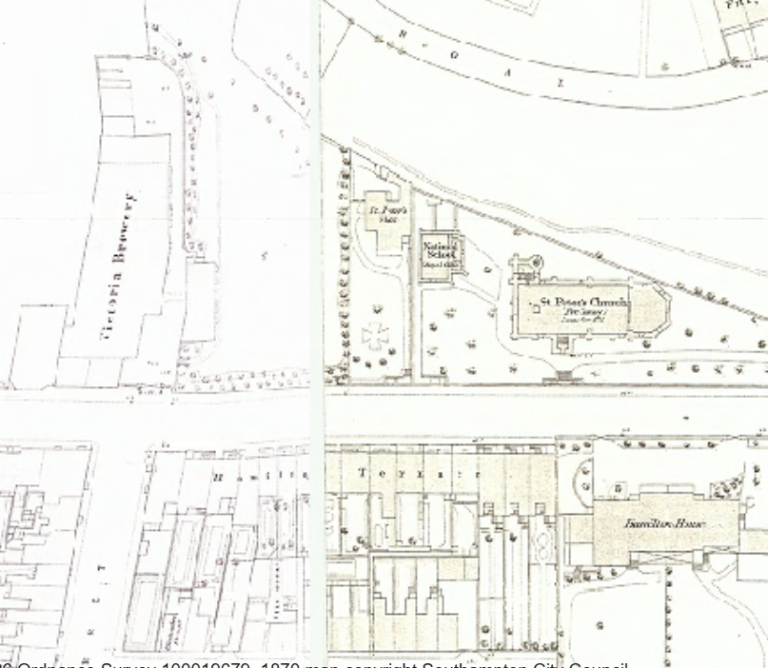
1870 map showing location of the Victoria Brewery
For Andrew Barlow’s 80th Birthday in December 1900 he received a testimonial in a gilt frame which read; “Victoria Brewery Southampton December 28th 1900. To Andrew Barlow Esq. We the undersigned engaged in your service at the Victoria Brewery Southampton offer you our hearty congratulations on this the eightieth anniversary of your birthday and take the opportunity of showing the great respect and esteem in which you are held by us and sincerely trust that you may be spared for many years to be with us”. It was signed by all the employees, some of whom had been there over 30 and 40 years.
According to the Southern Echo of 23rd May 1901 there was another a fire at the brewery. Flames were coming from the roof of the malt house. Staff tackled the blaze with their own hose keeping flames in check until the fire brigade put it out. Damage was over £100, and the cause unknown.
Andrew Barlow’s benevolence and support of good causes has been well documented by others, but I will mention that in September 1901 he distributed nearly £14,000 among various charities of the town. £4,500 to the Royal Southampton Hospital, £3,250 to the Queen Victoria Jubilee Nurses Institute £1,700 to Southampton Dispensary, £1,500 to the Southampton Free Eye Hospital, and £1,250 to the Homes in Shirley which have been named after him. Think about this for a moment. In today’s prices that total charity donation equates to a purchasing power of over £2 million today according to the Bank of England online Inflation Calculator.
I have read somewhere that Andrew Barlow did eventually retire and lived with his 3rd wife at Oatlands in Winchester Road, Shirley. His two sons, Andrew Barlow born in 1848 who became a brewer and John Hilton Barlow born in 1854, also a brewer, no doubt helped run the business.
In July 1902 there was sadly another fatal accident involving a labourer employed at the brewery. He was feeling a bit faint and went out of the door of the malt room for fresh air. He became giddy and fell 37 feet. The door was, as a rule, kept shut when not in use. The verdict was accidental death. Mr Barlow ‘expressed regret at the occurrence’.
Andrew Barlow died on 28th December 1904 at his home Oatlands Shirley aged 84. His obituary states he was a friend of Sir Frederick Perkins, and that he was married 3 times and left a widow and 2 sons and a daughter by his first wife. The following year, probate of his estate was issued to Sir John Brickwood, brewer and his grandson Gerald Haw Taunton Barlow of the Victoria Brewery (and one other). His Gross estate was £385,120; a purchasing power of over £60 million today according to the Bank of England online Inflation Calculator. From what I have read he was perhaps the richest businessman in Southampton.
In April 1905 the licence of the ‘Barlow Brewery’ transferred from the late Andrew Barlow to Gerald Haw Taunton Barlow. In October 1919, newspapers report the death of Charles Warr, who was the brewery accountant, and who had been associated with the firm for 52 years. He was aged 76.
The brewery was run by Andrew’s executors (and most probably his sons), and the directories of 1905 and 1909/10 show ‘Andrew Barlow (exors of) Commercial Road’. In 1910, the business was converted to A Barlow & Co, and in 1921 it registered as a limited liability company with a nominal capital £175,000. The family continued to support good causes and in 1926, they sponsored the ‘Victoria Challenge Cup’ in rowing.
From what follows, I believe the brewery was taken over by Brickwoods, despite some letters in the S Daily Echo in 1977 stating that they only took on the pubs. One letter says that their Foden steam wagons carried supplies to pubs from the rear of Aldridge’s brewery, Bedford Place. They had been taken by Brickwoods in 1927.
Philip Ely, in his ‘Portsmouth Papers, Portsmouth Brewers since 1847’ states that Brickwood & Co (brewers in Portsmouth) had a policy of keeping their brewery operating at full capacity so they needed outlets to sell their beers. They bought A Barlow & Co ltd in 1929 with their 53 pubs. Brickwoods became the leading brewer in Hampshire by 1930. As mentioned earlier a member of the Brickwood family was an executor of Andrew’s estate. The Brewery History Society also says Brickwoods took over the brewery, and their 46 (approx.) houses in 1929.
Brewing ceased in Southampton. Morris Road and the Skandia building are now on the site, just up from the Mayflower theatre, and on the opposite side.
I cannot find the exact date the Brewery was taken over by Brickwood & Co and when the brewery closed. The brewery buildings remained as in April 1931, Hammerton’s brewery was advertising their ales available from “Smeed & Smeed Ltd Victoria Brewery Commercial Rd.” In April 1934 it is reported that the brewery was being demolished and the site used for a “residential and commercial hotel, if present negotiations materialise”, and by March 1935 it had been demolished. Part of the land had been acquired by the Southampton Corporation and was part of a municipal scheme to provide work for unemployed men. They were creating a wide footpath and extended roadway. In January 1936 this was clarified as being a road through the site “from Commercial Road linking this road with the Polygon, the new road to form a continuation of Morris Road”.