A pint of beer is made up of about 95% water, so water is a key ingredient of beer and I feel that a brief history is warranted as it may help with understanding the types and recipes of beers brewed and the distribution of breweries.
In around 1233 land was granted to Franciscan Friars who established a friary in the town, and they accessed water from Colwell spring, which was located around the Gods House hospital area (area between Gloucester Square and Winkle Street). In 1290, they agreed with the land owner that they could enclose the spring within a stone wall, and pipe it to their friary. Other lead pipes were laid to other watering points called ‘Conduits’ and in 1310 they granted use of their water to the town. In 1420 they transferred the water supply and system to the Town Council, thereby creating one of the earliest known examples of a municipally controlled water supply in the country.
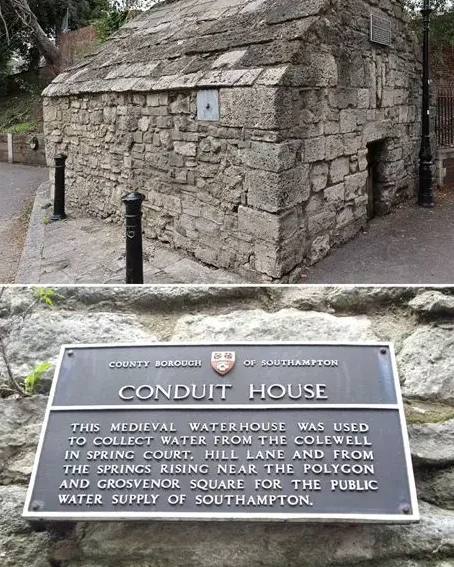
Southampton still has Conduit House, located opposite the Mayflower theatre. This marked a meeting point between 2 sources of water with one pipe to the West and 2 to the North. The two sources fed into a large tank that was then pumped through four-inch lead pipes down to the Bargate.
In 1740 a chalybeate spring, rich in iron and other minerals, was discovered in Southampton. To encourage its use a fountain was installed surrounded by gardens and the location is remembered today in the name of Spa Road off Castle Way.
The 1793-98 Universal British Directory has an item on water in Southampton. This states that the town was supplied with good fresh water supplied from 4 springs into 5 conduits. One was “Without Bargate” about 100 yards to the west, at the bottom of Orchard Street, another was a spring of Chalybeates contiguous to the shore 300 yards to the NE of Bargate. In Houndwell there were…” two springs which are conveyed to the surface by 2 leaden pipes”. These waters had different properties, the one to the north just being a spring of fresh water while the one to the south had qualities good for disorders of the eyes.
Note the reference to Lead pipes. Indeed, you will see as you read the various chapters that lead appliances were in extensive use in the brewing and water industries.
This water supply was proving inadequate for the increasing local population, visiting ships and sailors etc. and other supplies were needed. An article entitled 'The Artesian Well on Southampton Common', of 1843, sets out the position (an Artesian Well is a well that allows water to flow to the surface under natural pressure, the water being trapped between layers of rock underground).
In the autumn of 1837 the Commissioners of Water Works for the town engaged a Mr Clark to make experimental bores on the Common. There he found an almost unlimited and unfailing supply of water, and contracts were signed. The water was within horizontal layers of chalk. The shaft that was sunk enabled boring to upwards of 900 feet, and the rising water was pumped by steam power to reservoirs on the Common created (by manual labour) during 1839-1841. Two engines were used, each of 24 horse power.
The water quality was very good and in 1843 it was considered that in many respects” Southampton well bears a resemblance, particularly in the nature of the soils through which the excavations and boring have passed, to the celebrated artesian well in Paris”.
However, there were a number of issues as to quality and sufficiency of supply the further a customer was from the origin and there were a number of complaints from brewers which appear in the Hampshire Advertiser and other local papers. Indeed, ‘Mr Hills brewery’ in the docks moved from Southampton in 1871 because of the lack of sufficient water being supplied. He moved to Shepton Mallett and became involved in the Anglo Bavarian brewery (see the Hill Thomas brewery page).
As the reservoirs became insufficient, they were abandoned in 1883. Attempts were then made to take water from the Itchen at Mansbridge, but this water was found not to be pure. The Southampton Water works were then opened in 1888 at Otterbourne and by the start of the 20th Century the local water supply had been made much safer to drink.
Southampton is in a hard water area, due to the proximity of Limestone and Chalk rock. Hard water has high levels of calcium sulphate and bicarbonates and is used for dry tasting beers such as Bitter and India Pale Ale. In this respect the water in Southampton is similar to that at Burton-upon-Trent, traditionally regarded as the capital of the British brewing industry. Very hard water is often used to make Stout.