BREWERS FROM 1400 TO 1750 (ISH)
I direct you to a very interesting, and extremely detailed article appearing in an old journal from the Brewery History Society (BHS). It is entitled ‘Brewers Tales; making retailing and regulating beer in Southampton 1550-1700’, written by James R Brown. You can see this by clicking the link below, and I would strongly urge that you do so.
This article is a ‘stand-alone’ description of the brewing scene around 1620 so I will not repeat it. I have just tried to extract the basics, namely the names and locations of brewers, and these are listed below. Most of the detail has been taken from the BHS article, with a number of snippets from the National Archives, and some extra info from the Bristish Newspaper Archive.
I have taken the image of the John Speed 1611 map from a copy of a map handed out by SEE Southampton on one of their history walks. This can be used to help locate 7 breweries, but the 'Brewers Tales' includes the map, with breweries marked. Three were within the town walls, and four were sited beyond the walls.
However, I have to mention the Duke of Wellington in Bugle Street. According to various ‘online’ local sources, the Duke of Wellington was a house leased to Benedict Ace, a Mayor of Southampton, and in 1494 it was converted to an ale house by Rowland Johnson who named it Bere House, or Brew House. He was a Flemish brewer and had apparently imported his own brewery plant, together with hops from his home town in Holland.
So, is the Duke of Wellington the oldest brewery in Southampton? Possibly not, although I think all the local sources of information say that is was. In the detailed “Brewers Tales…” paper referred to above there is mention (Page 11) of “both a retail 'berehouse and a resident producer” referred to as 'Adrian the Beerbrewer' in 1454 with the suggestion that the use of an occupational surname meant he was probably Dutch. This would predate the Duke of Wellington by 50 years.
In 1771 the beerhouse was renamed the Shipwrights Arms, and local brewers John & Joseph Hunt were in occupation (See the Hunt & Co page). Was the pub still brewing, or did the Hunts just supply the premises? The name changed to the Duke of Wellington in 1815 after Battle of Waterloo. It was then owned, managed or run by various local breweries, the last perhaps being Coopers in the 1930’s. It is currently a Wadworth (a Devizes brewery) pub.
I should mention that Tony Gallaher in his book Southampton’s Inns and Taverns states that the pub “has been an inn or tavern since 1490” when Rowland Johnson acquired the building. Perhaps he ran it as a pub/inn/tavern for a time before he started brewing?
As an aside, is this the oldest pub in town? Or should that ‘honour’ go to the Red Lion? Both pubs still exist as pubs, and both have undergone extensive rebuilding/alteration over time. If we base the ‘first’ on the granting of a licence for the site, then the Duke of Wellington goes back to 1490 (Tony Gallagher) or 1494 (Historic Southampton), and the Red Lion 1552. If based on age of original sites, then the Red Lion dates back to the 12th century, while the Duke of Wellington was built over Norman vaults C1220 (Thirteenth Century). A score draw!
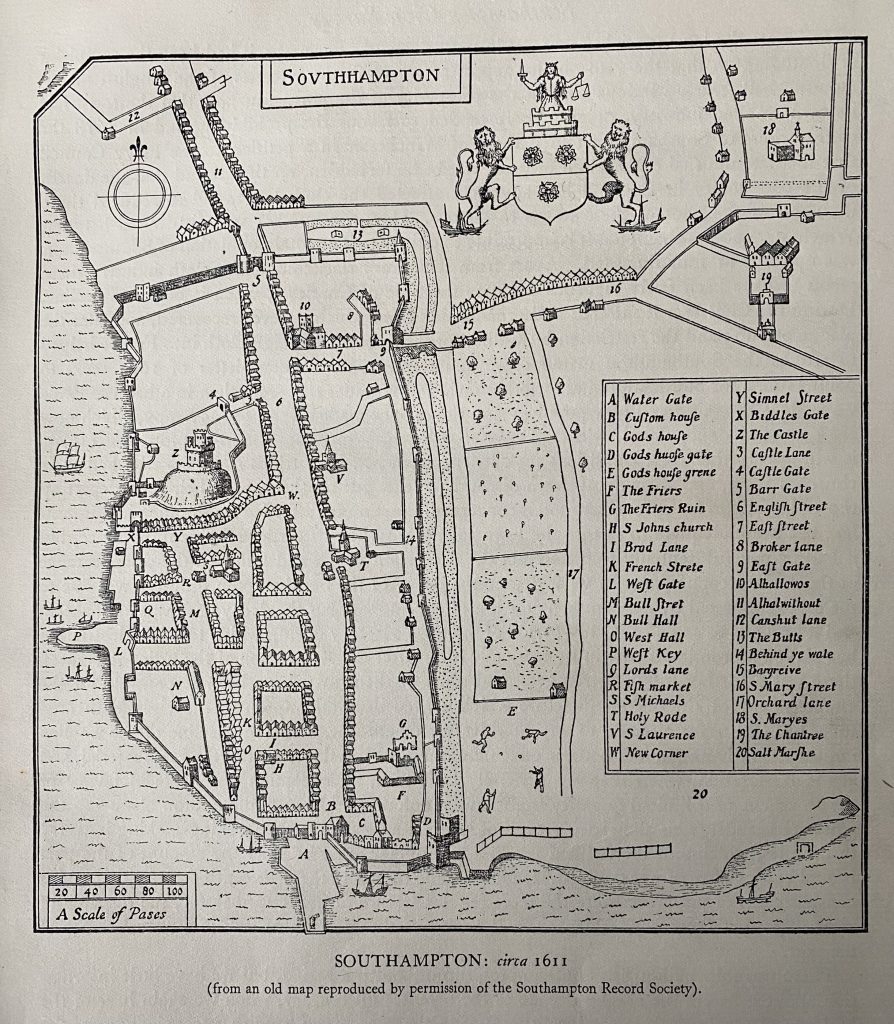
The list of early brewers is as below.
EDWARD BARLOW. He had a large brewhouse within the walls, in Simnel Street by the Beadle's Gate, which he acquired in 1598. (just below the Castle on the 1611 map, near the ‘x’). He described himself as a merchant and he was a trader in Serge as well as a brewer (Serge; a type of strong woollen cloth).
CHRISTOPHER BENBURY. He was prosecuted for selling to unlicensed ale houses in 1629. He was brewing in 1640. National Archives describe him as a brewer, All Saints, with reference to a Will of 30th July 1647.
GEORGE BURTON. He was a ‘beer brewer’ and in his inventory at the time he died 1651, but he was described as ‘Gentleman’ in his will.
CHRISTOPHER BENBURY. He was prosecuted for selling to unlicensed ale houses in 1629. He was brewing in 1640.
PETER CLYFF National Archives have a record of a Court case against the Mayor of Southampton “1475-1485”. “Action of account brought by Tilman Scluter of Southampton beer brewer.“
WILLIAM CHRISTMAS. He died in 1564 and was also running an Inn at his death.
CHRISTOPHER CORNELIUS. His brewhouse, stood at the top right-hand side of English Street within the town walls in All Saints Parish (located by the 10 on the 1611 map). This corporation-owned property measured 29ft wide by 220ft deep and was Southampton's largest and most prestigious brewery.
BERNARD CORTMILL. He occupied one of the East Street breweries in 1562. (between points 15 and 16 on the 1611 map).
JOHN CROKE. National Archives have details of a Court case. Short Title: Croke v James Plaintiffs: John Crooke the elder, and Michael Crooke his son, brewers, both of the city of Southampton and now prisoners in the Fleet. Defendants: Richard James, Richard Bisson, John Androwse and others. Subject: imprisonment for debt following forcible ejection from their brewhouse and maltings in Southampton. Regnal year: Michaelmas 37/38 Eliz I. Dated, 17th November 1594-16th November 1695.
JOHN GRANT. He had a substantial brewhouse on Windmill Lane, in the northern suburb of Above Bar (between 15 and 16 on the 1611 map), around 1620. He was presented for blocking the walls and hedges and doors of adjacent properties with his ‘beer carts’ in 1616.
NICHOLAS GRANT. Brewing in 1610
WILLIAM GRANT. He had a brewhouse in 1628.
GILES HASBERT. In the National Archives described as a Beer Brewer in a Court case 1533-1538.
THOMAS HEATH. He occupied a brewhouse (between points 15 and 16 on the 1611 map) around 1620.
JOHN JEFFREY. He was a mayor in 1598 and was brewing in 1602.
WILLIAM KNIGHT. William Knight occupied the large brewhouseon on English Street located by the 10 on the 1611 map). The contents of William Knight's brewhouse (which included a copper furnace worth £60 and over £129 in malt) were valued at £335 in 1667, the year of his death. Anne Knight, his widow, acquired Southampton's largest brewery upon his death.
WILLIAM LYNCH. A brewery occupied by William Lynch stood off English Street at the New Corner (by the ‘W’ on the 1611 map).
JOHN MAJOR. He had a large brewhouse in All Saints parish and on death in 1610, he was also Alderman in 1596 he was a beermaker, senior bailiff and all round big wheel, but he continued to produce double beer in defiance of a ban. He was fined, and complained so vociferously that he was temporarily incarcerated. He negotiated his release with the gaoler and went to the Guildhall in gown and cap, offering to sit on the Bench as a judge.
SAMPSON MANSBRIDGE. He occupied the brewhouse at above bar. He was brewing in 1581 and 1590.
THOMAS MALZARD. He had a brewery in East Street and died 1635 with estate of £25, of which £16 3s was in the brewhouse. He supplemented his income as an unlicensed ale house keeper. He was fined 19d for this in 1619 but the fine went to ‘the use of the poor alehouse keepers’.
EDWARD MANNINGS. In 1602 the 3 East street, died 1671 with estate of £31.
WILLIAM MITCHELL. In the National Archives described as a Brewer in a Court case 29th March 1768.
WILLIAM PARMETT. He had the third of the breweries between points 15 and 16 on the 1611 map around 1620, In 1627 he was one of the complainants in the Court Leet about fellow brewer Thomas Rought, who was accused of obstructing Windmill Lane with ditches.
THOMAS ROUGHT. He had a substantial brewhouse on Windmill Lane, beyond the walls, in the Above Bar suburb (extreme top left of the 1611 map, by the North point of the compass) He was still brewing in 1636, the year he died.
HENRY RUSSELL. In 1533 he was one of only 2 brewers awarded the right to supply Alderney & Guernsey, and he became Mayor in 1562. He occupied smaller premises in the suburb of St Mary's.
ROBERT RUSSELL. The Nation Archives hold a Will for him, described as a Beer Brewer Southampton.
TILMAN SCLUTER. National Archives have a record of a Court case against the Mayor of Southampton “1475-1485”. “Action of account brought by Tilman Scluter of Southampton beer brewer".
RICHARD SKINNER. He was prosecuted for selling to unlicensed ale houses in 1629.
JOHN SMITH. The National Archives. John Smith of Southampton, malster. Also another of John Cook of Subden in Sussex, sureties, John Smith of Southampton, brewer and William Hancock of Southampton, malster. 10th March, 1685/6.
PETER SPINKS
The National Archives. They hold the will if Peter Spinks, brewer of Southampton of 13th November 1765. Also, information accusing Robert Collis and others, his servants, of stealing fowls from his outhouse in 1760.
SAMPSON THOMAS. He probably occupied the brewhouse on Windmill Lane. In 1579 he was presented for ‘the filthy and unsavoury odours that proceeded from …his brewhouse’. He was brewing in 1581. The National Archives show a lease to a Thomas Beele, Inn holder re land at St Laurence (Lawrence).
PHILIP TOLDERVEY. Was brewing in 1609
ROGER TURNER. He was brewing in 1623, and died 1628.
RICHARD WALKER. He had a brewhouse in St Lawrence. He was a brewer and Alderman he was granted exclusive rights to sell ale and beer ‘unto all licensed inns and alehouses’ for three years, and would pay £240 for the monopoly in annual instalments of £80. The funds would go to the workhouse, and other poor at the discretion of the Corporation. He was also required to find out brewers supplying unlicensed ale houses and to tell the Mayor and Justices, with evidence. A new brewhouse was constructed for him at above Bar, and two months later all houses were instructed to buy his beer ‘and in no wise any other brewer of this town’. The brewer William Knight spearheaded resistance and the scheme was suspended indefinitely.
JOHN WARNER. Was brewing in 1623 and 1628.