R & W SANDERS
Behind the Blue Boar, East Street
Brewing started Circa 1770
Brewing ceased probably 1831
Taken over by J R King probably 1831
I start with the Hampshire Chronicle of 26 June 1775, which advertised for sale a brewing copper containing 145 Gallons, with a cock (correct!) in it, a main tub, underback, and two coolers; the whole being in ufe about four years. The Utenfils may be seen by applying to John Sanders, common brewer, in Southampton”.
This may suggest that John Sanders started his brewery in 1770/1. Was he selling this plant with a view to moving elsewhere? He certainly continued in the business, as he was described as a brewer in April 1776, in the National Archives and again in 1779 when archives show he was in front of the Quarter Sessions for “choking a ditch”. He is also referred to as a brewer in 1805.
The Universal British Directory of 1793-98 refers to John Sanders ‘fen’ (sen) as a brewer, and John Sanders Jun as a victualler. By 1803, they were trading as Sanders & Sons East Street. John senior kept the Blue Boar. The brewery was behind the Blue Boar, see the 1846 map which shows the pub. The brewery was in Kings Passage, which is also the address for the later J R King Brewery (see the King, JR page).
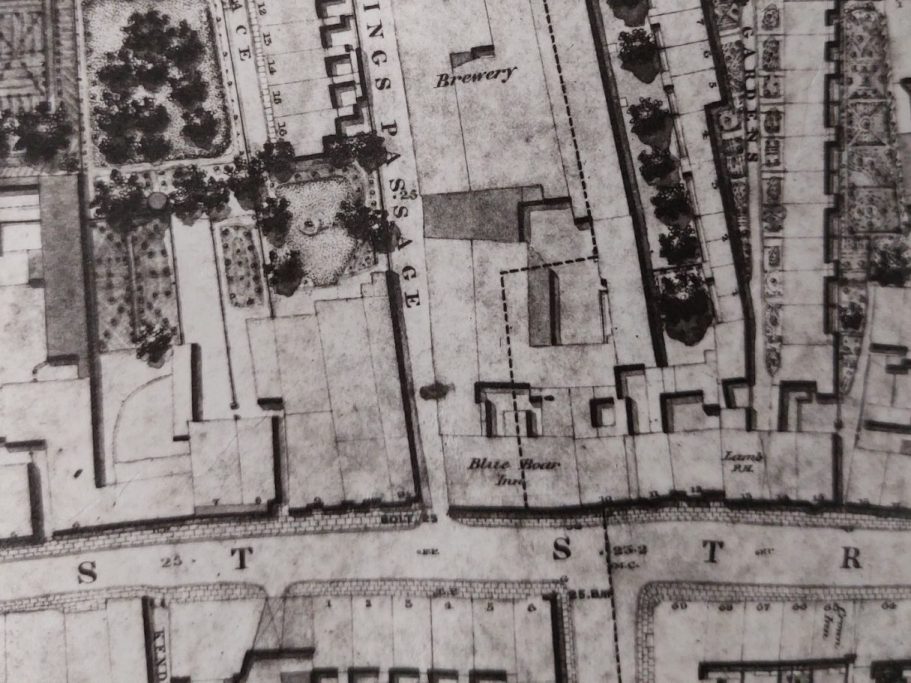
Extract from the 1846 town map, showing the Blue Boar, and 'Brewery'
John Drew of Houndwell Brewery, (see Houndwell brewery page) had a daughter Mary who married John Sanders Jun, so there was a link between these two brewing families. You will see later an entry from 1831 which refers to Sanders selling 3 acres of land in Houndwell “adjoining the above premises” (comprising at least parts of Sanders brewery), so was there more than a link?
The National Archives hold details of a lease in respect of a dwellinghouse, storehouse and garden in East Street, granted to John Sanders (I believe junior) near other premises he owned. The lease was for 40 years at a rent of £5pa. This is dated August 1803. In 1817, Robert and William Sanders surendered back the lease. Four years later, in March 1821, the National Archives refer to the lease granted to Robert and William Sanders for 40 years at £40pa in respect of a dwellinghouse, stable, cooperage, beer store, malt kiln, garden and land in East Street (17'4" x 332') up to the Hoglands, and adjoining other property they owned.
Also in 1821, they both took the “estate and effects of James Cooper of Newport, I.W., victualler,dealer and chapman, bankrupt, conveyed to (them) as his principle creditors”
In January 1809, as part of the George III Jubilee Celebrations in 1809, it was reported that Messrs R & W Sanders, brewers in East Street had distributed 10 sheep and supplied all comers with good strong beer from a tap in a large cask.
John Sanders senior died in 1802, but Robert and William Sanders had presumably already joined the business, as the directory reference in 1803 is to “Sanders & Sons”. By 1809, and in the 1811 Holden’s Directory we find Messrs Sanders, East Street, and Robert & William Sanders, brewers East Street. The last entry is in Pigots Hampshire Directory 1823/4, when Robert & William are shown again at East Street as brewers. They do not appear in 1836.
William Sanders died March on 12th March 1825 aged 55 ‘for many years an eminent brewer’. In February 1827 there was advertised a sale of three lots including a butcher’s shop and slaughterhouse. Particulars were to be had from “Robert Sanders Brewery East Street”. In December 1827 he is also described as a butcher and he donated from his shop “best Ox beef “to “40 industrious poor families”.
Robert Sanders dies six years later on 8th March 1831. The Hampshire Advertiser of 26th March 1831 carries a notice that all persons having claims to his estate were requested to send the particulars to his executors at his late brewhouse in East Street.
Immediately below this notice is a notice for letting. The Trustees of the late Robert Sanders were to let, for a term of ten years, the premises being the old established and extensive brewhouse at East Street in full trade, as well as the public houses belonging to the brewery, and a steam engine. The brewery was capable of mashing 84 quarters of malt per week (over 12,000 gallons a week). There was a good and comfortable dwellinghouse, adjoining substantial malthouses, a storehouse, stabling and every other convenience for the successful continuation of the business, and either with or without the several public houses. This property was “too generally known to require any further description, except to strangers, who to properly appreciate its value, must view it.” The tenant was required to take at a valuation the stock of beer, malt, hops, horses, drays, waggons, carts, and the carriages, and to comply with other terms to be explained to those interested. However, it was said that capital of at least 20,000/ was needed. (I think this was 20,000 shillings, making £1,000 or £93,000 approx. today according to the online Bank of England inflation calculator. To view, apply to Mr. Joseph Osbalbiston, at the brewhouse.
In March 1832 there was an auction of property of the late William Sanders including a “malthouse storehouse and stabling standing in the yard of the premises occupied by Mr James King” and also “3 acres of land in Houndwell “adjoining the above premises”. Note there is no mention of the brewery in 1832.
The brewery, or at least parts, was taken on lease by James King of J R King & Sons, (see the J R King page). Perhaps they took a lease of the brewery and other premises in 1831, and the executors of William Sander’s estate eventually sold the freehold, to JR King or to a third party.
It seems that Taylor & Moody, Sanders, JR King, and of course Coopers, all styled themselves as East Street Brewery, which is confusing! Sanders was possibly acquired by JR King. Taylors and JR King were both acquired by Coopers brewery, which was the last to use that name.