SHIRLEY MILLS BREWERY
Romsey Road Shirley
AKA Old Shirley Brewery from about 1859, Anchor brewery, Kingsford brewery
Brewing started Circa 1842
Brewing ceased 1900, acquired by Royal Mail and used for their ships laundry
I have titled this page the Shirley Mills brewery, although some historians may be unhappy as it was more often called the Old Shirley Brewery. Town maps can cause confusion between this, and the Shirley brewery in Old Shirley (see the Shirley brewery page); indeed, I was confused for some time until I had a ‘lightbulb’ moment. However, a 1905 newspaper contains a list of breweries from 60 years previous (ie 1845) and refers to the Anchor Brewery, Shirley Mills, and this name does also appear later. This brewery goes back to about 1842.
General online research will tell you that there was a manor with a mill at Shirley recorded in the 1086, Domesday Book. This mill was at the meeting of Tanners Brook and Hollybrook, near the junction of Romsey Road and Winchester Road. In earlier times there were three mill ponds and the mill ran on water taken from Tanners Brook, and Hollybrook. The building was taken over and used as a brewery for about 50 years, but a number of other businesses had addresses at Shirley Mills. Brewers came and went on a very frequent basis, (I make it ten) and the longest tenure was around 9 years. I also think this brewery also holds the record for the most reported auction sale notices.
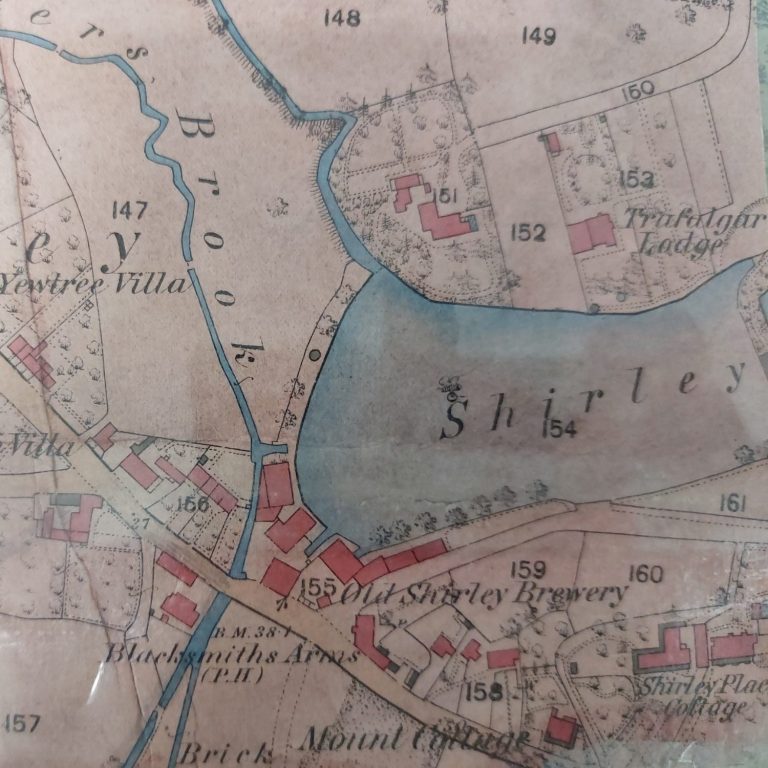
A photo of the '1865 1868' map at the Reference library in Southampton. This shows the brewery, and the Blacksmith's Arms at 197 Romsey Road. This does seem to have been the brewery Tap, which some say was nearby.
In April 1841, there is an advert in newspapers for the sale by auction of Shirley Mills as a whole, but with no reference to a brewery just the mill, lakes and meadows. Eight months later, the Hampshire Independent of 1st January 1842 carries an auction notice for the attention of brewers, capitalists, and others. For sale was the freehold property known as Shirley Mills with its extensive water power, and also about eleven acres of rich meadow land. Upon that part the above property (the meadow land?) there had recently been erected “regardless of expense a large commanding warehouse together with a most complete brewery with water wheel to drive the machinery”.
It could well be that the whole area was acquired by Joseph Till in 1841, and he had erected a brewery by January 1842 on part. The expense of building work may have ‘stretched’ him financially as by August 1842, newspapers carry notice of his bankruptcy. In September 1842 there is a further auction notice, similar to that in January, to take place on 13th October at the Blacksmith’s Arms Shirley. This was a sale by Jos Till, a bankrupt, of the freehold property, in 3 lots. Lot 1 was the desirable and newly erected brewery with all plant, complete and fit for immediate working and described as a handsome building with entrance gate on an extensive area of land covering more than 3 acres, with lakes “by which the present brewery is proposed to be worked”. Lots 2 and 3 were for more than 10 acres of meadow land adjoining.
Did Till brew here? His bankruptcy notice describes him as “a brewer Shirley Mills Hampshire”. The auction notice ‘proposed’ that the pond would power the brewery. Directories that I have seen do not help.
It appears that Edward Kingsford then acquired the premises, and although I am short on detail, we do know that by late 1843 the reference is to the Anchor Brewery. On 5th August 1843 a death notice appears of Anne, wife of Mr Edward Love Kingsford, Anchor Brewery Shirley Mills Southampton. By October 1843 the Shirley Mills Brewery is advertising that the Anchor Ale Shades at No 1 Bernard Street was then open to supply the public with Kingsford Imperial Ale at 6d a quart, mild Imperial ale at 4d, Dublin & London stout at 6d and East India Pale Ale at 6d. Apply Anchor Brewery Shirley Mills.
By February 1844 the Anchor Ale Shades was advertised for let by E L Kingsford, Anchor Brewery Shirley Mills. He did not trade at the brewery for long (if he brewed at all) as in August 1844 the Anchor Brewery was to be sold or let. It was described as being a six quarter plant (a brew of about 860 gallons a time) with 2 coppers, liquor and wort machinery ‘propelled by water’ of which there was always a plentiful supply, and a ‘splendid waterfall’. Kingsford may have had a side business as in March 1845 there appears an advert for skating on the ornamental lake at Shirley Mills Brewery! (March was clearly a much colder month in 1845 then 2026).
Whether there was sale or not, I am not sure, but we do know the premises were for sale again, as reported in newspapers of May 1845. They were described as being at Shirley Mills, 2 miles from Southampton, together with a villa with a garden and paddock of about 3 acres, and a splendid lake which was formerly a Salmon fishery of nearly 4 acres. The brewery was freehold and “upon a moderate scale, but with so much capability as to render it a formidable rival to some of the longer established houses in the town including the brewery store house constructed some 3 years ago” (1842). The brewery machinery was propelled by water power, and “the quality of the water for brewing purposes is excellent”.
I then meet my fist gap in information, until September 1847 when a “Compact little brewery” with plant was to be let. It was about 2 miles from Southampton with an “inexhaustible supply of good quality water on the premises”. It was to be let very cheap. A similar notice appears in September 1848, which followed an article in newspapers of 26th August that 20 lbs of copper had been stolen from an “unoccupied brewery”, the property of William Love Kingsford at Shirley.
Perhaps Kingsford acquired the brewery, and did brew for a short time to supply the Anchor Ale Shades then ceased brewing, and tried to let the brewery, unsuccessfully. He does not appear in directories at all, and there were numerous attempts to sell or let. The premises remained unoccupied and in the Hampshire Advertiser of 23rd September 1848, the Shirley Mill brewery was again to be sold or let with immediate possession. It was said that it may be used as a brewery and mill with water power and superior plant powered by overshot watermill, malt and store house, stables and yard.
There may finally have been a sale as we see that the Hampshire Independent of 17th March 1849 advertises a “desirable and convertible freehold premises, known as Shirley Mills Brewery” It was said that the property possessed great capabilities, and may be converted into almost any business premises requiring extensive room, such as founders, millers, coachbuilders, brewers, factors etc. and may be viewed on application to Mr. Hughes, on the premiers. This was repeated in April 1849.
We can see that Mr Hughes had acquired the freehold, but did he brew here? Is there a link with the Horseshoe Inn and Hughes & Co? (see those separate pages). I said on those pages that that there was a William Hughes at Church Road Shirley in 1847, which could be a connection with the Black Horse Shirley (see the Black Horse page). The newspaper notices of March and April 1849 shown earlier say that details could be had on application to Mr. Hughes, on the premises”. In 1849 and 1851, there is a Hughes and Tillot, Edge Tool makers listed at Shirley Mills. I wonder if, given the Shirley connection, that Hughes was a ‘brewer for hire’, filling in where required at Black Horse and Shirley Mills? Did William Hughes retire from Hughes & Co in November 1847 and move to Shirley Mills in around 1848, either as a brewer or in some other capacity? Further research is required.
We then come to my second gap, from 1849 until 1852 when the Hunts directory shows William Brown Baker at the Shirley Mills brewery, as does the 1853 PO Street Directory. He also appears in the 1849 directory as a maltster and brewer at Nutfield Nursling. This brewery is outside the area I cover …for now, but in newspapers of 17th February 1849 the Nutfield Brewery Nursling was for auction on 21st February, on the premises known as the Nutfield Brewery, and being a 4 quarter brewing plant (a brew of about 570 gallons at a time). It must follow that William moved here following the sale of that brewery.
The Hampshire Advertiser the following year, 1st April 1854, carries another advert for the Shirley Mills brewery. This was for the sale of several thousand gallons of fine old and pale ale, forty-five, twenty-one, and ten-barrel Vats, nine stllions, about 300 six, nine, eighteen, thirty-six, and sixty-four-gallon casks and puncheons, and also a capital six-pull beer engine. There was also a nearly new 8 tap pewter beer engine, with 160 foot of pipe. Also for sale was a 5-year-old powerful draught horse, a useful nag, dray trucks, pockets of hops and the usual requisites of a first class brewery. No reserve. The advert was largely repeated on 11th April. Clearly, there was brewing here in 1854.
The 1854 adverts related to the sale of equipment, not the brewery premises, and in October 1854, there was a notice to let the land and brickyard at the well known Bedwell Spring Shirley, “apply Mr Baker, brewer Shirley Mills”. There being no sale, Baker continued brewing here as confirmed by a notice for sale on 14th April 1855 of a compact freehold brewery in the occupation of Mr Wm B Baker with 8 quarter plant and with the advantage over other breweries of invaluable water power. Connected with this was a “Dwelling house where an excellent retail beer trade is carried on” together with a saw mill, in total about 4 acres.
In February, in the Hampshire Advertiser of 8th March 1856 we find that the “Old Shirley Mills brewery” had been taken by M’Kean & Tobin “in conjunction with their Windsor Brewery” which had been fitted out and could supply families and trade with their ales in casks of 4.5 gallons. The McKean & Tobin page sets out further details of this brewery but the brewing partnership was dissolved on 28th April 1857. The dissolution notice refers to the partnership between William Blair McKean, William Hibberson Tobin, John McCulloch Mckean and Anthony William Partridge, as brewers in Southampton and Shirley under ‘McKean Tobin & Co’. Dissolution was by mutual consent in respect of John McKean and William McKean (thereby leaving Tobin and Partridge).
In the 1857 directory, Anthony William Partridge, is listed at the Windsor brewery, and also as a brewer at Shirley Mills Brewery Old Shirley, so it appears that Partridge was probably taken on to brew in Shirley, although the directory also shows John McKean as a brewer of Nellfield Cottage Old Shirley. In February 1858, there appeared an advert for M’Kean’s pure ale; “This nutritious and wholesome beveridge brewed with so much success by Mr Rose who was for several years in the Windsor and Shirley Mills brewery can now be obtained in in 4 1/2 gallon casks at 1s from the brewery in Shirley where he is now engaged to brew for the private family trade.”
The 1859 Forbes directory lists Antony W Partridge as a brewer at Shirley Mills brewery, and it appears that McKean & Tobin had taken a lease of the brewery from Baker.
Perhaps as a result of the disputes I refer to on the McKean & Tobin page, the Shirley Mills brewery found its way to Messrs Dennett & Cole. They had been at the Royal York Hotel as brewers and retailers and their brewery was up for sale in October 1860, with the partnership being dissolved in December that year. (see the Royal York Brewery page). Henry Dennett Cole and Christian Legget Hider retired, leaving Henry Richard Hooper to carry on business at the Royal York Hotel.
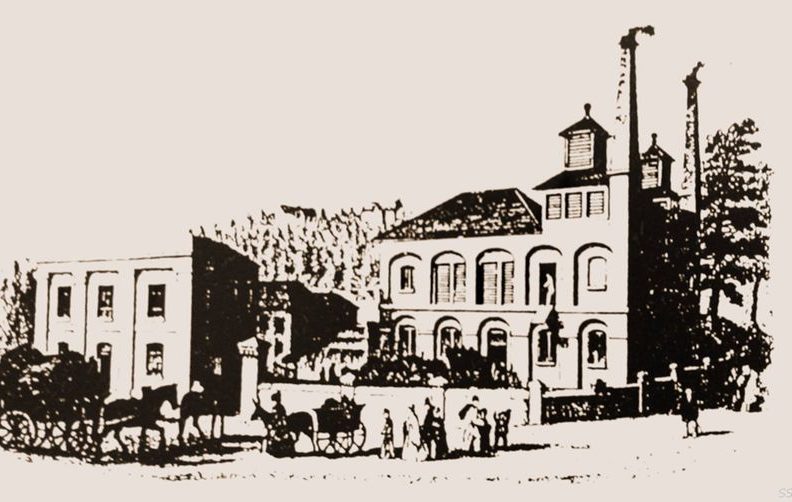
A sketch of what is said to be the brewery which commonly
appears in books and online, date not known.
In the same newspaper, an advert announced that Cole & Hider had reopened their offices at Above Bar and were selling Cole & Hider’s pale ale and mild ale in casks of any size. This was suitable; “also for invalids and all persons wishing a truly delicate ale their Tonic ale……possessing great restorative qualities and pronounced by the celebrated Dr Letheby the first analysist in the country, to be unadulterated pure and thoroughly fermented and calculated to agree with the most delicate stomach”. Orders could be received at the brewery, Old Shirley, or their reopened offices. In September 1860 there was notice they had closed the Above Bar offices, and a store was wanted near the docks and railway for storing ale and stout.
In July 1860, William Tucker had been a cooper with them for about 2 years, at Southampton and then Shirley. In the Hampshire Independent of 21st January 1860 there appears an advert for Cole & Hider’s East India pale ale in casks of 9 gallons and upwards, from Cole & Hider Pale Ale Brewery Old Shirley and Southampton. It seems that there was a transition period when they were at both sites, and in June 1861 there was a notice for sale by auction of 300 hogsheads and firkin beer casks all new within 3 years, at the Royal York brewery yard. Also a four-wheel dray, a 5 quarter mash tub, and two 13 barrel working rounds. The owner was giving up the export trade, and viewing was to be on the morning of the sale, and before then at Old Shirley Brewery. Note the change of name. Note also reference to a 5 quarter mash tun. The 1855, and 1863 sale adverts refer to an 8 quarter mash tun at Shirley Mills. The Royal York page refers to a 5 quarter mash tun at the Royal York, so the sale was presumably of the mash tun previously at Royal York. Brewing at the Royal York must have ended in 1860.
The 1861 Forbes directory also shows Messrs Cole & Hider as brewers at Shirley brewery Old Shirley, but by the 1863 PO directory the listing is for Henry R Hooper at Ivy Lodge Shirley, which I find confusing as in the Hampshire Independent of 14th September 1861, notice was given that Henry Richard Hooper brewer of Shirley had assigned all his estate to George Mannings of Downton, a miller and maltster and William Mew of Newport, brewer, upon trust for the benefit of Hooper’s creditors, who were invited to make a claim. (A Henry Richard Hooper was also a solicitor in Newport Isle of Wight, but appears to be unconnected.
By 9th May 1863 however, change was again in the air as newspapers carry an advert for the sale of the freehold of Shirley Mills, and brewery plant, flour Mills and large lake. This was by order of the mortgagees under power of sale, and to take place on 12th May. The premises were described as an eight quarter brewery with large tun room offices, room over, bottling room, stables and cart house. The brewery was worked by water power, and there was a valuable artesian well with apparatus attached, excellent plant with two coppers, 20 pontoons, mash tub, refrigerator, liquor and underbacks, lift pump, working squares as well as the machinery and gear for the water wheel. Also included was a beer house with bar, tap room club room and 3 other rooms, and capital flour mill. The brewery was in the occupation of Alfred Davis who had an unexpired term of about 10 years held at a rental of £120pa. I did wonder on the Black Horse page if the Alfred Davis was the same Alfred Davies who was at that brewery for a time.
Note that the brewery had a 6 Quarter capacity in 1844, and 8 Quarter by 1854, and 1863, a 30% increase, so presumably business was good.
It does seem therefore that William Baker owned the freehold of the whole of ‘Shirley Mills’ and the lake, and subleased various areas, including the brewery. It is a shame we do not know when the lease was granted, nor when Cole & Hider transferred it to Alfred Davis. It is possible that Davis brewed here until around 1866/67, as the 1867 Forbes directory then lists W N Winstanley at the brewery, as does the 1869 Cox directory.
However, we know he was brewing in 1866 as the Hampshire Independent of 2nd May 1866 carries an advert for Anglo Bavarian ale and stout from Vandecasteele and Winstanley, Old Shirley Brewery. They were in partnership and the Hampshire Independent of 13th October 1866 carries a notice of the dissolution of their partnership as from 28th July 1866 whereby William Newham Winstanley was to continue the business and would settle all debts. The Hampshire Independent of 17th October 1866 carries a notice that all persons having a claim against the partnership should contact Mr Vandecasteele who held a bond for £800 supplied by Winstanley.
If you search ‘Edward Tucker’ in the Brewery History Society website, you will see that in 1861, patent No775 was taken by Louis Jean Vandecasteele, of the city of Lille, France, brewer, for the invention of “improvements in brewing”. In 1866 a Mr Vanderasteele was trading as the Bavarian Brewery, at the foot of Haverstock Hill London. Despite various spellings, this is surely the same person who was at Shirley Mills.
This predates the completely different Austro-Bavarian Brewing Company of 1882 (see the Hill Thomas & Co page) but it is interesting to see the ‘Bavarian’ name this early. No mention of lager! But I digress.
In August 1867, an application for a new licence was made by a tenant of Winstanley, for a new house on the corner of Brewhouse Lane, which was not granted.
Once again, this tenure was short, and newspapers of 2nd January 1869 report on the first sitting of the Bankruptcy Court for proof of debts of William Newham Winstanley brewer of Shirley. His failure was said to be down to “heavy losses and law expenses occasioned by, and in connection with, the partnership between himself and Louis Vandecastelli, also depression in trade and losses from bad debts”. He was discharged by Order of 15/2/1869.
Welcome to my third gap in information. The next in line to brew here were the Irelands three years later. In newspapers of 28th April 1869 they wanted a man and wife without incumbrances to manage a brewery tap. A small salary was to be given as the man could occupy his time elsewhere during the day. Two months later on 5th June, there appeared an advert for the Old Shirley brewery; E Ireland was sending out ales stouts and porter in fine condition. Alexandra pale ale, India pale ale, AK pale ale. mild ales, X ale, XX, XXX, XXXX. “E Ireland strongly recommends his 10d ale to farmers and large consumers “
The Hampshire Advertiser of 19th November 1870 reports on a case of embezzlement. Thomas Davis, a drayman employed by Edmund Ireland, had received funds in excess of 16s for beer delivered and not accounted for to his employer. He pleaded guilty, the excuse being he had lost his purse. He was sentenced to 6 month’s imprisonment with hard labour.
The 1871 Cox directory refers to Alfred Ireland and Edmund Ireland as brewers at the Old Shirley brewery, and in October 1871 newspapers reported an accident to Mr E Ireland. He was thrown over the back of the trap he was riding, falling on the back of his head. He had “concussion of the brain and he now lies in a most precarious condition”.
A formal notice of dissolution of the partnership was announced on 4th February 1874. Edmund Ireland and Alfred Ireland “in the trade or business of brewers carried on by us at the Old Shirley Brewery, parish of Millbrook” under the style and title of Edmund and Alfred Ireland, was dissolved by mutual consent. The business was to be carried on by Edmund Ireland solely. However, by 8th July 1874, some 5 months later, there was a first meeting of creditors of Edmund Ireland, a brewer. On 13th June 1877 there are reports of liquidations of E Ireland of Old Shirley brewery Southampton and of West Cowes Isle of Wight brewer and wine merchant.
There is then another gap in information between 1874, and 1878 when both Alfred and Edmund are listed, but in different directories. 1880 it is just Edmund who is referred to.
The next change happened in 1880, when in December there was a beer house to let apply to “Bass & Co Old Shirley Brewery Nr Southampton”. However, the 1884 Southampton directory refers to Lambert & Morris (should be Norris) at the Old Shirley brewery, 23 Romsey Rd. However, the main entry says Bass & Co, who were of course large brewers in Burton on Trent.
The Lambert and Norris partnership had relocated to Arundel West Sussex where their Eagle brewery in Tarrant Street was later taken over by Friary, Holroyd and Healy of Guildford in 1910 with 81 houses.
In November 1885, Bass applied for possession of the Forest Inn, Millbrook Road. However, by 1887, the brewery had changed hands again. This owner was W H Complin, a member of the Complin family of brewers near Alton, and in 1887 there was a notice concerning a dog that had been lost from the Old Shirley brewery, with W H Complin asking for its return.
Walter J Complin appears in the 1887 Cox’s Directory as a brewer at the Old Shirley brewery Romsey Road (with a similar entry in 1888/9 Kelly’s. In newspapers of August 1888 there are auction sale notices for a sale on 24th August by order of the mortgagees, of the freehold property known as the Old Shirley brewery which was leased to W J Complin Esq at the junction of Winchester and Romsey Roads with fixed plant. Also the brewery tap on Romsey Road adjoining the brewery. Also advertised were picturesque freehold residences between 2 lakes and surrounded by woodland, and the freehold dwelling Park Villa, Park Rd Shirley, the whole commanding a rental of £250 pa.
Note the sale was again of the freehold, with the fixed plant, with the rental advertised. Complin was still trading in July when there is a report of a workman’s outing of the Old Shirley Brewery workers to Alton where they joined the men employed by the Holybourne Brewery (near Alton where Complins was based). By February 1890 there was an announcement of a change of Address. Mr W H Complin had terminated his lease of the brewery and said he would open new premises at Bitterne on March 1st 1890, the Cobden Bridge brewery Bitterne Southampton. There was also a price list, for XXXX strong ale 1s 6d a gall, XXX mild ale 1s 4d, XX mild beer 1s, bitter ale 1s 6d, family ale 1s 2d, bitter beer, 1s, stout 1s 6d, porter 1s. Discount 5% COD.
The brewery had been managed by Walter Henry Complin, while the Holybourne brewery, near Alton, remained with Walter John Complin assisted by his other son John Fowler Complin. After the splitting the two operations it was decided that a new brewery was required in the Southampton area and Walter Henry Complin moved the business to what would become the Cobden Bridge brewery Bitterne Triangle. By the 1890/91 Kelly’s, Complin is listed at Cobden Bridge. See the Cobden Bridge brewery page for a continuation of this branch.
In July 1891, there was another auction sale of 5 houses with large rooms, used as a school, 2 pieces of meadow land, freehold land near Totton station, the Old Shirley brewery with brewery tap ‘and pretty residence’ including the upper lake and pleasure grounds at the head of Old Shirley Pond. On 21st January 1892 there was a report of an annual supper at the Brewery Tap given by Mr Neal, where the proprietor of Old Shirley brewery, Mr Complin presided, so he still had a presence at this time.
The HCC Archive refers to sale particulars in 1891, being a plan and requisitions on title relating to Old Shirley brewery and 'The Lakes', Shirley, Fletcher to Player. Fletcher presumably bought the freehold in 1888 and sold on again only 3 years or so later.
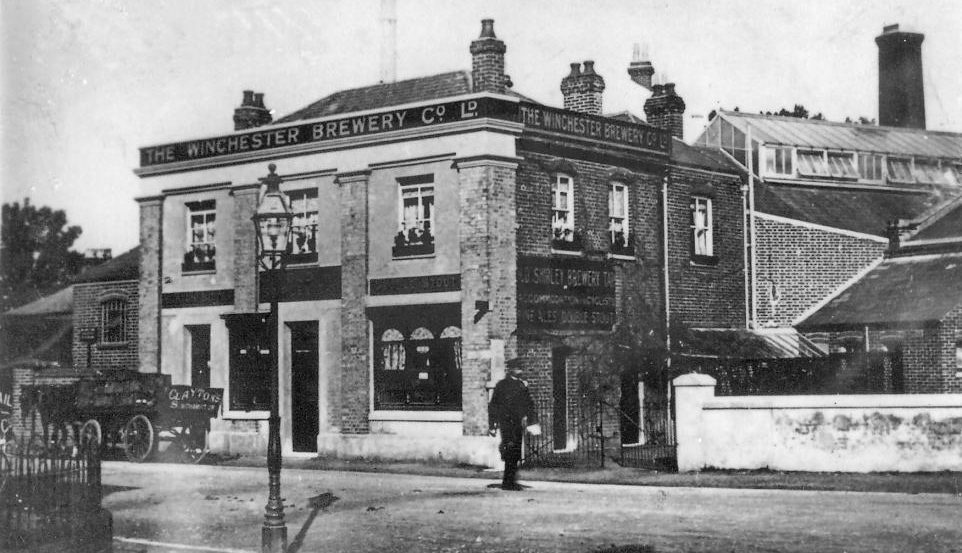
The Old Brewery Tap was acquired by the Winchester Brewery 1899. In 1900, the brewery site was acquired by Royal Mail and used for their ships laundry until 1920. The building was demolished in 1959 and a car sale room now occupies the site.