APOLLO INN
AKA the Grove Street Brewery
13 Chapel Road (on the corner with Grove Street).
Brewing started 1835 or before
Taken over possibly by Wheatsheaf Brewery, Circa 1875
Brewing ceased Circa 1899
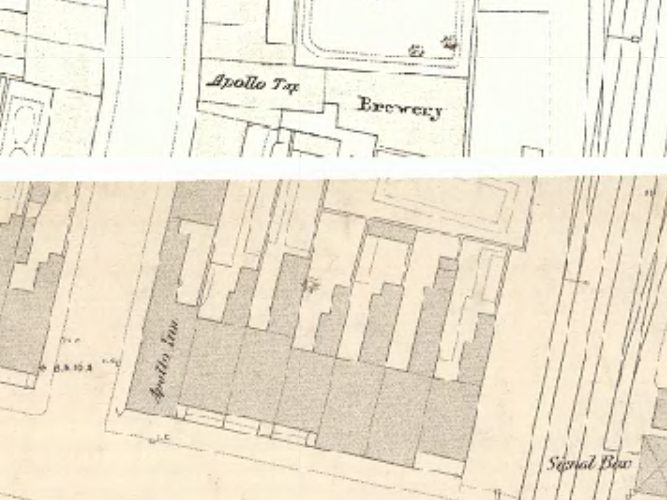
The Apollo Inn Tap was at 96 Grove Street (1 Grove Street in the 1840s when it was known as the Apollo Saloon). The brewery was behind the tap, and the Apollo Inn was separate, at 13 Chapel Road, on the corner of Grove Street and Chapel Road, as shown on the 1870 town plan. Tony Gallager in his book Southampton’s Inns and Taverns says the Apollo Inn had its own brewery, and in the 1850’s, as we shall see, the brewer Francis Welsh was in residence. However, up until then, there is reference to the Grove Street Brewery, with J Waters, as brewer listed.
In the Hampshire Advertiser of 28th November 1835, there appears a notice headed ‘Grove Street Brewery Southampton’, in which J Waters returned thanks to customers for ‘past favours’ and to say he had a constant stock of good home brewed ale which he warranted to be of the very best quality and free from adulteration of any kind at reasonable prices. He was determined to supply nothing but a wholesome and nutritious beverage, the produce of genuine malt and hops. He is also described as a brewer of St Mary’s in a report of a court case in 1835, and in November that year, J Waters of the Grove Street brewery was again advertising that he had a stock of “good home brewed ale”.
The 1836 PO directory refers to John Waters at Chapel Road. By the 1839 Fletcher & Forbes directory he is shown as a retail brewer at Grove Street, but thereafter he is at Chapel Road until 1849, when the listing shows him at the Apollo Saloon 9 Chapel Road. It seems clear that Waters occupied both premises, as there is a report in newspapers of 22nd June 1887 dealing with local rating in the year 1837. It was said that John Waters had a house in Chapel rated at £8, and for his brewery attached at £3 and for his beer shop £2, showing that the liquor trade at that time was not very profitable.
Inquests were regularly held at the Apollo, and in November 1842, such an inquest concerned the accidental death of a customer at the “Waters brewery Grove street”. The customer had “been drinking rather too freely” and it seems he left and walked over the Chapel Quay where he was found drowned.
The 1845 directory shows John Waters as brewer at 9 Chapel Road, and by 1847, he is also at the Apollo Saloon 1 Grove Street. In the Hampshire Independent of 26th August 1848, he applied (again) for a licence for ‘the Apollo Beershop’. He said he had built a ‘large brewery and had kept the house many years’.
Changes then occurred around 1850 and in 1851, W Hellens is listed as a brewer and retailer at Grove Street, and Waters is not listed at all. In the 1850s the Welsh family take over. As we see later Henry Eason Welsh, (the son of Henry Welsh) was a proprietor of the Apollo brewery and later the Wheatsheaf brewery and afterwards connected with a brewery concern in Winchester. He had two sons, Frederick Welsh and William Welsh.
In the 1851 PO Street Directory, Francis Welsh is an Innkeeper and brewer at the Apollo, as he is up until 1853. In 1855, he is an Innkeeper. In the 1851 Census, Francis R Welsh is a brewer and employer of 2 men, and a Harry Welsh is shown as his brother.
At the 1859 Licensing sessions, the licence of the Apollo was transferred from Francis Thomas Welsh to Henry Welsh (son to father). By 1863, Francis is at the Lion Brewery, Shirley (see the Lion brewery page). Henry Welsh is an innkeeper and brewer at Grove Street, in 1859, as he is in 1861. By 1865, he is an Innkeeper.
The 1871 Cox’s Directory shows Samuel Bowles, as a brewer and publican here, and he is also so shown in 1875. In that year, an advert appears for the sale of ‘several empty quarter casks, apply Apollo brewery and spirit store Chapel Road’.
There is reference in newspapers of 21st February 1877, to Edward White Bowles at the Apollo Brewery. However, by the time of the 1878 and 1880 Cox directory, Henry Welsh Is at the Apollo Inn as a brewer and wine and spirit merchant. I can see nothing listed later, but he is shown at Wheatsheaf brewery at this time (see the Wheatsheaf Brewery page). Indeed, both the Wheatsheaf brewery and the Apollo were owned by Welsh, and from much the same time.
It seems that the business of the Apollo Inn and the Tap operated out of freehold premises, which were bought in 1876 by Henry Welsh. In the Southampton Observer and Hampshire News of 30th November 1878, there is a report of a Court case, re Welsh V Mannings, to enforce specific performance of a contract for the sale of a brewery, known as the Apollo brewery Southampton for a sum of £1,500 (about £151,000 today according to the Bank of England Inflation Calculator). Welsh’s case was that in 1876 he agreed to purchase the brewery for £1,500. There was a mortgage of £1,000 so he paid £500, taking possession at Michaelmas 1876, the balance to be paid when the Conveyance of the property was executed. (A conveyance is the Deed which transfers title of freehold property). Mannings did not give notice to the mortgagee so this action was for Mannings to pay off the mortgage and complete the sale. There were counter arguments but the Vice Chancellor said that Welsh’s position was correct and ordered a Declaration for Specific performance (i.e. the sale had to be completed).
Less than three years later, in April 1881, there is a notice of auction on 7th April, of the freehold premises 96 Grove Street with cart shed stable and store with a frontage of 55ft. Also the freehold premises known as the Apollo brewery immediately in the rear of lot 1, with land adjoining and held on a lease of 21 years at rental of £1pa. This is the same year as the Wheatsheaf Brewery was to be sold, and which was acquired by Henry E Welsh.
The 1881 Census shows Joseph Chinnock here as a brewer, with his wife Louise, a bar attendant. (sometimes ‘Chinnoch’). He died on 3rd August 1881, aged 44 years at the Apollo Inn. His obituary, in newspapers of 11th August, states that he was employed by Mr Welsh of the Wheatsheaf brewery for many years. He was he landlord of the Apollo, and the licence was transferred to his wife at the October transfer sessions.
The Hampshire County Council Archives of 1899 refer to a conveyance of the Wheatsheaf brewery, the Apollo Tavern and brewery Chapel Road and Grove Street, together withseveral freehold and leasehold houses, and the goodwill of the business. This was all transferred by Henry Welsh and Frederick Welsh to Scrase's Brewery Ltd. This was clearlyone sale of both breweries, and perhaps confirms my belief that Wheatsheaf acquired Apollo in or around 1875.
According to Dave Marden in his books ‘Southampton’s Chapel Area’, and ‘Southampton’s Lost Streets St Mary’s and Golden Grove’, the Apollo Inn carried on trading until it closed in 1925 when it became a private residence. The Apollo Inn Tap had closed by the mid 1870’s, but It had a brief revival as the bar for the Southampton Sports and Social Club in the 1930s. It was one of the last buildings standing in the area in the 1970s.
The Hampshire Independent of 3rd December 1904, reports the death of Henry Eason Welsh, aged 78, former proprietor of the Apollo brewery and later the Wheatsheaf and afterwards connected with a brewery concern in Winchester. He had been living in Hove for some years.