WILLIAM SLATER’S BREWERY
Canal Walk, Southampton
Brewing Started C1836
Acquired by Richard Taylor, Golden Lion 1860.
Brewing ceased 1860 as ‘Slaters’. Continued under Golden Lion
The Brewery History Society, (BHS) produced an excellent article on the history of this brewery which you can still see in their ‘Brewery Wiki’ page on their website. I have, with permission, taken the liberty of copying sections to this page, but would urge you to read their full article at http://www.breweryhistory.com
William Joseph Slater was born in Southampton in October 1803, the son of Joseph Slater and Susannah Taylor. In June 1831 he married Sarah Forder, who may have been a member of the Southampton Forder family who were brewers and wine merchants. The enterprise started at what was 73 Canal Walk, which later became the United Flags, and then the Lord Roberts, which backed on to the Old Bond Store (the ‘Malthouse’ on the 1870 map shown later). Brewing took place here, I suggest, before moving to the Old Bond Store.
The BHS article states that Slater “opened a beer house in Canal Walk, later known as the United Flags, and took over a building behind it where he operated a brewery. This building was built circa 1800, against the then standing town wall, as a warehouse served by the proposed Southampton and Salisbury Canal.” To digress, Canal Walk was named after the canal which ran along the outside of the Eastern walls of the town, having originally been a medieval moat. It was opened on 1795, but was not a success and closed, leaving mud filled stagnant ditches by the walls. The area was eventually built over). The BHS continues “The Eastern part of the store was converted into a dwelling house and the land to the south turned into a garden. During the 1840s the building was converted into a malthouse and a brewhouse was added to the north-east corner.” A coach house and stables were also erected about this time. The brewing equipment included a wooden vat and paddle, a weighing balance with barrel grabs and weights and electric machinery used with a belt driven shaft. (An early example of the move away from steam?).
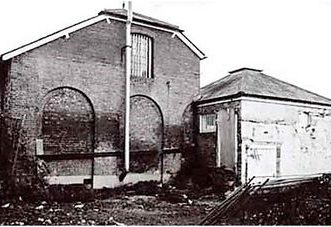
Eastern elevation,brewery on right, next to Old Bond Store. Photo courtsey of the BHS.
William Slater is first listed as a brewer in the 1836 PO directory at Canal Walk. In 1839, Slater W is a brewer & retailer of beer at Canal Walk, and in the 1839 Robson’s Southampton directory he is at Back of Walls as a brewer and beer retailer, at Union Terrace. You will see from the map that the buildings fronted both Canal Walk and Back of Walls. In the 1841 Census, William is aged 37 and is a brewer, living with his wife Sarah. He does not appear at all in the 1843 Directory.
William Slater is first listed as a brewer in the 1836 PO directory at Canal Walk. In 1839, Slater W is a brewer & retailer of beer at Canal Walk, and in the 1839 Robson’s Southampton directory he is at Back of Walls as a brewer and beer retailer, at Union Terrace. You will see from the map that the buildings fronted both Canal Walk and Back of Walls. In the 1841 Census, William is aged 37 and is a brewer, living with his wife Sarah. He does not appear at all in the 1843 Directory.
In 1845 W Slater re-appears in directories as a maltster and brewer. On 18th April 1846, there is a newspaper report of George Askell pleading guilty to using ‘abusive language’ to William Slater, brewer. He was fined 1s and costs or 14 days’ imprisonment.
In the 1847 PO directory, William Slater is shown at 3 Union Terrace, nearly opposite the United Flags. (Union Terrace was a separate section that later became Nos 7 to 15 Canal Walk), There is no further reference to William Slater then until 1849, when again he is a maltster and brewer, at Back of the Walls and 3 Union Terrace. There is however reference to William Hughes as brewer of Union Terrace in 1847, and again in 1849. (See the Hughes & Co page, there could be a connection?)
William Slater died in early 1850, aged 47, and the business was carried on by his widow, Sarah. In the 1851 census she was described as a brewer and maltster employing seven men, living at 23 Lower Ditches with her son, also William aged 18 years. Living with them are Richard Hurst, a maltster aged 60 years, and James Hurst, aged 31, a maltster’s assistant. Father and son? By 1853 one directory refers to Sarah in the same terms as the Census, but the PO directory refers to W Slater, meaning William Slater’s son, who would have been about 20 years of age at that time. He may have taken over a lot earlier as a newspaper report of 22nd May 1852 contains a Court report of allegations of yet more abusive language, this time by Sarah Denton, who was charged with obscene language in Canal Walk. “Mr Slater, brewer had forbidden her and others from entering because of their disgusting language. She came again and the police detained her. She was discharged.”
William junior continued as a brewer and beer retailer, appearing in the 1855 Directory. However, he was on the move in 1857 as we see in the Hampshire Advertiser of 31st October which runs an advert in for the brewery “with excellent retail trade attached" to be let and entered on immediately. It was described as "an excellent five quarter brewery, (a brew of about 720 Gallons at a time) with capital store cellars, malthouse, private residence and premises, for carrying on the retail trade, situate in Canal Terrace and Back-of-the-Walls, Southampton, for many years in the occupation of the late Mr. W. Slater".
However, it probably did not attract interest as William still appears in the 1857 Kelly’s directory but there is also an entry for Scrase and Baker at 1 Upper Back of Walls. The 1859 Forbes directory shows him at 2 & 3 Upper Canal Walk, as a brewer & spirit merchant and at at 10 Upper Back of Walls with Scrase H and Baker A (this would be the Old Bond Store).
Brewing had probably ended under the ‘Slaters’ name around 1860, as in newspapers of 4th August 1860 we find a notice headed “Brewery (Late Slater’s) Back of Walls Southampton. Richard Taylor having taken the above brewery is now supplying families with pure and genuine ales in small casks at 1s, 1s 4d, and 2s a gallon. Porter and stout, 1s, 1s 4d, and 1s 8d per gallon, and bottled stout 5s per dozen quarts, 3s per dozen pints”.
The 1861 Directory lists R Taylor, as a brewer and spirit merchant at Upper Back of Walls, and also as a brewer, wine and spirit merchant at the Golden Lion Upper Cana Walk. The Golden Lion was close to Slaters brewery, at No 60, as shown on the plan. See my separate page on the Golden Lion Brewery for the continuation of this story.
There is a further entry in the 1861 Directory; Richard Taylor, brewer, 10 Blechynden Terrace’. Perhaps Taylor moved from Blechynden Terrace to acquire this business.
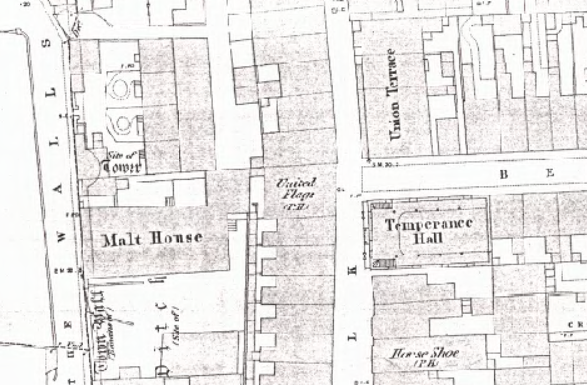
1870 Town map, showing the Old Bond store, shown as Malthouse.
The business therefore seems to have had been hived off to Mr Taylor, and to Scrase, and to Coopers, and brewing ceased. Part of the Old Bond Store, the Malthouse, was leased to Coopers Brewery. In the Hampshire Advertiser of 16th August 1862 there is notice of an auction in 2 lots on 22nd August, of brewery and malthouse leases, on the premises of the Golden Lion Canal Walk. This included “the lease of the Malthouse and stabling now in the occupation of Cooper and Kent".
Sarah Slater died on 13th March 1865. According to the Brewery History Society, in the 1861 census Sarah Slater was living at 33 High Street as a gentlewoman. William and Fanny Slater were living at Millbrook, where William was working as a railway clerk. William's younger brother was at Cambridge studying for the church. (relevant later!) He eventually became curate of St. Lawrence, Southampton.
On 24th April 1878, an obituary appears for the Rev Joseph Slater, of Southsea. “The son of a brewer of this town” (Southampton) aged 39. On 5th Oct 1878 a report appears of an ‘important property sale’ from his estate. Lots were principally of beer houses and shops in Upper Canal Walk, but the leasehold malthouse and yard at Back of Walls occupied by Coopers was sold to Mr Scrase for £860. The Golden Lion sold for £710 to Mr Alfred Watts with seven other houses (I assume beer houses). We can assume that Taylor was a tenant, or leaseholder.
The BHS article states that the Old Bond Store was taken over by Scrase’s Brewery on 10th July 1891 and was described as a ‘Storehouse, malthouse, coachhouse, stable, outbuilding, yard etc’. That brewery remained in occupation until 1926, when they were taken over by Strong’s brewery of Romsey.
The overall picture is not certain but it seems more than likely that William Slater Snr owned the freehold of the brewery and the Golden Lion. When he died, much, if not all, of his properties passed to William’s younger brother and leases were granted on the malthouse to Coopers, and other parts to Scrase’ brewery. There was also lease of the Golden Lion, possibly granted to Richard Taylor, on his acquisition. It seems likely that the Slaters’ plant was used for brewing, and to supply the Golden Lion.
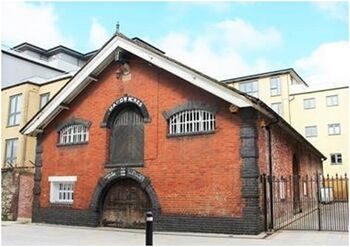
The Old Bond Store. Photos courtsey of the BHS
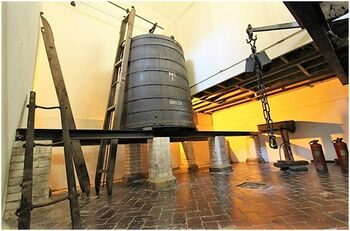
The Brewery History Society article completes the story of the Old Bond Store;
“Further alterations were made in the 1870s, including the west façade, the insertion of the ground floor (the present basement was probably the original ground floor), the iron columns in the basement and ground floor, the revised fenestration and the massive slate roof.”
“Strong’s relinquished the lease in 1930-31, and the buildings, now described as "Bonded Store, Steam Lorry Shed and Other Buildings" were let to Messrs. Sutton & Co., General Carriers, of London, with A. E. Chandler & Co. (Wine & Spirit Merchants) of 125 Portswood Road as sub-tenants. Chandlers remained as tenants until the 1960s, apparently as sub-tenants of Hall & Woodhouse of Blandford Forum. The last tenants, Distributor Wales and West (Wessex) Ltd., trading as DWW Agencies, took over in 1968 and ended the Bond Store's association with the licensed trade. The building survives substantially unaltered and known as the Old Bond Store today.”
As of August 2026, this historic Grade II listed building has been converted for use as a space for private space for small-scale weddings and private events for up to 60 guests. This is an example of another landmark old building being repurposed and preserved, the other notable example perhaps being the old Wool House, which is now the Dancing Man brewery and pub.
Is it possible that there were four breweries within a short distance in Canal Walk; Slaters (Golden Lion), Hughes & Co, Canal Walk Brewery, and the Horseshoe Inn.