FORDER & CO LTD
Hampton Court Brewery, 23 (later 47) French Street, and 113 High Street
Brewing Started 1822
Listed as Forder & Co from 1867
Acquired by Brickwoods 1925
Brewing ceased 1925
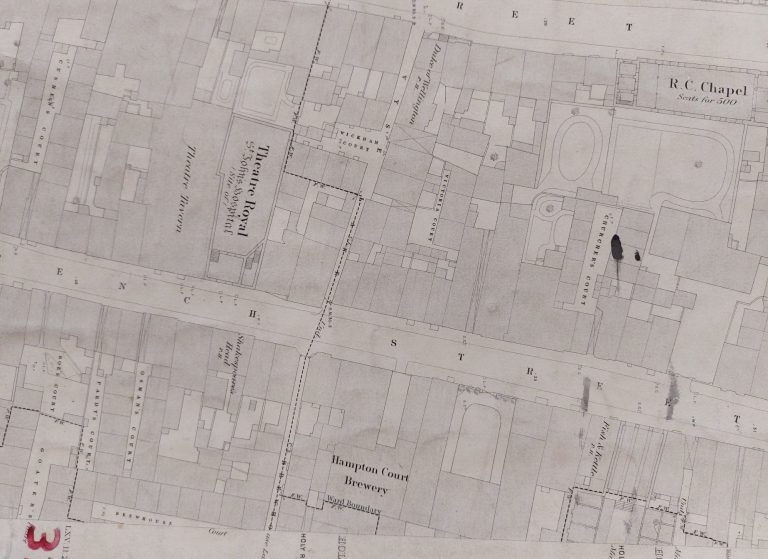
Forders was also known as the Hampton Court Brewery, after it’s location in French Street, and sometimes ‘Lock’s Brewery’. The brewery was situated between the Shakespeare’s Head and the Fish & Kettle in French Street, just behind Hampton Court, after which presumably the brewery was named. It was a well-established Southampton brewery, wine and brandy importer. The brewery tap was the Hampton Court Brewery Bar, 24 French Street. The Lock family was running the Hampton Court brewery before the Forders took over in the early 1870s. An advertisement from 1863 states the Hampton Court brewery was established 1822.
There are three parts to this story, so I will divide this page in to 3 separate sections. There are also 3 unanswered questions (at least for now!) which I highlight.
PART 1
This part relates to the beginnings of this brewery which may have arisen from Steele & Co, wine merchants and coopers at Hampton Court , shown in the 1803 and 1811 directories. After that we have to look at Pigots Hampshire directory 1823/4 (and 1827) which lists Henry Lock as a brewer at French Street, an entry repeated up until 1839. Henry Lock was also an importer of brandy wine, and a spirit merchant, and in partnership with Richard Lock. In newspapers of 12th March 1827 we see notice that their partnership as retail brewers was dissolved, as between Richard Lock & Henry Lock on 10th March 1827, and the business in French Street was continued by Henry Lock.
The brewery possibly became a separate business from the wine and spirit trade in the late 1830’s or the early 1840s, as different businesses are advertised in newspapers. The 1843 Fletcher & Forbes directory shows Henry Lock as a brewer at 23 French Street. In the 1841 Census, Henry Lock is also a brewer
In the Hampshire Independent of 24th September 1842 there appears an auction notice for a sale in two Lots. Lot I was a dwellinghouse and shop at No. 61, French Street, it was said that the whole of Lot I was let on a repairing lease to Mr. Henry Lock, brewer, who had an unexpired term of nine years, from Midsummer last, at the very low rent of £14 per annum. I mention this simply to show that Henry Lock seems to have taken a lease on commercial premises in the same area in June 1841. This was a grocery shop occupied by a S Lenney, and which had “a capital stone arched cellar under the same about 50ft deep and 9ft high with access from the street”. A sublease to a tenant with a large cellar for storing wines, spirts and beers sounds a good idea!
This seems to have been a time of expansion as at the August 1848 Licensing Sessions, it was said that Henry Lock had carried on the business of a brewery for 15 -16 years. He had recently purchased premises at Hampton Court adjoining his own premises and he wanted a licence for the entire site. There would be 20-30 rooms with a large brewery. Objections were raised because of the number of carts in the street. He did say he would ‘remedy this inconvenience’, and that it would be a free house.
Henry Lock Snr was involved in Magistrates proceedings reported in the Hampshire Advertiser of 27th October 1849, under the heading Systematic Stealing. “Mr. Henry Lock, a large maltster and brewer, of Southampton” together with the superintendent of police on a search warrant went to the premises of William Holmes, at Winnall, a beershop keeper and brewer. Mr. Lock suspected that he had malt and other property belonging to him, and concealed on his premises. Mr. Lock found nearly a whole pocket of new hops, which he identified as his property, and also two empty sacks, but no malt. It appeared that Holmes had brewed the day before. A brother of Holmes was in the employ of Mr. Lock, and worked at his malt-house at Highfield, and Mr. Lock stated that within the last three months he had lost no less than forty quarters of malt from his premises there.
In reports of 25th October 1851 regarding a fire at premises near the brewery, it was said that Henry Lock helped by using his brewery well. He put his horse in the mill track of the brewery to pump up water to a large tank to which a hose was attached so water went to the ‘town engine’ which came in to his yard. However, “the firemen had in the first place stupidly forgotten to bring with them any buckets”. Also, when water was pumped to the engine, “they had forgotten to insert the plug in the bottom of the engine. There appeared to be a great want of discipline among the firemen. One of them was obliged to be sent home in a state of drunkenness”. It was also said that others who should have brought hooks etc had “left them at home”. The fire was put out but “not until Mr Holliday’s house had been completely gutted and everything in it including wearing apparel destroyed”. The engine returned next day to put water on smouldering embers. They left but had to return when the fire caught again. The cause of the fire was a mystery.
In the 1852 Hunts Directory (and again in 1853) the entry is “Lock & Adams Hampton Court Brewery French Street. The 1853 directory refers to Homan Adams as a brewer at Hampton Court, together with Henry Lock as a brewer & spirit merchant (as well as an advert for W & T Forder wine & spirit merchants). The Street listing in 1853 places him and Henry Lock at No. 21 French Street, as well as No 23. I cannot find references to Adams, other than a report that Mrs Homan Adams gave birth to a daughter at Hampton Court Square in April 1851. Of further interest, in October 1857 there is reference to the marriage of John Adams (the third son of Ralph Adams) to Matilda, the only daughter of Henry Lock brewer. Sadly, just 8 months later, there is notice of her death in her 24th year, on 24th May 1858. Clearly there was a relationship between the Adams family and the Lock family which may help
explain the previous entries.
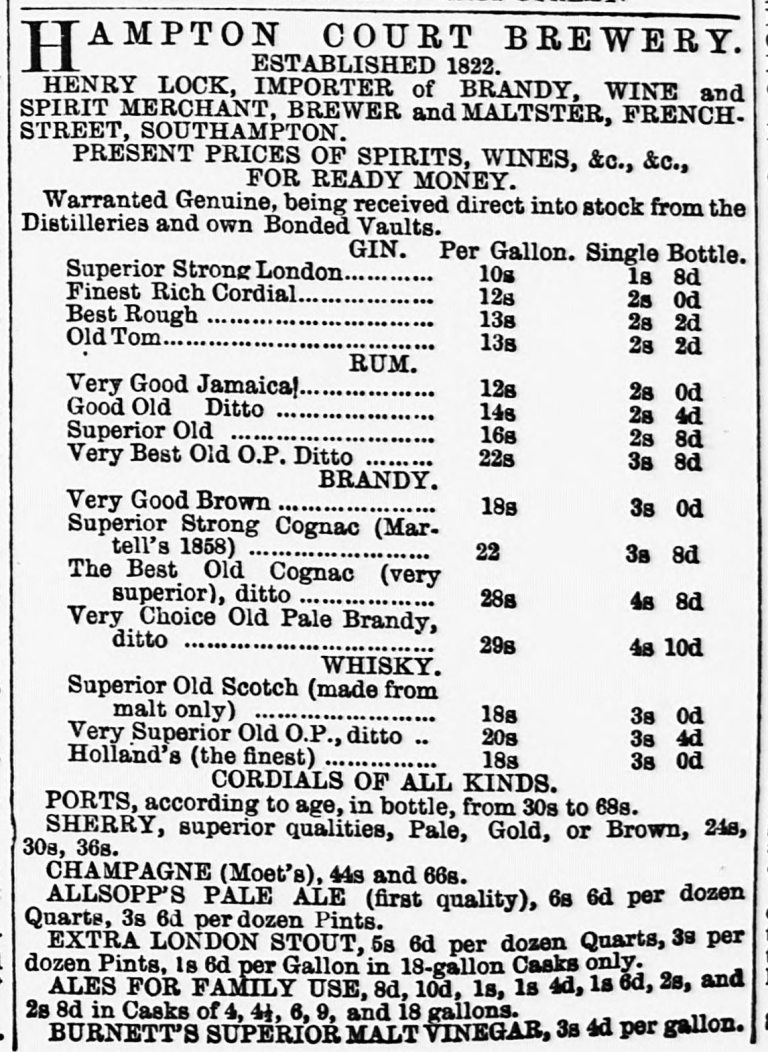
By 1855 we just see Henry Lock at 23 French Street, as we do in 1859, but by 1861 we are back to “Lock & Adams 23 French Street brewers and spirit merchants” as well as Innkeeper. Also we find Henry Lock Snr as a ‘Gent’ at Hampton Court, and Henry Lock Jr as a brewer. In 1863, Henry Lock is a brewer innkeeper and wine and spirit merchant, and he, and his father are at 22, 23 and 24 French Street. After 1863, I can find no ‘Locks’ listed as brewers although interestingly, newspapers carry numerus, and regular adverts for Henry Lock at the Hampton Court brewery being an importer of brandy wine, and a sirit merchant,brewer and maltster. Prices for wines and spirits are given, with prices also for Allsops Pale Ale, Extra London Stout, and ales for family use, (plus Burnett’s malt vinegar by the gallon!).
On 2nd October 1870 Henry Lock ‘for many years’ proprietor of the Hampton Court Brewery’ died at home at Rosehill Cottage Nursling, aged 74 years. In the 1871 and 1876 Cox directory we find Charles W Higgins as a brewer at 22 French Street, and also William Forder, a wine and spirit merchant, (Forder & Co) and Thomas Forder (Forder & Co). Messrs Forder are listed at No 23 French Street, and there is also a John Bright listed at No 22, (Innkeeper) with a Thomas Bailey (Cellarman). I believe it is at this time the Forders take on the brewing business. From here on, the brewery ‘belongs’ to ‘Forder & Co’.
PART 2.
I think some background to the Forder story is relevant so I will go back in time for a moment. There may also also be a link here with William Joseph Slater, a brewer in Back of Walls, (see Slater’s Brewery page). In June 1831 he married Sarah Forder, who may possibly have been a member of this family.
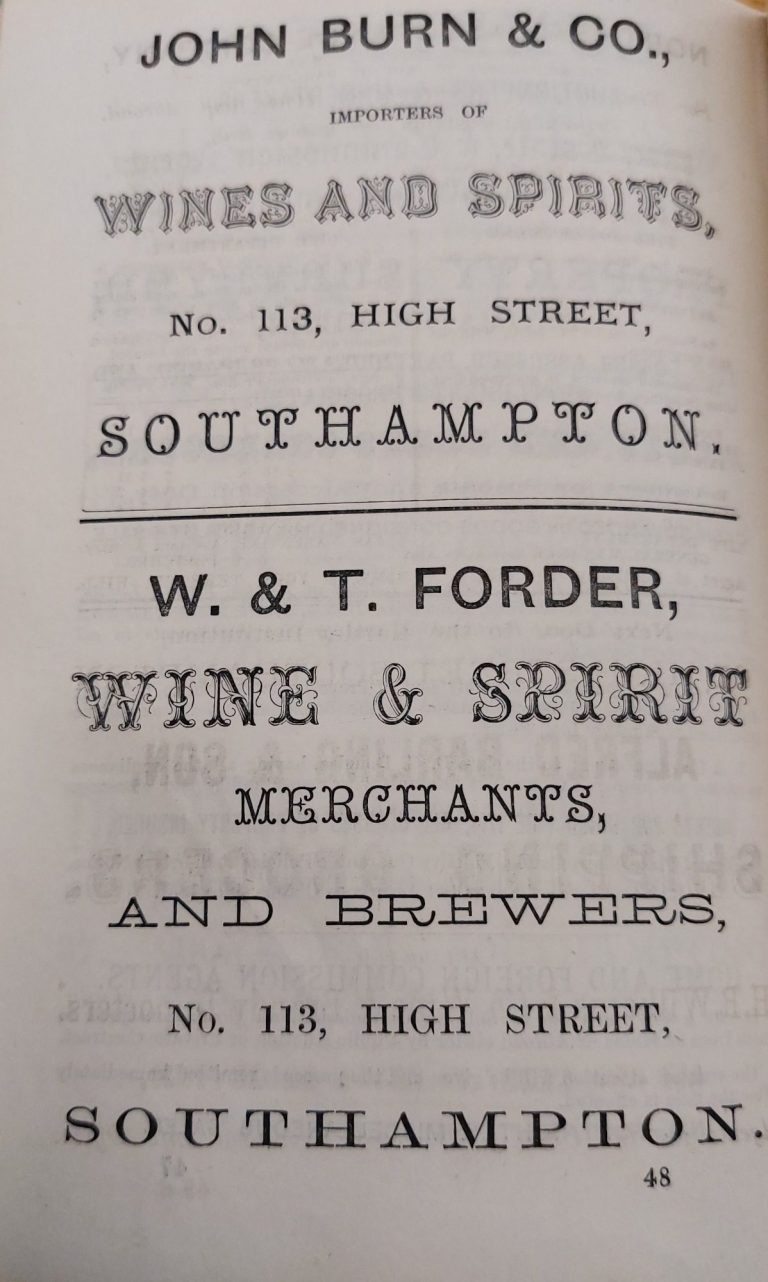
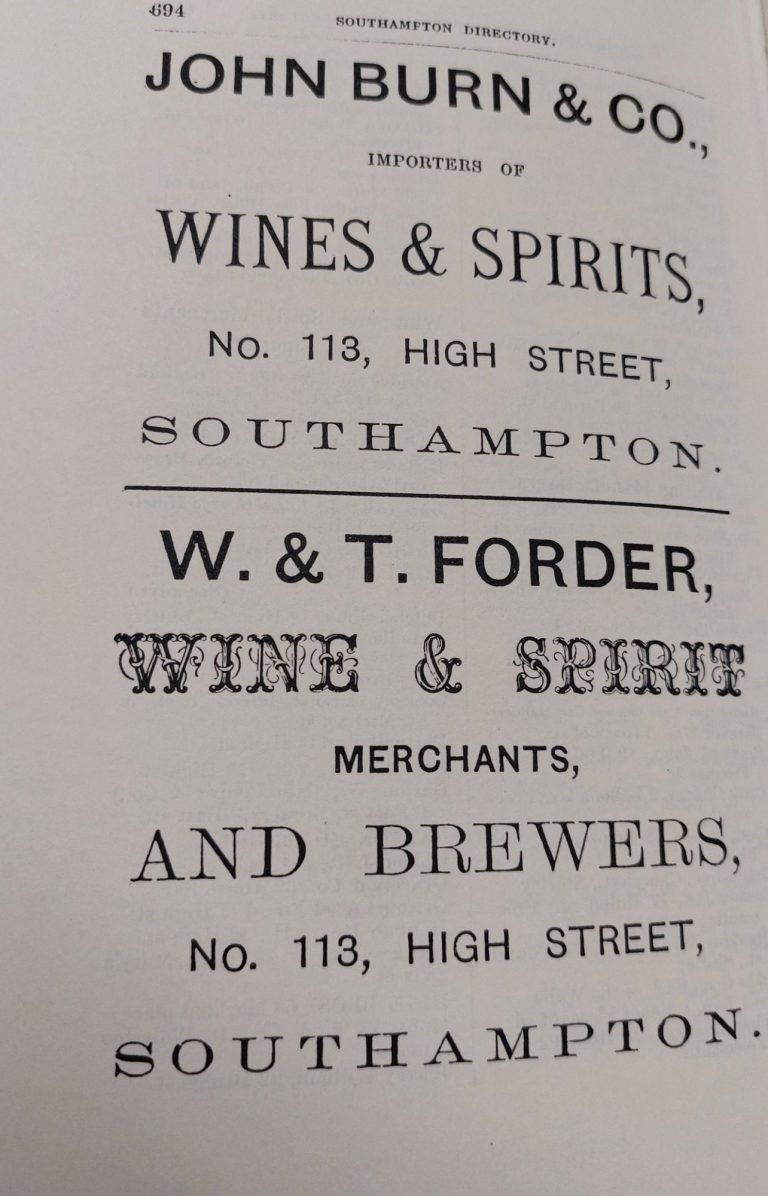
William and Thomas Forder were brothers, and wine merchants, and were in partnership from Circa 1837 (based on later obituaries). In 1836, 1839, and 1843, William Forder is a wine merchant. By 1854, 1847 and 1849, William and Thomas are wine and coal merchants at 113 High Street. Over the years, they were in the business of Forder Bros wine merchants, and also W & T Forder, brewers and wine merchants. Unanswered question 2. Were they brewers, and where were they brewing?
Meanwhile, John Burn & Co are also wine merchants at this same address, 113 High Street in 1836 and 1839 directories, as they are with slight variations until 1863. By 1871, Burn & Co, HJ Cooksey and J H Cooksey are all trading as Cooksey Son & Burch. Around this time we also see Stiles Cooksey & Son as brewers. Burn and Co also have adverts on the same pages as Forders in directories. I Cannot see any reference to Burn and Co as brewers, but could this help answer unanswered question 3?
The 1843 Fletcher & Forbes directory shows Forder & Sons as wine merchants 113 High Street, and also importers, but not as brewers. Meanwhile, directories and newspapers continue to refer to William & Thomas Forder as wine and coal merchants at 113 High Street.
In newspapers of June 1845, it is announced that “W and T Forder” had taken over the wine, spirit and coal business of Thomas Hall & Co. with the wine business being conducted from 113 High Street. In 1853, they are wine and porter merchants.
Things then get a little confusing as in November 1863, there is an advert for the letting of a 10 quarter malt house, apply to Messrs W & T Forder (this is not the malt house in Highfield. Could this be the ‘Malt House’ shown on the 1870 town map in Simnel Street, not far away?). However, in the 1867 Gutch directory we find Alfred Davies as a brewer at Hampton Court brewery and by 1869, ‘Forder & Co’ as wine and spirit merchants. Alfred Davies could just be an employed brewer. In August 1867, newspapers describe him as a brewer in French Street.
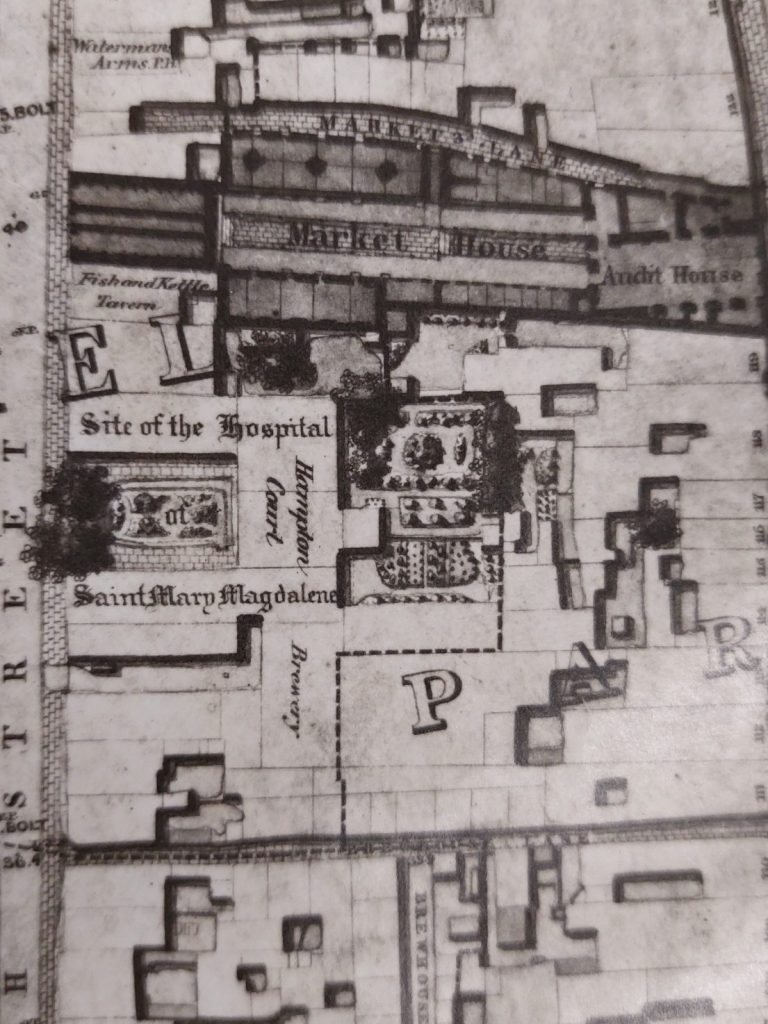
The First unanswered question. If he had been trading 15-16 years, this would place him at the brewery in 1832/3, which is 10 years earlier than when the brewery was established, according to adverts. Was he part of Steele & Co. and were they brewers? In 1846 the town map just shows ’brewery’.
The 1851 Census shows Henry Lock as a brewer (aged 57) with a son Henry, aged 18 years and his name continues in directories from 1854, until 1863 as a brewer, and sometimes also as a maltster at 23 French Street
Newspaper advert from April 1863 showing the brewery was established in 1822
PART 3
The business became Forder & Co in 1867, run by William and Thomas Forder.
Unanswered question 3. How did this happen? I cannot find any announcements of takeover, or acquisition. Henry Lock died in 1870 so would have been around 70 years of age and perhaps his retirement or ill health let to this change.
In February 1871, an auction notice appears for the sale of the freehold 20 quarter malthouse with stabling sheds maltsters dwelling house yard and garden at Highfield and now in the occupation of Messrs Forder & Co. The sale was by the executors of the late Henry Lock (note this is twice the capacity of the malting ‘let’ previously). On 25th February, it was announced that it had sold for £1,500, the same having been built by Henry Lock. However, in August 1873, the freehold was for sale again.
Advert from 1876, nt there is still reference to W& T Forder rather than Forder & Co.
In 1874, we again find William and Thomas Forder and Forder & Co at 113 High Street. Entries are similar in 1878 but confusingly also as Forder & Co wine and spirit merchant and brewer, at the malthouse Highfield (which presumably did not sell in 1873, unless it was sold with a ‘lease back’ taken). Similar entries appear in directories of 1880 and 1883.
By June 1876, newspapers report that John Bright Jnr and Snr are at Hampton Court brewery. In January that year he (which one!) had been appointed as president of the Licensed Victualler’s association of Southampton. In June 1876, John Bright the younger is described as being of the Hampton Court Brewery Bar as a spirit merchant, and elsewhere as innkeeper. Bright, Higgins and both Forders are listed at 22 French street in street listings, in 1876.
In 1846, the town map (left) just showed 'brewery' and by 1870 on the right, as 'Hampton Court brewery'.
The 1876 Cox Directory shows typical entries for this time, with both William and Thomas Forder being shown as Forder & Co, together with Forder & Co wine and spirit merchants and brewers at French Street and High Street.
In July 1878 the results of an auction were announced of the Quick & Co Wheatsheaf brewery (see Wheatsheaf brewery page). The Wheatsheaf brewery and Wheatsheaf Tavern together with the brewery tap at Back of Walls was sold to Mr Edgar Smith of Southampton for £4,610. Messrs Forder bought the brewery trade in the 12 public and beerhouses, most on lease, for £3,000. In May 1880, William, and Thomas Forder brought a case against John Brannan for £50 damages. On 11th September 1879, certain fixtures of the Wheatsheaf brewery were sold including a Hop Back, 13ft long and 4 ft. wide. Brannan was employed byForders to move it to their brewery, but did so ‘in an unskilful way’, and the building was damaged.
Thomas Forder may have faced allegations of sexism today. In a court case reported on 23rd July 1881, it was said that Thomas Forder did not refuse applicants for the post of landlord of a pub “with the exception of a lady and that was because they never accepted landladies”.
Remember, the business became Forder & Co in 1867, and it traded as Burn, Forder & Co in the early 1800s. Directory entries in 1884 refer to “Burn John Forder & Co Hampton Court brewery French Street,” as they do in 1886 and 1887. In 1887 Thomas & William Forder appear as brewers, and Forder & Co as brewers and Wine & Spirit merchants at 113 High Street.
Newspapers of April 1884 refer to death of Mr Killy of Hampton Court Brewery, but I can find no other references to him.
William Forder died on 11th August 1887 aged 82. Thomas Forder of Forder Bros Wine Merchants, and W & T Forder brewers and wine merchants, died on 19th February 1899 at home in Bugle Street aged 72. He was described as a widower who left a son and daughter. He owned the Old Theatre, the Gaiety Music Hall and ‘Lock’s Brewery’, all in French Street. He was a Specific Commissioner of the Southampton Harbour and Pier Board, as was his brother who died 2 years ago.
Thereafter, directory entries simply refer to Forder & Co at 113 High Street, sometimes at Hampton Court with offices at 113 High Street. By 1912/13 they also had bonded vaults at 89 High Street, and by 1913/14 the listing is just “Hampton Court Brewery 47 French Street”. I have seen a reference that the business was carried on by his son.
The brewery supplied the Gaiety Music Hall in 1888, when Forder & Co also advertised their Specialty XX Pale Ale at 1s a gal. Also their XXX Pale Ale at 1s 6d a gal, and their Double Stout at 1s 6d a gallon “Guaranteed brewed from malt and hops only.” Also they were agents for Ind Coope & Co and Reid & Cos London Stout from 113 High Street. The advert also says that Forders’ are the oldest established wine and spirit importers in Southampton. The same advert appears in 1899, although in that year, W B Mew Langton & Co Ltd (brewers on the Isle of Wight) had taken over the cellars and other property immediately adjoining No 100 formerly occupied by Messrs Forder & Co. At this time Forders’ were agents for Bass, Allsops and Ind Coope, Guinness and Courage.
Continuing the theme of questionable employment practices, on 22nd November 1890 newspapers ran an advert for “two steady men with good characters accustomed to brewery work”, and a bottle washer, Forder & Co Hampton Court brewery. Two years later “Wanted respectable girl as general servant aged 16-17 apply Hampton Court Brewery French Street”
In February 1893 the Hampton Court Brewery advertised ‘Exhibition Ales now in splendid condition are guaranteed to be brewed from the finest malt and hops only.’ AK ale was 1s a gallon, PA 1s 4d a gallon, BA 1s 6d a gallon, and Double Stout 1s 6d a gallon, all delivered free to all parts. They were also advertising their Hampton Court Ale at 2s per dozen in screw stoppered Imperial bottles, from Forder & Co Hampton Court brewery. At one time, they were selling 100 gal casks for use as waterbuts!
Newspapers of November 1894 report that a one legged labourer was charged with being drunk and disorderly, and causing wilful damage to the Hampton Court brewery. He was drunk and said he wanted to wet his whistle. The landlord refused to serve him and he smashed three panes of glass value 18s. He told the Court he wanted to play his whistle in the pub, but the Chairman said he had previously said he wanted to wet his whistle. He pleaded guilty and was sentenced to 14 days for the first offence and a month for the second.
The brewery had connections with the local football club, as in February 1905, there is reference to Mr Hoffman of the Hampton Court brewery receiving an occasional licence for the Dell for the next match.
The business became a limited company in 1908. A new 10 quarter plant (allowing a brew of about 1,450 gallons) was installed in 1914. The company was bought by Brickwoods (brewers in Portsmouth) in 1925 with 21 pubs. In newspapers of 10th July 1925, there is an auction notice for the sale of the freehold and leasehold properties, Nos 60, 62, 64 and 66 French Street, 9, 10 and 11 Cossack Street, 47 Bugle Street, and a shop and dwelling at 18 Carlton Place. I believe this was however after the takeover.
Philip Ely, in his ‘Portsmouth Papers Portsmouth Brewers since 1847’ says that Brickwoods had a policy of keeping their brewery in Portsmouth operating at full capacity so they needed outlets to sell their beers. The last directory entry for Forder’s brewery is in the 1924 Kelly’s. In 1925, they had bought Sir Frederick Perkins & Sons Ltd, as well as Forder & Co Ltd for a total of £132,000 (just over £7million today) together with 21 Forder pubs (and 6 Perkins pubs). Both breweries were closed, but one of Forder’s directors, Huw Perkins joined the Brickwood’s board. As is often the case, the buyer just wanted the pubs!
On 7th July 1928, an advert appears for the sale of brewing plant utensils and plant and machinery of Hampton Court Brewery, installed new in 1914, formerly in the occupation of Forder & Co. A two furnace Galloway boiler with pipes in good working order was listed, with a 6 1/2 hp Tangynes Steam engine, a 35-barrel open fire copper with moveable fountain dome, a 10 quarter cast Iron mash tun, a 15 barrel Lawrence Refrigerator, cast Iron cooling tank 18ft X 10ft in 3ft sections, 6 X Kari Pine round fermenting vessels, a Nalder and Nalder rotary malt screen, 2 large galvanised liquor tanks, about 1 ton of copper sheeting and piping, about 2-ton scrap lead, and some Karie Pine in various lengths (Kari Pine, a coniferous tree usually found in New Zealand).
This seems to have been the final act of disposal of the last traces of the brewery. The Tap was destroyed in a wartime air raid, as was, I believe, the brewery. However, the brewery logo survives, in particular on the front corner window of the London Hotel at Terminus Terrace (previously the Davis’s Railway Hotel), as shown in my photo on the left.
The site of the brewery was redeveloped some time ago with the Polymond House and Kimber House buildings there now.