Sir Frederick Perkins & Sons Ltd
40 Orchard Lane (directly behind Globe Hotel)
Also Globe Brewery, and Southampton brewery from 1890.
Brewing started 1871, when taking the Globe Commercial brewery
Brewing ceased 1925
Acquired by Brickwoods 1925.
To see the story from the beginning, see the Globe brewery page. Jane Farnden was running the Globe, but in 1867 she sold a large stock of beers and household items, and she probably ceased brewing that year. By 1869, Palmer & Perkins are listed at 40 Orchard Lane, the Globe Brewery, which was a separate area to the Globe Hotel. By 1876 the hotel was owned by the Barlow’s Victoria brewery.
Richard Hopkins Perkins senior was running the brewery with his grandson, and then by his son, Sir Frederick Perkins (who had been a partner, or at least had an interest in, the Albion brewery (see the Albion Brewery page). The business was operating as Sir Frederick Perkins & Sons by 1902, and a new 8-quarter brewery was erected in 1908. They became a limited company in 1912.
By February 1877 the reference is to the Globe Steam Brewery so it looks as if some improvements were made after acquisition.
Before we move on, I think it best that I clarify the Perkins family tree. To begin with, they were not connected, with the Barclay Perkins & Co Brewery, of the Anchor Brewery London, who merged with the Courage Brewery.
Richard Hopkins Perkins was born in 1794 and died in December 1881. I will call him‘Richard Senior’. He had seven children, including Sir Frederick, Perkins, George Pardy Perkins, and Sarah Perkins, and Richard Henry Hopkins. George Pardy became Alderman, and had a son, Richard Hopkins Perkins. I will call ‘Richard senior’s’ grandson ‘Richard Junior’ who, as we see later, was involved with the brewery.
Frederick was therefore brother to Sarah, born 1835. On the Albion Brewery page, I have said that Sarah married Frank Lankaster, making him Frederick’s son in law and giving a reason for the Perkins connection to the Albion brewery.
Richard Senior’s son Richard Henry did, I believe become the well known R H Perkins, Auctioneer, as in shown in each Census.
Sir Frederick Perkins was born on 2nd June 1826. He was a Liberal Party politician, and a successful brewer, and wine and spirit merchant in both Southampton and London, occupying extensive wine vaults in Southampton. In the 1861 Census he is described as a wine merchant in Southampton employing 6 men, and in 1871, as a JP and wine merchant. He was Mayor of Southampton five times: in 1859, 1861, 1862, 1868, and 1869. He was knighted in 1873, and became the MP for Southampton in 1874. He was married three times; his second marriage was to Isabella Bloomfield Croskey and they had six children, Sir Frederick Perkins died on 8th November 1902 at home at 2 Grosvenor Square, Southampton, leaving an Estate of nearly £52,453, (Just over £5.5m today according to the Bank of England Inflation Calculator). The Southern Echo of 10th November 1902, page 2, carries a detailed Obituary for those interested in a more detailed social history.
Back to the brewery. In September 1868, the employees of Perkins & Sons upholsterers and of Palmer & Perkins of the Globe Brewery Orchard Lane met at Canute Hotel to celebrate coming of age of Councillor G P Perkins, (the older brother of Frederick).
In July 1869, there appears an advert for Palmer & Perkins asking that the public try Palmer & Perkins pale ales, equal to Burton at 1s and 1s 2d a gall, with Dinner ale at 1s and 1.6d Which was “warranted brilliant and sound”.
The 1871 Cox directory shows ‘Perkins, R H Jun. Globe Brewery 40 Orchard Lane’, as well as ‘Perkins Richard Hopkins (Perkins & Sons) Cumberland Place’. These were Richard senior and Ricard junior, ie grandfather and grandson.who took over the brewery from Palmer & Perkins.
In January 1871, Richard junior of the Globe Brewery Orchard Lane was using a previous advert, inviting the public to try Perkins pale ales, equal to Burton at 1s and 1s 2d per gallon In September 1872, an Off Licence was granted to the Brewery.
Directories from 1876 to 1884 refer just to R H Perkins Jun at the Globe Brewery Orchard Lane, with Sir Frederick Perkins, as a JP, MP, and wine & spirit merchant 41 Above Bar.
In April 1881, Perkins sold the Engineers Arms in Northam to Mr H E Welsh of the Wheatsheaf Brewery for £1,200, having been let at £30pa.
Richard senior died in December 1881, and it would seem that his grandson had been running the brewery for 5 years or so. In newspapers of 15th April 1882, there is a notice of sale by the executors of the late R H Perkins, by auction of the “The Albion Brewery, with hotel and two dwellinghouses, the brewery stores and stable yard”. Also included was the Globe brewery, and a house in Bridge Road, a house in Winchester Street, the Grapes Inn Oxford Street, seven houses in Oxford Terrace, five houses in Queens terrace, three houses in Hamilton Terrace, and various other properties. On 22nd April, the same advert with the same auctioneers is repeated BUT with no reference to the sale of the Globe Brewery properties.
From what we saw on the Albion brewery page, I believe that the sale was of the leasehold premises. Perhaps R H Perkins Snr had acquired the lease of the Albion Brewery. However, we have to explain the announcement made in the Hampshire Independent of 16th December 1882. This referred to the Albion Brewery and continued that R H Perkins, (the son) having purchased the above announced that after the 25th Inst. orders entrusted to him addressed to Globe Brewery Orchard Lane would receive prompt attention. By January1883, adverts refer to orders to The Globe and Albion breweries. Frank Lankaster of the Albion brewery, had died in March 1882, so perhaps R H Perkins Jun purchased the premises from both estates.
There is however another notice on the same day re the Albion brewery. This is by Mr Stephen Scott, who, having disposed of the business of the Albion brewery to Mr. Henry Welsh of the Wheatsheaf brewery announced that after 9th of December, orders entrusted to Mr. Welsh addressed to the Wheatsheaf brewery, Bridge Street would receive prompt attention.
How can we explain this? If these notices are correct, Perkins and Wheatsheaf breweries both said they had taken over Albion brewery, and would deal with orders. Perhaps Scott sold the business to Welsh, while the premises were sold to Perkins and there was some joint arrangement between Wheatsheaf and Perkins breweries. Perkins had sold the Engineers Arms to Welsh the previous year. I cannot work this one out, so will say nothing further here and try to ‘dig deeper’ later.
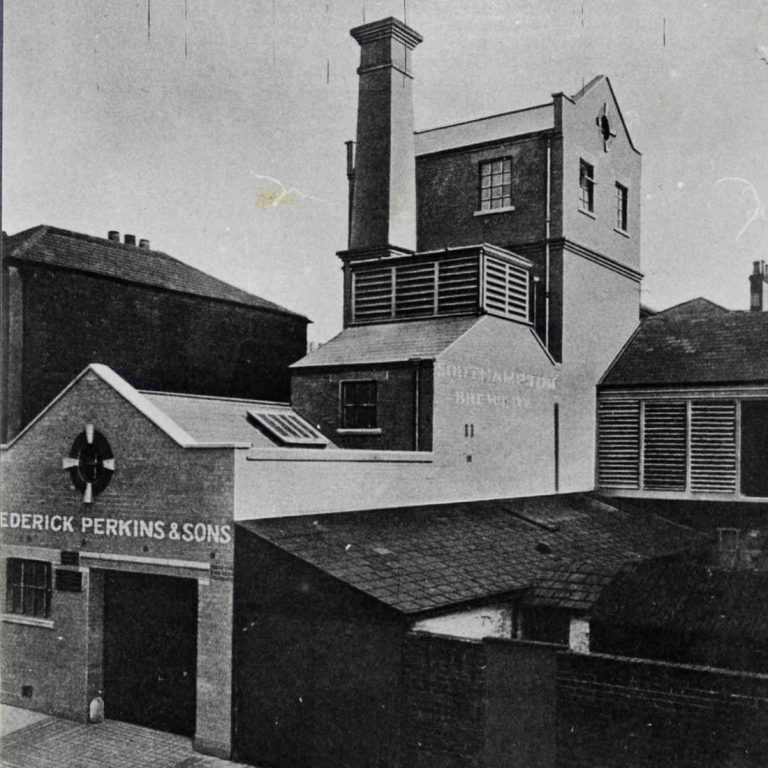
Photo of the brewery, courtesy of the Brewery History society. No the very faint wording 'Southampton Brewery' on first floor. A good example of a 'tower' brewery
The 1883 Foster & Roud Directory refers to RH Perkins at the Globe Brewery Orchard Lane, and Richard Hopkins Perkins at the Globe brewery, with Sir Frederick Perkins a wine and spirit merchant at 41 Above Bar This entry is repeated, more or less, up to the Kelly’s
1888/9 Directory, however in 1886, the reference is to the Phoenix Globe Brewery at 40 Orchard Lane; surely an error. So we have Richard Junior and another ‘R H Perkins’ running the business. This may have been another son of Richard senior, Richard.
In February 1883, there is an advert for “Commodious stores with steam power to let adjoining the Albion Hotel St Mary’s Street” suitable for factory, apply R H Perkins Globe brewery, so the connection did continue. In April 1886, R H Perkins Globe Steam Brewery was again urging the public to try Perkins pale ales, and Bass ale and Guinness stout in all sizes.
There was a sad incident in May 1888, when an accident occurred at the brewery. Billy Edward Hooker aged 40 was found in a tank by Samuel Wallbridge. He was head down in 16 inches of water.
Richard junior died on 28th November 1888 aged 41 years. His obituary says he was eldest son of Alderman G P Perkins, a brother of Sir Frederick It was reported that he was born locally and carried out the business of brewer at the Globe brewery for many years.
We then come to a period where I need to research further, as it seems that Perkins had breweries in Southsea as well as Southampton, and the ‘Globe’ Brewery became the Southampton brewery. An advert appears in July 1889; Frederick Perkins the Southampton brewery, Southsea and London. The finest pale ale expressly brewed for family use in screw stoppered imperial pints 2s a doz. Also, Southsea Aerated Waters, and wine importer above bar, Southsea and London. By June 1890 they were also advertising family ale, and golden ale (equal to stout in nourishing properties). By March 1891, the family pale ales were available in cask. As well as in bottle in screw topped imperial pints. Again, reference to the Southampton Brewery appears.
Following the death of Richard junior, the business was run by Sir Frederick from 1889/90. The 1890/91 Kelly’s directory refers to Sir Frederick Perkins as a brewer (for the first time) and a wine and spirit merchant at 40 Orchard Lane and 41 Above Bar. The entry is similar in 1892, but also with reference to the Southampton Brewery. By 1898 there is also reference to the vaults at 2 High Street, and in 1900, vaults at 16 Bugle Street.
In June 1891 we see an advert; “The Southampton Brewery finest pale ales, specially brewed for family use” in cask and bottles, screw stoppered imperial pints. Credit terms available. Frederick Perkins Wine importer etc 41 Above Bar and the Southampton Brewery Southampton.” Later adverts also make strong reference to their “Southampton Family Pale Ale our own brewing and not surpassed in quality and brightness”.
Also, in January 1902, there is reference to grains for sale, on application to the Southampton Brewery Orchard Lane.
Sir Frederick Perkins died at Southampton on 8 November 1902. He had four sons at this time, Arthur, Rodney, Richard Harry, and Julian. In December that year, the Beer Licences for 54 London Road and 42 Above Bar Street were transferred to his son Julian Perkins. There is mention of a Special Committee meeting of the Magistrates and Brewers of the town in January 1903, when Julian Perkins was present (together with numerous other brewers mentioned on this website!). It is likely that Julian was one of the ‘and sons’. I can find no detail to suggest who the other(s) may have been, although some or all could have been in the business in name only.
Major changes took place in 1908, as reported by the Southern Echo on 6th May. It was reported that a new Southampton Brewery by Messrs F Perkins and Sons of 54 London Road and 21 Above Bar and Orchard Lane had been erected “on a site adjacent to their old brewery in Orchard Lane.” The work took about five months and the first brew was made on 30th April. It was said that in view of the fierce licensing questions, building a new brewery ‘seems unique’. On 11th May they were advertising for a brewing pupil at the new brewery, where practical and scientific instruction would be given.
In June 1908 they were advertising the larger plant at the new brewery in Orchard Lane, and their 2s 6d bottled beer was now 2s per imperial pint, cash.
In November 1908 they were the sole agents for Raggetts Stout in cask and bottle. Cellars and stores 21,23, 25 Above Bar entrance in Spa Road. (George Raggett & Sons Ltd, were based in Duke Street, St James, London SW1, and according to the Brewery History Society it is thought that they weren't brewers. They were well-known for their 'Nourishing Stout' which it is thought was commissioned from other brewers. Bearing in mind Sir Frederick’s London connection, was it brewed in Southampton and bottled in London?).
The expansion in to a new brewery may have attracted the attentions of a local predator, or perhaps, because of the difficult trading conditions at the time, the brewery was not doing as well as expected. Either way, Perkins & Sons was acquired by Brickwoods (brewers in Portsmouth) in 1925. Philip Ely, in his Portsmouth Papers Portsmouth Brewers since 1847 states that Brickwoods had a policy of keeping their brewery operating at full capacity so they needed outlets to sell their beers. In 1925, they bought Sir Frederick Perkins & Sons Ltd, and Forder & Co Ltd for a total of £132,000 (just over £7million today), with 21 Forder pubs and 6 Perkins pubs. Both were closed. Perhaps Brickwoods simply wanted the pubs as part of their expansion, since as well as Perkins and Forders, they also took over and closed W Aldridge Brewery, and Barlow’s brewery, all within 4 years.
The Hampshire CC Archives hold an agreement for sale of the business and goodwill of the Globe Brewery from 1925. This includes freehold and leasehold public houses specified in schedules which include 'The Beehive', the 'Waggoners Arms', 'The Grapes', the 'Globe Hotel', the 'Cyprus Hotel', the 'Empire Music Hall' and 'Palace Theatre’. “Conveyed by F Perkins & Sons to Brickwood & Co Ltd, 1925”.
Directories refer to the Perkins brewery up until the 1926/27 Kelly’s when we see Brickwoods at 40 Orchard lane.
In 1903, when the cellar occupied by Sir Frederick at Above Bar was being refloored, workmen discovered a bricked in well containing over 20ft of water. The well “had the appearance of being hundreds of years old”, and was supposed to be supplied by a spring as the water was clear.
The site was occupied by Ocean Trading Company in about 1930, and closed 1950’s.
Sir Frederick occupied wine vaults in Southampton, and there are some details on the Sotonopedia web page.
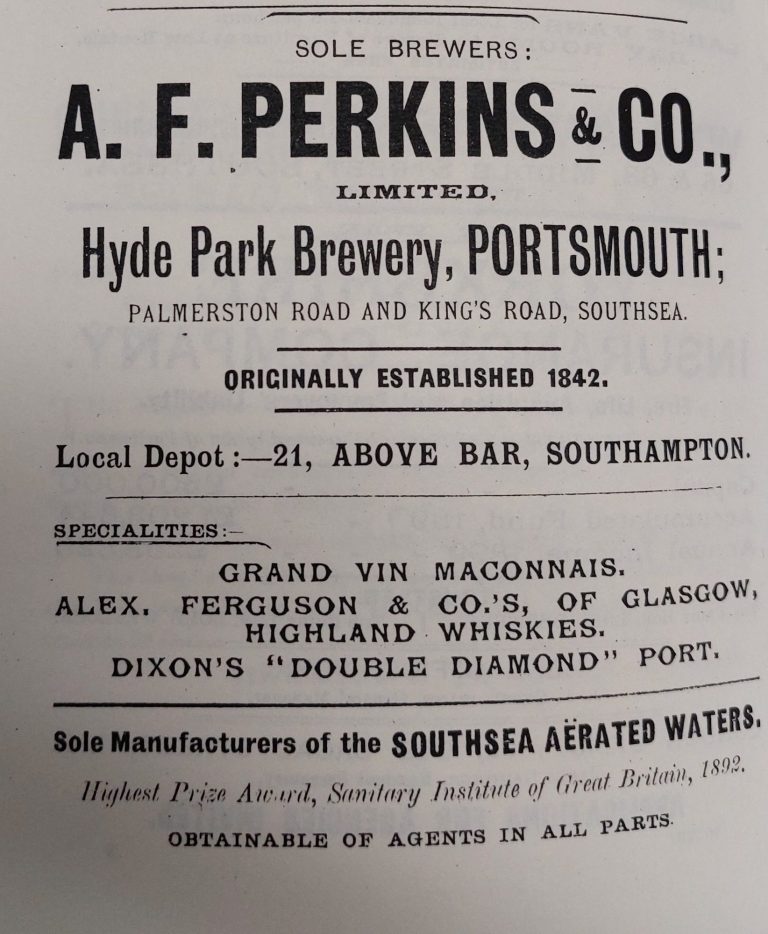
Directories from 1901 show similar entries as previously, and showing addresses for vaults and stores. By 1903, the entry is “Frederick Perkins & Sons” which continues until 1920.
The Southern Echo of 29th December 1902 reports a fire at the office of the Southampton Brewery Orchard Lane owned by Messrs F Perkins and Sons that morning. It was extinguished before much damage was done. There was a ‘motor bicycle’ in the office, full of fuel, and it is believed heat from a stove caused one of the petrol reservoirs to burst and petrol trickled toward the stove, resulting in an explosion. Staff put out the blaze as the fire brigade arrived.